
Australia vs Egypt Match Result
Table of Contents Show
Views 5
TL;DR: Australia vs Egypt Match Result
Egypt eliminated Australia 4–2 on penalties after their FIFA World Cup 2026 Round of 32 match finished 1–1 following extra time. Emam Ashour headed Egypt in front after 13 minutes from Karim Hafez’s cross. Australia equalized in the 55th minute when Mohamed Hany headed into his own net.
Neither side found a winner during the remaining regulation time or the additional 30 minutes. Egypt then converted all four shootout penalties through Mahmoud Saber, Ramy Rabia, Mohamed Salah and Hossam Abdelmaguid. Jackson Irvine and Awer Mabil scored for Australia, while Harry Souttar missed high and Lucas Herrington hit the crossbar.
Patrick Beach was Australia’s best player, but Tony Popovic replaced him with Mathew Ryan for the shootout. Ryan did not save a penalty. Egypt advanced to face Argentina; Australia were eliminated. Betting settlement depended on whether markets covered 90 minutes, qualification or the shootout.
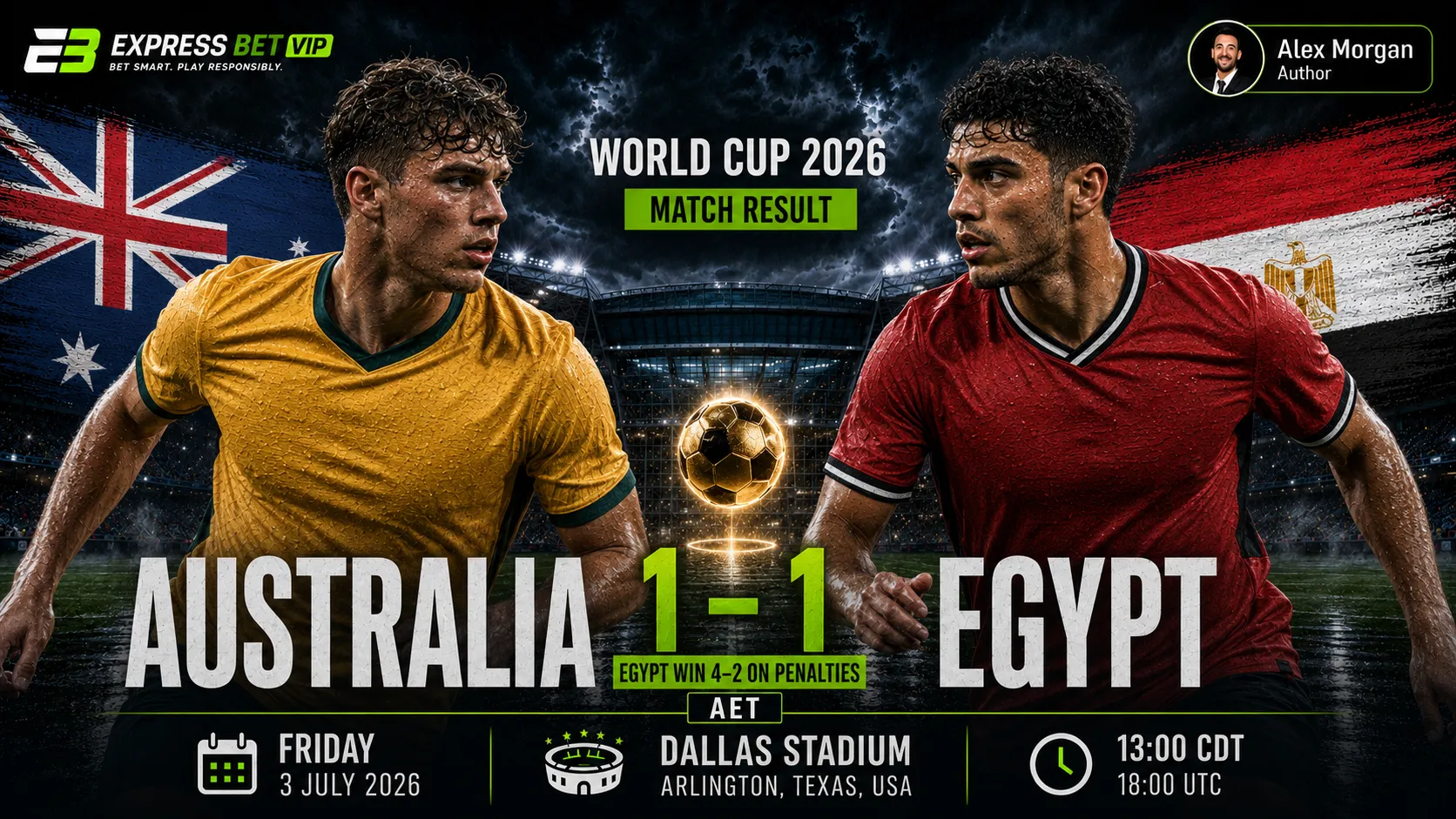
Quick Facts: Final Score, Goals, Venue, and Match Status
| Match fact | Verified information |
|---|---|
| Match | Australia vs Egypt |
| Competition | FIFA World Cup 2026 |
| Stage | Round of 32 |
| Date | July 3, 2026 |
| Kickoff | 13:00 CDT / 18:00 UTC |
| Host country | United States |
| City | Arlington, Texas |
| Stadium | Dallas Stadium |
| Attendance | 70,244 |
| Score after 90 minutes | Australia 1–1 Egypt |
| Score after extra time | Australia 1–1 Egypt |
| Penalty shootout | Egypt won 4–2 |
| Egypt goal | Emam Ashour 13’ |
| Australia goal | Mohamed Hany own goal 55’ |
| Referee | Gustavo Tejera, Uruguay |
| VAR | Not confirmed from reviewed public data |
| Surface | Natural-grass World Cup field |
| Roof status | Retractable roof; match configuration not confirmed |
| Tournament impact | Egypt advanced to face Argentina; Australia were eliminated |
The match result must be written carefully. Egypt did not win 4–2 during normal play. The official match score was 1–1 after extra time, with Egypt winning the separate penalty shootout 4–2.
Verified Facts vs Analysis
| Category | Status | Information |
|---|---|---|
| Score after extra time | [CONFIRMED] | Australia 1–1 Egypt |
| Shootout result | [CONFIRMED] | Egypt won 4–2 |
| Goals | [CONFIRMED] | Ashour 13’; Hany own goal 55’ |
| Shootout misses | [CONFIRMED] | Souttar and Herrington |
| Egypt’s flawless shootout | [CONFIRMED] | Four kicks, four goals |
| Australia’s goalkeeper change | [CONFIRMED] | Ryan replaced Beach before penalties |
| Egypt’s midfield advantage | [ANALYSIS] | Supported by possession and territorial data |
| Australia’s direct attacking plan | [ANALYSIS] | Visible from crosses, transitions and second-ball play |
| Indoor conditions reducing weather exposure | [ANALYSIS] | Plausible from stadium design; exact roof position unconfirmed |
| Closing odds | [UNKNOWN] | Not available from verified public data |
This distinction prevents shootout events from being confused with regulation-time statistics. Penalties taken in a shootout do not count as player goals or as ordinary match shots.
Final Score and Match Summary
Egypt reached the World Cup Round of 16 after winning the kind of match that asks for composure long after tactical neatness has left the building.
Emam Ashour gave Egypt the lead after 13 minutes. Karim Hafez delivered from the left, Ashour moved away from Australia’s defensive attention and headed past Patrick Beach.
Australia had already threatened through Cristian Volpato, whose fifth-minute attempt struck the crossbar. The Socceroos were therefore not passive, but they struggled to sustain possession through Egypt’s midfield.
Egypt controlled 58% of the ball and generated 1.32 expected goals to Australia’s 0.84, according to FotMob. The figures suggest a narrow Egyptian advantage rather than domination.
Australia equalized ten minutes after halftime. Mohamed Hany attempted to defend a ball into the area and headed it beyond his own goalkeeper. The own goal changed the emotional balance and forced Egypt to rebuild after having protected their lead for more than 40 minutes.
The game became cautious after 1–1. Both teams understood that one poor turnover could end the tournament. Egypt retained more possession, while Australia looked for direct attacks, crosses and set pieces.
Patrick Beach made an important late save to preserve the draw. He remained Australia’s most reliable player through 120 minutes.
Then came the goalkeeper decision.
Tony Popovic replaced Beach with Mathew Ryan shortly before penalties. The theory was familiar: introduce an experienced goalkeeper specifically prepared for the shootout. Egypt responded by scoring four times from four attempts.
Harry Souttar missed Australia’s opening kick. Jackson Irvine and Awer Mabil scored, but 18-year-old Lucas Herrington struck the crossbar with Australia’s fourth attempt. Hossam Abdelmaguid then converted the decisive penalty.
Tournament football eventually turns every tactical plan into a discussion about nerve. Egypt kept theirs. Australia found the crossbar twice in one afternoon and left with neither occurrence feeling remotely fortunate.
Goal Timeline
13’ — Emam Ashour, Egypt, header
Karim Hafez received space on the left and delivered toward the central area. Ashour moved beyond his immediate marker and attacked the cross with a well-timed run.
The midfielder directed his header past Beach to give Egypt an early lead. Australia’s defensive failure involved both pressure on the crosser and tracking inside the box.
Nestory Irankunda was among the players who failed to follow Ashour’s movement. Once the cross arrived, Beach had insufficient time to adjust.
The goal allowed Egypt to play with greater control. They could circulate the ball without needing to force high-risk passes and could ask Australia to break down an organized block.
55’ — Mohamed Hany, Egypt, own goal
Australia’s equalizer came through sustained pressure around Egypt’s area. Hany attempted to deal with a dangerous delivery but headed the ball into his own net.
The action was officially recorded as an own goal, not as a goal for an Australian attacker. That attribution matters for scorer markets, player records and structured data.
Hany had reportedly received treatment after a collision during the early part of the second half. No verified medical evidence established that the incident caused the own goal.
The equalizer changed Egypt’s task. A team that had been managing a lead now had to increase its attacking ambition without opening transition space for Irankunda and Australia’s wide players.
Key Moments That Changed the Match
Volpato struck the crossbar
Cristian Volpato’s fifth-minute effort hit the woodwork. An early Australian lead would have forced Egypt to abandon their patient structure before it had settled.
Instead, Egypt survived and scored eight minutes later.
Ashour escaped his marker
The opening goal was decided before the header. Ashour identified the space, while Australia’s midfield and defensive line failed to communicate the handover.
Jordan Bos suffered a knee injury
Bos left during the first half after damaging his knee. Feyenoord later confirmed that the injury required surgery and would keep him out for approximately three months.
His departure reduced Australia’s natural width and attacking support from left-back. Kai Trewin defended responsibly after replacing him but did not provide the same overlapping threat.
Hany’s own goal
The 55th-minute own goal prevented Egypt from protecting a narrow lead through the final half-hour. It gave Australia belief and changed the match from controlled Egyptian advantage to knockout uncertainty.
Beach’s late save
Beach produced a vital stoppage-time intervention to force extra time. Australia’s goalkeeper had already justified his selection before being removed for the shootout.
The disputed handball appeal
Australia appealed for a penalty late in regulation time after the ball struck an Egyptian player in the area. No penalty was awarded.
Australian commentators disputed the decision, but the reviewed evidence does not establish an obvious error strongly enough to describe Australia as having been definitively denied a valid penalty.
The goalkeeper substitution
Ryan replaced Beach near the end of extra time specifically for penalties. It was the most consequential coaching decision of the match because Egypt converted every attempt.
Souttar’s opening miss
Souttar sent Australia’s first penalty high. Missing first immediately transferred scoreboard pressure to every later Australian taker.
Herrington hit the crossbar
Herrington’s fourth Australian penalty struck the bar. Abdelmaguid then had the opportunity to end the contest and did so.
Local Match Conditions: Stadium, City, Weather, Pitch, and Crowd
| Local factor | Verified or observed detail | Football meaning | Match evidence | Betting meaning | Status | Anti-template status |
|---|---|---|---|---|---|---|
| City | Arlington, Texas | North Texas faced severe July heat outside | Daytime fixture in Dallas–Fort Worth region | Outdoor weather had less influence than at open venues | [CONFIRMED] | Fixture-specific |
| Stadium | Dallas Stadium | Retractable-roof design and enclosed bowl | Match played at AT&T Stadium under FIFA naming | Reduced direct weather volatility | [CONFIRMED] | Fixture-specific |
| Roof | Retractable | Can shield field from direct sun and extreme heat | Exact match position unavailable | Do not assume outdoor heat markets | [UNKNOWN] | Fixture-specific |
| Surface | Temporary natural grass | Different from the venue’s normal NFL turf | FIFA tournament installation | Possible unfamiliarity, but no major failure observed | [CONFIRMED] | Fixture-specific |
| Attendance | 70,244 | Large crowd amplified shootout pressure | Officially reported | Relevant to psychology, not predictive certainty | [CONFIRMED] | Fixture-specific |
| Match length | 120 minutes plus shootout | Increased fatigue and substitution importance | Confirmed | Late and shootout markets became central | [CONFIRMED] | Fixture-specific |
| Goalkeeper switch | Ryan replaced Beach | Changed shootout matchup | Egypt scored all four | Directly affected penalty-market narrative | [CONFIRMED] | Fixture-specific |
Dallas Stadium was one of the tournament venues where exterior climate and playing conditions could differ significantly. Arlington’s July weather was hot, but the retractable-roof stadium offered a level of environmental control unavailable in Miami or Kansas City’s open playing areas.
The exact roof position and internal temperature were not confirmed in the reviewed public match data. It would therefore be wrong to assign a precise temperature or claim that climate control determined the tempo.
The venue used a natural-grass system installed for the World Cup. AT&T Stadium normally uses artificial turf for Dallas Cowboys games. The tournament field showed no verified widespread failure, unusual bounce or dangerous deterioration during this match.
The enclosed bowl concentrated noise during the shootout. That increased the sense of pressure but did not favor the nominal home team. Egypt’s penalty takers executed cleanly while two Australians missed.
Stadium-Specific Match Impact
| Stadium factor | Detail |
|---|---|
| Stadium | Dallas Stadium |
| Common name | AT&T Stadium |
| Location | Arlington, Texas |
| Attendance | 70,244 |
| Normal capacity | Approximately 80,000, depending on configuration |
| Pitch type | Temporary natural-grass World Cup surface |
| Normal NFL surface | Artificial turf |
| Roof status | Retractable; exact match position unconfirmed |
| Acoustic effect | Enclosed bowl amplified shootout noise |
| Surface condition | No major verified defect |
| Wind relevance | Limited if roof was closed; exact status unknown |
| Goalkeeper distribution | No clear venue-specific effect |
| Set-piece effect | Australia’s equalizer followed pressure from a delivery into the area |
| Data status | Mixed confirmed and unavailable information |
The stadium’s most relevant contribution was not extreme heat on the grass but the reduction of external weather variability. The game did not show the obvious heat-management pattern seen at exposed outdoor venues.
The temporary grass permitted conventional ball circulation. Egypt could move possession through midfield, and both teams attempted quick combinations without persistent surface-related disruption.
The large video board, enclosed stands and full crowd created an intense visual and acoustic environment during penalties. Egypt handled that environment better.
City and Weather Impact
| Factor | Match context |
|---|---|
| City | Arlington |
| Metropolitan area | Dallas–Fort Worth |
| Host country | United States |
| Time zone | Central Daylight Time, UTC−5 |
| July climate | Very hot, often sunny, with occasional thunderstorms |
| Kickoff | 13:00 local time |
| Outdoor temperature | Not used as match-field temperature |
| Indoor temperature | Not available from verified public data |
| Humidity | Not available |
| Wind | No clear match effect |
| Rain | No verified match effect |
| Altitude | Approximately 180 metres; not significant |
| Likely physical effect | Controlled more by stadium configuration than outdoor forecast |
| Data status | City climate known; exact match readings unavailable |
A 13:00 kickoff in Texas would normally make heat the first tactical subject. Dallas Stadium complicates that assumption because its roof and enclosed design can isolate the field from direct afternoon conditions.
The match still lasted 120 minutes. Fatigue became visible in the reduced tempo and cautious extra-time approach, but duration offers a stronger explanation than weather.
Neither team maintained an aggressive press throughout. Egypt chose positional control, while Australia alternated between pressure triggers and a compact defensive block.
No verified evidence linked cramps, handling errors or either goal directly to the local weather.
First Half Analysis
Egypt began with greater control in midfield. Hamdy Fathy and Marwan Attia provided a stable platform, while Ashour moved into advanced spaces around Australia’s holding midfielders.
Mohamed Salah and Omar Marmoush occupied Australia’s defenders without dominating them. Their presence still affected the defensive line because Australia could not allow either player to receive freely in transition.
Australia’s attacking threat came through Volpato and Irankunda. Volpato’s early strike against the crossbar showed that Egypt’s control was not immediate or complete.
Irankunda pressed aggressively and tried to carry the ball at defenders. His directness gave Australia an outlet but also left him isolated when midfield support arrived late.
Egypt’s opening goal exposed the space behind Australia’s midfield attention. Ashour delayed his run and attacked Hafez’s cross after the defensive line had focused on Salah and Marmoush.
After taking the lead, Egypt reduced unnecessary risk. They moved the ball across the back line and midfield, waiting for Australia to open central gaps.
Bos’s injury damaged Australia’s left-sided progression. Trewin defended competently after entering but offered less natural attacking width.
The halftime score of 1–0 reflected Egypt’s greater composure. Australia had created the best non-goal chance through Volpato but lacked continuity in possession.
Second Half Analysis
Australia increased their physical pressure after halftime. Their midfield moved closer to the forwards, and the full-backs attempted to support attacks earlier.
The equalizer came in the 55th minute. Australia put another delivery into an uncomfortable defensive area, and Hany headed into his own goal.
Egypt initially looked unsettled. Their midfield distances widened, and Australia found more second balls around the penalty area.
Hossam Hassan responded by introducing Hossam Abdelmaguid and Haissem Hassan after the hour. Abdelmaguid strengthened the defence, while Haissem provided additional energy and crossing threat.
Australia introduced Ajdin Hrustic and Mohamed Toure to increase creativity and physical presence. Hrustic attempted progressive passes, but Egypt frequently closed the receiving lanes.
Salah remained relatively quiet in open play. Australia’s defenders prevented him from isolating a single opponent near the box. His limited influence during the match did not reduce his importance during the shootout.
The late handball appeal created controversy, but no penalty followed. Beach’s stoppage-time save then ensured extra time.
Extra Time and Penalty Shootout
Extra time was cautious. Both teams had already spent substantial energy protecting against transitions, and neither coach wanted to turn the final 30 minutes into an uncontrolled exchange.
Egypt retained slightly more technical security. Australia remained dangerous through direct play but rarely opened the Egyptian defensive block with a clean combination.
Beach’s performance suggested that Australia had a goalkeeper in rhythm. Popovic nevertheless introduced Ryan shortly before the shootout.
The change had a logical basis. Ryan possessed more international experience and may have prepared specifically for Egypt’s penalty tendencies. The result does not prove the process was irrational, but it made the decision unavoidable in the post-match analysis.
Penalty shootout sequence
| Round | Australia | Result | Egypt | Result | Running score |
|---|---|---|---|---|---|
| 1 | Harry Souttar | Missed high | Mahmoud Saber | Scored | Australia 0–1 Egypt |
| 2 | Jackson Irvine | Scored | Ramy Rabia | Scored | Australia 1–2 Egypt |
| 3 | Awer Mabil | Scored | Mohamed Salah | Scored | Australia 2–3 Egypt |
| 4 | Lucas Herrington | Hit crossbar | Hossam Abdelmaguid | Scored | Australia 2–4 Egypt |
Egypt’s technique was consistent. Saber and Rabia established the advantage, Salah used a central Panenka-style finish and Abdelmaguid converted the decisive kick.
Ryan did not save any of Egypt’s attempts. Mostafa Shoubir did not need to make two conventional saves because Souttar missed the target and Herrington struck the frame of the goal.
A shootout is not a lottery. Placement, goalkeeper information, emotional control and repeatable technique all matter. Egypt executed those elements better.
Tactical Picture: Why Egypt Advanced
Egypt’s midfield gave them greater control of the match. Fathy and Attia protected the centre while Ashour moved forward to connect with the attack.
Their possession structure created a 58–42 advantage and allowed them to complete longer sequences than Australia. Egypt did not turn that possession into overwhelming chance volume, but it controlled where much of the match was played.
Australia defended with commitment and attacked more directly. Their best route involved quick releases toward Volpato or Irankunda, followed by crosses and second-ball pressure.
The loss of Bos reduced Australia’s width. Without his overlapping runs, Egypt could defend more narrowly and give greater attention to the central forwards.
Egypt’s full-backs were vulnerable when isolated, but Australia did not create those situations consistently. Hany’s own goal came from defensive pressure rather than a repeated tactical superiority.
The Pharaohs also managed the bench well. Abdelmaguid entered to reinforce the defence and later scored the winning penalty. Haissem Hassan added energy on the flank.
Australia’s final tactical gamble failed. Ryan entered for a shootout in which Egypt’s four takers displayed excellent control. The decision did not cause Souttar and Herrington to miss, but it removed the goalkeeper who had been performing well throughout the match.
Tactical Collision Map
| Zone | Edge | Evidence | Key player | Local-condition effect | Result impact |
|---|---|---|---|---|---|
| Australia left | Egypt after Bos injury | Reduced Australian overlap | Jordan Bos/Kai Trewin | Indoor conditions not decisive | Narrowed Australia’s attack |
| Australia right | Australia intermittently | Irankunda carried directly | Nestory Irankunda | Stable surface supported dribbling | Created pressure, no goal |
| Central midfield | Egypt | 58% possession and better continuity | Hamdy Fathy | No outdoor heat disruption confirmed | Controlled tempo |
| Egypt penalty area | Even | Australia forced own goal but few clean chances | Mohamed Hany | No surface effect | Equalizer |
| Australia penalty area | Egypt | Ashour’s run produced opener | Emam Ashour | No clear local effect | Opening goal |
| Transitions | Australia threatened | Volpato and Irankunda attacked quickly | Cristian Volpato | Stable field supported ball speed | Crossbar chance |
| Set pieces and crosses | Australia | Pressure caused own goal | Australian delivery unit | Indoor wind reduced as a likely factor | Equalizer |
| Goalkeeper play | Australia before shootout | Beach made important saves | Patrick Beach | Enclosed venue reduced weather variables | Forced penalties |
| Bench impact | Egypt | Abdelmaguid defended and scored decisive kick | Hossam Abdelmaguid | Extra time increased bench value | Won shootout |
Player Ratings and Individual Performances
Australia Player Ratings
- Patrick Beach — 8.0: Made important saves and carried Australia to the shootout. His replacement remains the match’s central coaching controversy.
- Lucas Herrington — 6.0: Defended with maturity for long periods but struck the crossbar during the shootout.
- Harry Souttar — 6.5: Strong in aerial duels and central defending. Sent Australia’s opening penalty high.
- Alessandro Circati — 7.0: Helped limit Salah and Marmoush during open play.
- Jordan Bos — 6.5: Offered width before suffering the knee injury that ended his match.
- Aiden O’Neill — 7.0: Worked efficiently in midfield and competed well against Egypt’s numerical advantage.
- Jackson Irvine — 6.5: Supplied leadership and converted his penalty, although Australia struggled to control midfield possession.
- Connor Metcalfe — 5.5: Had limited influence and faded as the game became more cautious.
- Cristian Volpato — 7.0: Australia’s most dangerous first-half attacker. Hit the crossbar and attempted to progress the ball directly.
- Nestory Irankunda — 6.5: Led pressing and transition attacks but lost Ashour’s movement for the opening goal.
- Australia’s central forward — 5.5: Worked against Egypt’s centre-backs without receiving enough high-quality service.
- Kai Trewin — 6.0: Defended reliably after replacing Bos but could not replicate his attacking width.
- Ajdin Hrustic — 6.0: Added passing ambition but was frequently crowded out.
- Mohamed Toure — 5.5: Offered physicality but remained isolated.
- Awer Mabil — 6.5: Converted his penalty.
- Mathew Ryan — 5.5: Introduced for the shootout and failed to stop any of Egypt’s four attempts.
Egypt Player Ratings
- Mostafa Shoubir — 7.0: Remained composed through 120 minutes and the shootout. Australia’s two misses reduced the need for a decisive save.
- Mohamed Hany — 5.5: Defended adequately for long periods but scored the own goal that brought Australia level.
- Ramy Rabia — 7.5: Egypt’s strongest defender. Made important clearances and converted his penalty.
- Yasser Ibrahim — 6.0: Improved after an uncertain opening period and competed well physically.
- Karim Hafez — 7.0: Created Egypt’s goal with an accurate cross.
- Hamdy Fathy — 6.5: Protected the defence and helped Egypt control central possession.
- Marwan Attia — 6.5: Maintained midfield structure and became more influential during extra time.
- Emam Ashour — 7.5: Scored the opening goal through intelligent movement and an accurate header.
- Mostafa Ziko — 5.5: Had limited attacking influence before being replaced.
- Mohamed Salah — 6.5: Quiet during open play but converted a high-pressure penalty with composure.
- Omar Marmoush — 6.0: Occupied defenders without consistently escaping their marking.
- Hossam Abdelmaguid — 7.5: Strengthened Egypt’s defence after entering and scored the decisive penalty.
- Haissem Hassan — 6.5: Added energy and delivered dangerous balls from the right.
- Trezeguet — 6.0: Provided width but did not create a decisive open-play moment.
Best Players of the Match
- Man of the Match: Patrick Beach. Australia’s goalkeeper made the saves that kept the team alive through 120 minutes.
- Best attacker: Emam Ashour. His movement and header produced the only goal scored by an attacking player.
- Best midfielder: Aiden O’Neill. He competed effectively despite Egypt’s possession advantage.
- Best defender: Ramy Rabia. He remained composed, cleared danger and scored in the shootout.
- Best goalkeeper: Patrick Beach. His removal before penalties did not diminish his match performance.
- Best substitute: Hossam Abdelmaguid. He helped stabilize Egypt before converting the winning penalty.
- Most underrated performance: Karim Hafez. His delivery created the opener.
- Most disappointing performance: Australia’s penalty execution. Two of four attempts failed to reach the net.
Injuries, Suspensions, Cards, and Discipline
| Player | Team | Incident | Minute | Status | Next-match impact |
|---|---|---|---|---|---|
| Jordan Bos | Australia | Knee injury | First half | Required surgery | Expected absence of about three months |
| Mohamed Hany | Egypt | Head-impact concern | Second half | Continued playing | No confirmed next-match absence |
| Yasser Ibrahim | Egypt | Yellow card | Extra time | Booked | Accumulation impact not confirmed |
| Haissem Hassan | Egypt | Yellow card | Not precisely verified | Booked | Impact not confirmed |
| Other cards | Both | Complete list unavailable | — | [UNKNOWN] | Not confirmed |
| Red cards | Both | None | — | [CONFIRMED] | None |
Bos’s injury was the most serious physical consequence. Feyenoord later confirmed surgery and an expected recovery period of approximately three months.
Referee and VAR Analysis
Uruguayan referee Gustavo Tejera oversaw a physical and frequently interrupted contest.
Australian players and commentators criticized several decisions, particularly the late handball appeal and challenges involving Bos. The penalty appeal was not awarded, and no subsequent official finding established that the decision was clearly wrong.
The referee’s management occasionally contributed to Australia’s frustration, but the result cannot reasonably be reduced to officiating. Australia still reached the shootout and missed two penalties without forcing Shoubir to save them.
The complete VAR team and full review log were not available from verified public data.
Match Statistics
| Statistic | Australia | Egypt |
|---|---|---|
| Possession | 42% | 58% |
| Expected goals | 0.84 | 1.32 |
| Total shots | 16 | 14 |
| Touches in opposition box | 34 | 30 |
| Regulation/extra-time goals | 1 | 1 |
| Shootout penalties scored | 2 | 4 |
| Shootout penalties missed | 2 | 0 |
| Attendance | 70,244 | 70,244 |
| Corners | Not available from verified data | Not available |
| Pass accuracy | Not available | Not available |
| PPDA | Not available | Not available |
Australia recorded more shots and box touches despite having less possession. That reflects their direct approach: they progressed quickly and delivered into the area rather than building through long passing sequences.
Egypt’s higher xG indicates that the average quality of their chances was greater. The 1.32–0.84 difference was meaningful but not overwhelming.
Shootout penalties must remain separate from the ordinary match statistics. Egypt’s four converted kicks do not turn the match score into 5–3 or add goals to Salah’s tournament total.
Betting Result Angle
| Market | Pre-match expectation | Actual outcome | Winning side | Key trigger | Caution |
|---|---|---|---|---|---|
| 90-minute match winner | Egypt slight favorite in many markets | 1–1 | Draw | Hany own goal | Extra time excluded |
| To qualify | Egypt favored narrowly | Egypt advanced | Egypt | Flawless shootout | Price and timing matter |
| Double chance | Egypt or draw | Successful | Egypt/draw | Match level after 90 | Operator rules apply |
| Under 2.5 goals | Supported by cautious matchup | Two goals | Under | Limited finishing quality | Shootout goals excluded |
| Both teams to score | Uncertain | Yes | Yes | Own goal equalizer | An own goal counts for team totals |
| Correct score | 1–1 | 1–1 after 90 and extra time | 1–1 | Hany own goal | Check whether market settles at 90 |
| Ashour anytime scorer | Secondary option | Scored | Ashour | 13’ header | Exact odds unavailable |
| Penalty shootout winner | Market available late/live | Egypt | Egypt | Australia’s two misses | Small sample, high variance |
| Ryan shootout saves | Tactical substitution created attention | Zero | Under positions likely benefited | Egypt’s accurate penalties | Exact market availability unknown |
The standard match-winner market settled as a draw because the score was 1–1 after 90 minutes. Egypt-to-qualify positions won only after extra time and penalties.
Under 2.5 goals succeeded in ordinary settlement. Shootout kicks are not counted toward totals or both-teams-to-score markets.
The own goal counted as Australia’s team goal for both-teams-to-score settlement, even though no Australian player received an individual scorer credit.
Local Betting Impact: What the Venue and Conditions Changed
| Local factor | Market possibly affected | Actual evidence | Interpretation | Overreaction risk | Safer conclusion |
|---|---|---|---|---|---|
| Retractable-roof venue | Goals and tempo | Weather did not visibly disrupt play | Reduced outdoor volatility | High | Do not price Arlington as a normal open-air match |
| Temporary natural grass | Passing and player props | No major surface failure | Broadly neutral | Medium | No verified pitch-driven edge |
| Enclosed crowd noise | Shootout psychology | Two Australian misses; Egypt perfect | Pressure environment mattered | High | Technique remains primary |
| 120-minute duration | Substitutions and live totals | Tempo fell in extra time | Fatigue increased caution | Low | Separate 90-minute and extra-time markets |
| Goalkeeper change | Shootout props | Ryan saved none | Direct tactical-market relevance | Medium | Outcome does not prove every such change is wrong |
| Afternoon kickoff | Weather assumptions | Stadium reduced direct exposure | External temperature was not field temperature | High | Use venue configuration, not city forecast alone |
What This Result Means for the Knockout Bracket
Egypt advanced to face Argentina in the Round of 16 in Atlanta. Australia were eliminated.
This was Egypt’s first World Cup knockout-stage victory. It also took the team into the Round of 16 for the first time since the 1934 tournament format.
Australia remained without a World Cup knockout win. Their previous eliminations had come against Italy in 2006 and Argentina in 2022.
Egypt’s reward was a meeting with the defending champions. The additional 30 minutes and emotional cost of the shootout reduced their recovery time, while Australia’s tournament ended immediately.
What Egypt Did Right
Egypt controlled midfield possession and prevented Australia from turning every transition into a clear chance.
Hafez and Ashour executed the opening goal cleanly. The cross arrived accurately, and Ashour’s run exploited Australia’s tracking failure.
Hossam Hassan used Abdelmaguid effectively. The substitute improved Egypt’s defensive security and later accepted responsibility for the decisive penalty.
Most importantly, Egypt prepared and executed the shootout. All four takers used different approaches but maintained control.
What Australia Got Wrong
Australia did not track Ashour’s run for the opening goal. That failure forced them to chase the match against a team comfortable protecting central areas.
Their attack generated 16 shots but only 0.84 xG. Too many attempts came without creating a clear positional advantage.
The loss of Bos reduced their width, and the replacement structure did not fully compensate.
The goalkeeper substitution will remain the largest question. Beach had performed well, while Ryan entered cold and did not stop a penalty. The move was defensible in theory but unsuccessful in practice.
Australia’s penalty selection also created risk. Souttar opened the shootout despite being a centre-back, while 18-year-old Herrington took the fourth kick under elimination pressure. Both missed the target.
Coach Analysis
Tony Popovic built an Australian side capable of competing through 120 minutes. The defensive plan limited Salah and Marmoush, while Volpato and Irankunda provided transition threat.
His forced substitution after Bos’s injury was reasonable. His final substitution defined the match.
Replacing Beach with Ryan was a calculated decision, not random panic. Yet it removed a goalkeeper who was in rhythm and replaced him with one who had not played during the tournament. Egypt’s perfect execution made the gamble look particularly severe.
Hossam Hassan’s Egypt were not spectacular, but they were organized. The midfield controlled possession, and the substitutes improved the team rather than merely changing personnel.
Abdelmaguid’s introduction was especially important. He strengthened the defensive line and delivered the decisive penalty.
Player Milestones and Records
Egypt recorded their first World Cup knockout-stage victory.
The Pharaohs won their first World Cup penalty shootout by converting all four attempts.
Hossam Abdelmaguid scored the penalty that secured Egypt’s first place in the Round of 16 since 1934.
Australia remained without a World Cup knockout-stage victory.
Jordan Bos played every Australian match at the tournament before suffering the knee injury against Egypt.
Historical Context and World Cup Analogies
Australia had experienced shootout success in qualification, most notably with goalkeeper Andrew Redmayne’s specialist substitution against Peru in 2022. That history made Popovic’s late goalkeeper change understandable.
The difference was execution. Ryan did not save a penalty, while two Australian takers failed to hit the net.
Egypt entered with their own difficult shootout history, including the 2021 Africa Cup of Nations final loss to Senegal. In Arlington, their technique and emotional control were far better.
This was not a match of attacking abundance. It was a contest in which both teams survived long enough for four precise Egyptian penalties to become the final tactical argument.
Incidents and Controversies
Australia’s late handball appeal produced the main refereeing dispute. Tejera did not award a penalty, and the decision stood.
Australian criticism also focused on the challenge that injured Bos and on Egypt’s management of stoppages. These complaints should be reported without converting frustration into unsupported accusations of corruption or deliberate officiating bias.
A pre-match confrontation involving an Egyptian team official and local police was reported but did not directly affect the match itself.
Information Gain: What This Article Adds
The decisive distinction is between the 1–1 match result and Egypt’s 4–2 shootout victory.
The tactical review also explains why Egypt controlled possession while Australia produced more shots, how Bos’s injury changed Australia’s width and why the Beach-to-Ryan substitution became more important than any weather factor.
The local analysis treats Dallas Stadium as an enclosed, retractable-roof venue rather than applying a generic Texas heat narrative to the playing conditions.
Local Information Gain Quality Check
| Detail | Included | Status | Fixture-specific | Update required |
|---|---|---|---|---|
| Stadium | Yes | [CONFIRMED] | Yes | No |
| Correct city | Yes | [CONFIRMED] | Yes | No |
| Roof design | Yes | [CONFIRMED] | Yes | Exact match position |
| Internal temperature | No | [UNKNOWN] | Yes | Authoritative match reading |
| Surface | Yes | [CONFIRMED] | Yes | No |
| Attendance | Yes | [CONFIRMED] | Yes | Only if corrected |
| Crowd effect | Yes | [OBSERVED] | Yes | No |
| Weather effect | Qualified | [ANALYSIS] | Yes | Roof status |
| Betting risk | Yes | [ANALYSIS] | Yes | Verified closing odds |
| Tactical-local link | Yes | [ANALYSIS] | Yes | Tracking data |
| Anti-template status | Passed | [ANALYSIS] | Yes | Recheck after updates |
Source and Data Appendix
| Data point | Status | Source type |
|---|---|---|
| Match score | [CONFIRMED] | FIFA |
| Shootout score | [CONFIRMED] | FIFA |
| Goal scorers and times | [CONFIRMED] | FIFA, Reuters |
| Assist | [CONFIRMED] | FotMob |
| Shootout sequence | [CONFIRMED] | AP, Reuters and match reporting |
| Stadium | [CONFIRMED] | FIFA |
| City | [CONFIRMED] | FIFA and local venue data |
| Attendance | [CONFIRMED] | ESPN/Sky Sports |
| Referee | [CONFIRMED] | FIFA appointment reporting |
| VAR team | [UNKNOWN] | Not available |
| Lineups | [REPORTED] | FotMob and match reporting |
| Substitutions | [REPORTED] | Match reports |
| Cards | [PARTIAL] | Complete list unavailable |
| Bos injury | [CONFIRMED] | Feyenoord/Reuters |
| Possession | [REPORTED] | FotMob |
| Shots and xG | [REPORTED] | FotMob |
| Closing odds | [UNKNOWN] | Not verified |
| Roof position | [UNKNOWN] | Not available |
| Pitch type | [CONFIRMED] | Tournament and venue reporting |
| Tournament impact | [CONFIRMED] | FIFA |
Update Protocol
- Update if FIFA corrects the goal or assist attribution.
- Add the complete official lineup and substitution record.
- Add the confirmed VAR team.
- Add exact roof status and internal match temperature if released.
- Update card and suspension information.
- Update Bos’s recovery timeline if Feyenoord issues a new medical report.
- Add verified closing odds with timestamps.
- Preserve the distinction between regulation, extra time and the shootout.
Last updated: July 17, 2026
Final Verdict
Egypt advanced because they remained more composed at the last point where composure could still decide anything.
They controlled more possession, created slightly better chances and scored first through Ashour. Australia responded through pressure and Hany’s own goal, then defended well enough to force penalties.
Beach gave Australia the opportunity to reach the shootout. He was removed before it began. Ryan did not save a kick, Souttar missed high and Herrington found the crossbar.
Dallas Stadium largely removed the external Texas weather from the main football explanation. The temporary grass behaved normally, the enclosed bowl intensified the shootout and the decisive conditions were psychological rather than meteorological.
Egypt’s four penalties were controlled and accurate. Australia’s were not. After 120 minutes of tactical caution, that difference was enough to create Egyptian history.
Responsible Betting Note
Football betting carries financial risk. Accurate tactical analysis does not guarantee a successful wager.
Regulation, extra-time, qualification and shootout markets have different settlement rules. Read those rules before placing a bet. Penalty-shootout goals normally do not count toward conventional totals, correct-score or player-scorer markets.
Never chase losses or gamble with money required for housing, food, bills or other daily expenses. Set financial and time limits, take breaks and use licensed operators only. Check local gambling laws. Betting should remain entertainment, not income.
Summarize this article with AI. Use this page URL as the source:
Summarize this article with AI:
FAQ
The match finished 1–1 after extra time. Egypt won the penalty shootout 4–2.
Emam Ashour scored for Egypt in the 13th minute. Australia equalized through a Mohamed Hany own goal in the 55th minute.
Patrick Beach was the editorial Man of the Match after making important saves for Australia through 120 minutes.
Egypt advanced to face Argentina in the Round of 16. Australia were eliminated.
The 90-minute match-winner market settled as a draw. Egypt-to-qualify selections won, while under 2.5 goals and both-teams-to-score “Yes” positions also succeeded. Shootout kicks did not count toward ordinary goal totals.