
Belgium vs Egypt Match Result
Table of Contents Show
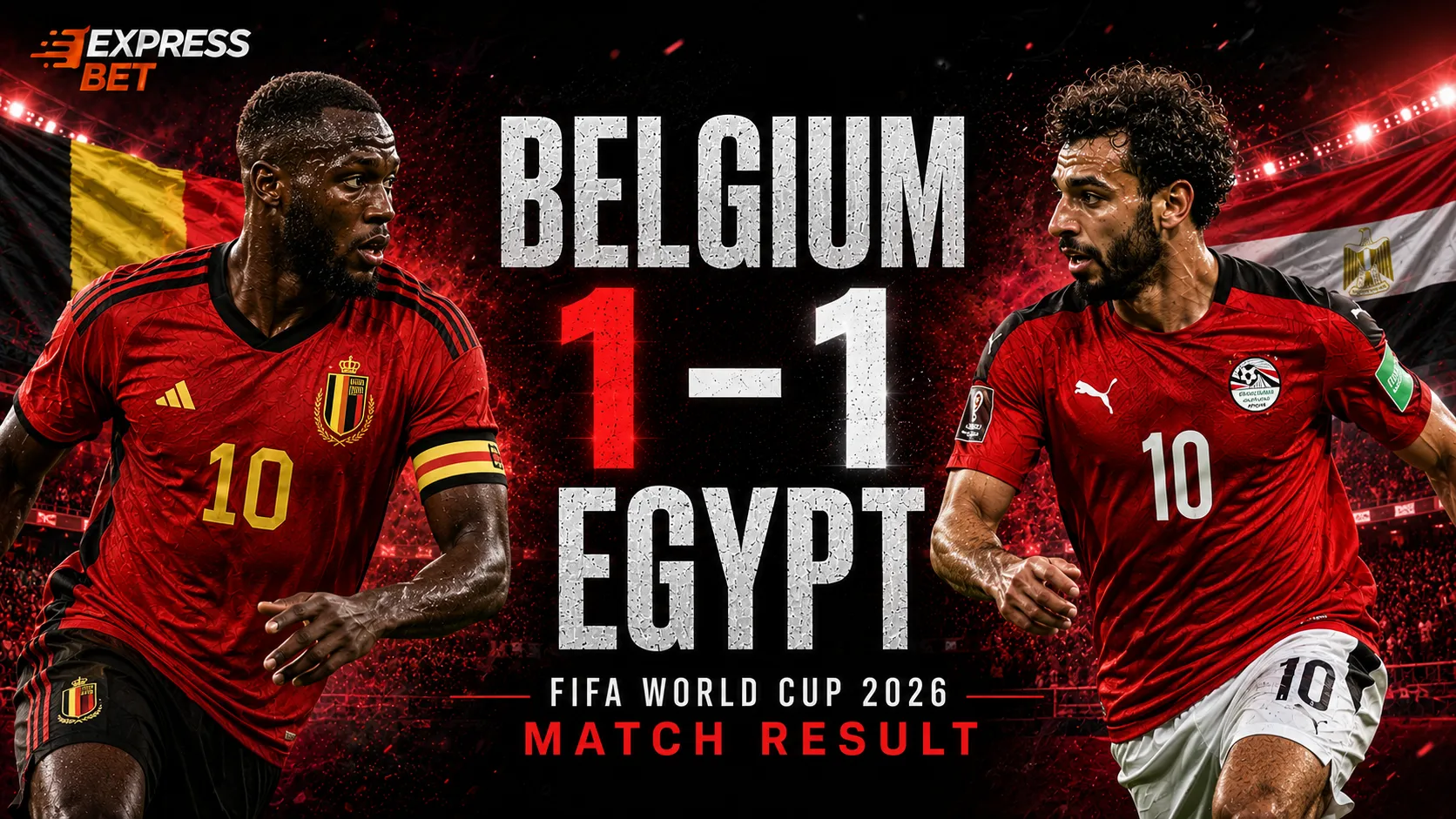
The Belgium vs Egypt match result was a 1-1 draw in their FIFA World Cup 2026 Group G opener at Seattle Stadium. Emam Ashour gave Egypt the lead in the 19th minute after a Mohamed Salah assist. Belgium equalised in the 66th minute when Mohamed Hany scored an own goal under pressure from substitute Romelu Lukaku. The main turning point was Lukaku’s introduction, which changed Belgium’s penalty-box presence almost instantly. Ashour was Egypt’s standout player, while Lukaku and Nicolas Raskin changed Belgium’s second half. The result left Group G level after IR Iran and New Zealand also drew. Betting outcomes rewarded the draw, under 2.5 goals, and both teams to score, depending on odds and market rules.
| Detail | Information |
|---|---|
| Match | Belgium vs Egypt |
| Competition | FIFA World Cup 2026 |
| Stage | Group stage |
| Group | Group G |
| Date | 15 June 2026 |
| Kickoff time | 12:00 p.m. local time / 19:00 UTC |
| Host country | United States |
| City | Seattle |
| Stadium | Seattle Stadium |
| Final score | Belgium 1-1 Egypt |
| Half-time score | Belgium 0-1 Egypt |
| Attendance | 66,775 |
| Referee | Ramon Abatti, Brazil |
| VAR | Juan Soto, Venezuela |
| Assistant referees | Danilo Manis and Rafael Alves |
| Fourth official | Kevin Ortega |
| Belgium formation | 4-2-3-1 |
| Egypt formation | 4-2-3-1 |
| Weather | Heat-advisory conditions reported; around 30°C on the field |
| Pitch condition | No major confirmed pitch controversy |
| Surface type | Not confirmed in the official match report |
| Roof status | Open stadium conditions; no roof factor confirmed |
| Penalties | None |
| Red cards | None |
| Yellow cards | Belgium 2, Egypt 2 |
| VAR involvement | Late Egypt penalty appeal checked and not awarded |
| Betting result | Draw; under 2.5 goals; both teams to score “Yes” |
Belgium and Egypt drew 1-1, and the scoreline was not some polite compromise. It was the correct verdict from a match where both sides had enough evidence to be angry and enough flaws to know why they did not win.
Belgium arrived with more possession expectation, more elite European names, and the usual burden attached to a team that still carries pieces of a golden generation in its luggage. Egypt arrived with Mohamed Salah, Omar Marmoush, discipline, and a very old World Cup hunger: the search for a first win at the finals.
The opening rhythm belonged mostly to Belgium’s ball circulation. Rudi Garcia’s team used a 4-2-3-1 with Charles De Ketelaere as the starting central forward, Jeremy Doku and Leandro Trossard as wide attackers, and Kevin De Bruyne behind the front line. Youri Tielemans wore the armband and worked alongside Amadou Onana. The back four had Thomas Meunier, Brandon Mechele, Nathan Ngoy and Timothy Castagne in front of Thibaut Courtois.
Egypt also used a 4-2-3-1, though in practice it often became a compact 4-4-1-1 without the ball. Mostafa Shoubir started in goal. Mohamed Hany, Yasser Ibrahim, Hamdy Fathy and Ahmed Fatouh formed the defensive line. Mohanad Lashin and Marwan Attia screened midfield. Salah, Mostafa Zico and Emam Ashour worked behind Omar Marmoush.
Belgium had early possession but not early clarity. Doku tried to attack one-v-one situations. Trossard drifted. De Bruyne looked for forward passes. Egypt refused to give them the central lane. Hossam Hassan’s side defended narrow, doubled up on Doku, and waited for Salah and Marmoush to turn Belgium’s advanced shape into transition space.
Then Egypt scored.
Ashour’s goal in the 19th minute was a thunderous strike from the edge of the area after Salah’s setup. It was his first international goal and the kind of shot that makes every tactical board in the room look briefly irrelevant. Belgium had more ball before it. Egypt had the one action that mattered.
That goal changed the match. Egypt became more comfortable in their defensive posture. Belgium became more rushed. The Belgian first half was technically active but blunt. They finished the half without a shot on target in the official match flow, while Egypt had sharper moments through Zico, Marmoush and Salah’s delivery.
Belgium improved after the break, but not immediately enough. De Bruyne hit the post from a free kick in the 53rd minute. Egypt then had a dangerous spell, with Salah forcing Courtois into a save and Ashour wasting a major rebound chance. This was the moment where Egypt could have made the match 2-0. They did not. Tournament football enjoys saving those receipts.
Garcia made changes. Nicolas Raskin and Maxim De Cuyper entered in the 56th minute. Belgium gained more balance and better passing rhythm. Then Lukaku came on in the 66th minute. Within seconds, Belgium were level. Meunier drove a dangerous cross into the six-yard corridor, Lukaku attacked the space, Egypt’s defenders scrambled, and Mohamed Hany turned the ball into his own net.
Belgium had escaped. Egypt had not collapsed.
The final quarter was open. Lukaku had shots blocked and later headed over from close range. Shoubir made a fine save from Mechele. Marmoush and Zizo kept Egypt alive on the counter. There was also a late Egypt penalty appeal involving Zizo and De Cuyper. VAR did not award it.
The final whistle gave both teams a point and gave Group G an immediate knot. Belgium and Egypt drew. IR Iran and New Zealand later drew 2-2. Four teams, four points total, nobody in control. Football administrators call that balance. Coaches call it stress.
Egypt’s goal came from the exact kind of action Belgium had to avoid: Salah facing forward, Egyptian runners near the box, and Belgium’s defensive midfield line not killing the danger early enough.
Salah received in the right-half space and moved the ball into Ashour’s shooting lane. Ashour set himself at the edge of the area and struck with power. The shot flew beyond Courtois, who had little time to set. The finish was clean, violent, and completely against the soft rhythm of Belgium’s early possession.
The assist belonged to Salah, but the goal belonged to Ashour’s nerve. A player can receive the ball in that area and pass responsibility sideways. Ashour did not. He struck through the ball and gave Egypt a 1-0 lead.
Defensively, Belgium were too passive around the edge of the area. Onana and Tielemans had not closed the first danger. Mechele and Ngoy were holding the line but could not affect the shot. Courtois saw it late and had no realistic answer.
Tactically, the goal validated Egypt’s plan. Hossam Hassan did not need Egypt to dominate the ball. He needed Salah and Marmoush to create enough panic in transition, and he needed midfield runners to attack the second phase. Ashour did exactly that.
Emotionally, it was massive. Egypt were chasing their first World Cup win. A lead against Belgium in Seattle was not the win, but it was an invitation to dream. Football should really come with a warning label before those moments.
Belgium’s equaliser came 20-odd seconds after Romelu Lukaku entered the match.
The move started from a quick Belgian restart after a free kick in their own half. Belgium moved the ball forward and attacked before Egypt’s defensive block fully reset. Thomas Meunier drove a dangerous cross toward the six-yard area. Lukaku attacked the corridor between Yasser Ibrahim and Mohamed Hany. The Egyptian defenders tried to deal with the body, the run, and the ball at once. That is a lot of paperwork in one second.
The ball was diverted into the net off Mohamed Hany. Officially, it was an own goal. Practically, it was a Lukaku goal without Lukaku’s name on the line.
The build-up also brought some discussion because Belgium appeared to restart from a more advanced position than where the foul had been awarded. Egypt still had to defend the action. They did not.
Tactically, the goal was a clear product of Belgium finally having a real penalty-box reference. De Ketelaere had linked play but had not pinned Egypt’s centre-backs. Lukaku did. His first movement immediately altered Egypt’s defensive priorities.
Emotionally, the equaliser was sharp and cruel. Egypt had defended for over an hour, had chances to make it 2-0, and then conceded because one substitute’s presence made their line panic. That is tournament football in one ugly little package.
VAR did not overturn the goal. The score became 1-1, and the match entered its best phase.
Kevin De Bruyne had Belgium’s first early shot. It did not become a major chance, but it showed Belgium’s intention to use him between the lines rather than bury him in deep midfield.
Egypt noted it. They narrowed around him quickly for much of the first half.
Marwan Attia was booked in the 13th minute. Timothy Castagne followed one minute later.
The early cards mattered because both teams were already fighting over transition control. Attia’s booking limited some of Egypt’s midfield aggression. Castagne’s booking made Belgium’s right-to-left defensive coverage less clean. A World Cup opener rarely waits before introducing consequences.
Ashour’s goal changed everything. Belgium went from patient possession to forced invention. Egypt went from disciplined outsider to team with something to protect.
The goal also made Salah’s role more valuable. He did not need constant touches. He needed the correct one.
Mostafa Zico’s shot on target in the 33rd minute reminded Belgium that Egypt were not only defending. Courtois had to be sharp.
That moment mattered because Belgium had not yet created a shot on target. Egypt’s lead was not a freak event inside a dead match. They were dangerous.
Jeremy Doku sliced wide before half-time. The chance looked better than the shot.
Doku had been Belgium’s main one-v-one outlet, but Egypt doubled him well. When he did finally get a shooting lane, the finish betrayed him. Belgium went into half-time trailing and still without the attacking proof they needed.
De Bruyne struck the post from a free kick early in the second half.
This was the first clear sign that Belgium were beginning to bend the match back. The shot had Shoubir beaten and hit the frame. Egypt survived, but the warning was clear. Belgium were moving from sterile pressure into actual danger.
Salah forced Courtois into a save with a downward header. Ashour then had a huge rebound chance and missed badly.
This was one of the match’s turning points. At 2-0, Egypt could have gone into full survival mode with a historic win in sight. At 1-0, Belgium still had oxygen. Belgium soon used it.
Belgium’s first major substitutions changed the match rhythm. Raskin gave Belgium better balance and a cleaner passing angle. De Cuyper replaced Onana and changed the left-side structure.
The changes did not instantly equalise the score, but they improved Belgium’s control. The midfield stopped looking as heavy.
This was the defining Belgian moment. Lukaku did not need minutes to settle. He needed one run.
His presence changed the Egyptian back line immediately. Mohamed Hany’s own goal was the official event; Lukaku’s gravity was the football event.
Maxim De Cuyper was booked in the 75th minute. That mattered later because he was involved in the late Egypt penalty appeal.
A substitute full-back on a yellow card against late Egyptian runners is not exactly a calm closing plan.
Nicolas Raskin delivered a strong cross from the right. Lukaku found space and headed over from close range.
That was Belgium’s chance to win it. It was also a reminder of Lukaku’s complicated World Cup relationship with missed late chances. Football can be extremely unsubtle when it wants to be.
Zizo went down near the edge of the box after contact involving De Cuyper. VAR checked and did not award a penalty.
Egypt felt they had a case. The available replay discussion suggested the contact may have been outside the area, and obstruction rather than a clear penalty. Either way, the decision stood.
Brandon Mechele had a late shot after a Belgian free-kick sequence. The ball brushed the roof of the net.
It was the final Belgian push, and it summed up the match well: Belgium had pressure, size, and moments. Egypt had just enough resistance.
Belgium’s first half was one of those possession-heavy performances that sounds better in a spreadsheet than it looked on the grass.
The 4-2-3-1 gave Belgium a familiar shape. Onana and Tielemans were supposed to protect the back line and give De Bruyne freedom. Doku and Trossard had to stretch Egypt from the sides. De Ketelaere was asked to connect play as the central forward.
Egypt’s 4-2-3-1 became much deeper without the ball. Salah started from the right but drifted into central creative pockets. Ashour worked from the left side but repeatedly moved inside. Zico supported Marmoush, who played as the high forward and transition outlet.
Belgium had the ball but struggled to create clean access into the box. Egypt’s midfield screen did its job. Lashin and Attia stayed compact. Hamdy Fathy stepped out when required. Hany and Fatouh protected the wide zones. Yasser Ibrahim defended the central lane with discipline.
Doku was the obvious Belgian route. Egypt knew this and doubled him whenever he received near the touchline. That forced Doku into either backward passes or difficult dribbles through traffic. Trossard had similar problems on the opposite side. Belgium’s wide play looked busy, not sharp.
De Bruyne tried to find pockets, but Egypt did not allow many clean central receptions. When Belgium did get near the box, the final ball was often too slow or too predictable.
Egypt’s goal changed the first half completely. Ashour’s strike gave Egypt a lead and reinforced their tactical conviction. They no longer needed to chase the ball. They needed to keep the game narrow and wait for moments.
Belgium’s defensive issue was transition control. Salah and Marmoush did not need many touches to change the temperature. Zico’s shot in the 33rd minute forced Courtois into a save. Egypt also generated late corners before half-time through Ashour and Salah.
Belgium’s best first-half chances were not clean enough. Doku sliced wide in stoppage time. De Bruyne and Trossard had attempts, but Belgium still lacked a proper shot on target before the interval.
At half-time, Belgium were behind because they had controlled possession without controlling danger. Egypt were ahead because they had accepted their limits and maximised one decisive action.
Garcia had to add penalty-box presence and midfield energy. Hossam Hassan had to keep Egypt compact without letting the team retreat so far that Belgium could rain crosses forever.
The second half began with Belgium trying to raise the tempo. It also began with Egypt almost proving that Belgium had not fixed enough.
Doku carried more aggressively. De Bruyne found the post with a free kick in the 53rd minute. Belgium’s first real wave had arrived.
Then Egypt created the better chance. Salah’s header forced Courtois to save. Ashour attacked the rebound and missed badly. That was the moment Egypt may revisit most. The match was there. They had the knife. They put it in the wrong drawer.
Garcia changed the midfield in the 56th minute. Castagne and Onana came off. Raskin and De Cuyper entered. Belgium became lighter and more balanced. Raskin gave cleaner progression. De Cuyper gave another wide outlet and left-footed delivery.
Belgium’s pressure built. De Bruyne’s shot on target in the 62nd minute was Belgium’s first official shot on target. Tielemans also threatened from the edge. Belgium started winning corners. Egypt’s block was no longer comfortable; it was working.
Hossam Hassan’s side still carried danger. Marmoush had shots in the 60th and 65th minutes. Salah took corners and kept looking for the forward pass. Egypt were not sitting passively. They were trying to strike when Belgium overcommitted.
Then Lukaku entered. The match changed immediately. His movement toward Meunier’s cross created the own goal. Belgium did not suddenly become beautiful. They became more direct and more uncomfortable to defend. Sometimes football does not need a tactical seminar. It needs a large centre-forward making defenders do unpleasant things.
After 1-1, both teams opened up. Egypt substituted Ramy Rabia for Ashour in the 71st minute, then Zizo and Hamza Abdelkarim for Zico and Salah in the 76th. Belgium later removed De Bruyne and Doku for Vanaken and Fernandez-Pardo.
The last 15 minutes were a proper group-stage scramble. Lukaku had a blocked shot. Meunier forced a save. Mechele forced Shoubir into a strong stop. Marmoush had a shot blocked. Zizo tested the final third. Egypt appealed for a penalty. Belgium pushed one last free kick into the box.
Neither team found the winner. Belgium had more late pressure. Egypt had enough late threat to make the draw feel earned.
The second half revealed the match’s truth. Belgium needed Lukaku sooner or a different attacking mechanism from the start. Egypt needed to finish the 2-0 chance. Both teams made enough of a case to win. Both left with the correct punishment: one point.
This match finished level because Belgium had more control without enough early penetration, while Egypt had a better initial match plan but failed to kill the game.
Both sides started in 4-2-3-1 shapes, but the functions were different.
Belgium’s structure was built for possession. Tielemans and Onana were expected to receive from the centre-backs, draw Egypt’s first pressure, and feed De Bruyne between lines. Doku and Trossard were the width. Meunier and Castagne supported from full-back zones. De Ketelaere moved between centre-forward and link player.
Egypt’s structure was built for compression and release. Without the ball, Salah and Ashour dropped into a midfield line. Zico helped Marmoush screen Belgium’s pivots. Lashin and Attia protected the central lane. The back four stayed compact and narrow.
The first tactical win belonged to Egypt. They denied Belgium the half-spaces. Doku received, but often with two defenders waiting. Trossard had similar problems. De Bruyne received under pressure. De Ketelaere did not pin the centre-backs deeply enough.
That last point was crucial. Belgium had possession around Egypt, but not enough presence inside Egypt. De Ketelaere is technically smooth, but Egypt’s centre-backs were not dragged into the kind of panic Lukaku later created.
Egypt’s attacking plan was simple and effective. Salah drifted inside. Marmoush attacked space. Ashour arrived from the left. Zico supported the second ball. When Belgium’s structure stretched, Egypt looked quickly for Salah or Marmoush.
Ashour’s goal came from that freedom around the edge of the box. Egypt did not need ten passes. They needed the right pass and the right shot.
Belgium’s first major correction came with Raskin. His introduction improved passing angles and duel balance. Onana’s first half had been too slow in progression. Raskin gave Belgium a midfielder who moved the ball faster and joined the next action.
The second correction was Lukaku. His presence changed Egypt’s centre-backs. Suddenly Belgium could attack the six-yard corridor. Meunier’s cross became dangerous because Lukaku made it dangerous. Without that run, it may be just another cross into white shirts.
Egypt’s issue after scoring was depth. A deep block is useful. A block that cannot clear pressure becomes a waiting room. By the hour, Belgium were able to recycle attacks too easily.
Belgium’s issue after equalising was finishing. Lukaku’s late header was the chance. Mechele’s header forced a save. The pressure came. The winning goal did not.
Set pieces also mattered. Egypt had seven corners to Belgium’s two according to the official statistics, which underlines how dangerous they were in their own attacking spells. Belgium, for all their possession, did not dominate dead-ball volume.
The draw was therefore tactical, not random. Egypt’s plan won the first hour. Belgium’s substitutions won the next quarter-hour. The final spell belonged to chaos, and chaos was generous to neither side.
Thibaut Courtois — 7/10
Could do little about Ashour’s strike. Made an important save from Salah in the second half and stayed calm when Egypt threatened late.
Thomas Meunier — 7/10
Produced the dangerous cross that led to Hany’s own goal. Also had a shot on target. Defensively had some uncomfortable moments, but his attacking contribution mattered.
Brandon Mechele — 7.5/10
Belgium’s best defender. Made key interventions, had two attempts, and forced a late save from Shoubir. Strong in both boxes.
Nathan Ngoy — 6/10
Solid enough physically but not always clean in transition coverage. Egypt’s runners caused problems around him.
Timothy Castagne — 5/10
Booked in the 14th minute and replaced in the 56th. The card limited his aggression, and Belgium needed a different structure after half-time.
Youri Tielemans — 6.5/10
Captained the side and had two attempts. His passing was useful, but Belgium needed more tempo through midfield in the first half.
Amadou Onana — 5.5/10
Physically strong but not progressive enough on the ball. Removed in the 56th minute as Belgium searched for cleaner buildup.
Jeremy Doku — 6/10
Carried Belgium’s one-v-one threat but was doubled well by Egypt. Had one poor miss before half-time and was replaced late after a reported breathing issue.
Kevin De Bruyne — 6.5/10
Hit the post from a free kick and had Belgium’s first shot on target. Created moments, but this was not one of his more dominant World Cup performances.
Leandro Trossard — 6/10
Had three attempts but none on target. Worked across the front line but lacked final precision.
Charles De Ketelaere — 5.5/10
Linked play neatly in patches but did not occupy Egypt’s centre-backs enough. Replaced by Lukaku, whose impact made the contrast obvious.
Nicolas Raskin — 7/10
Improved Belgium’s balance after coming on. Delivered a strong late cross for Lukaku and gave the midfield more bite.
Maxim De Cuyper — 5.5/10
Added width but was booked in the 75th minute and was involved in the late penalty appeal. Useful but risky.
Romelu Lukaku — 7/10
Forced the equaliser almost immediately after entering. Also missed a strong headed chance late. A messy but decisive cameo.
Hans Vanaken — 6/10
Came on late for De Bruyne. Limited time to influence the match.
Matias Fernandez-Pardo — 6/10
Entered late for Doku. Gave fresh legs but little decisive impact.
Mostafa Shoubir — 7.5/10
Made important saves, including the late stop from Mechele. Could not prevent the own goal, which came from defensive chaos in front of him.
Mohamed Hany — 5.5/10
Unfortunate own goal, but the scoreline still records it. Had two attempts and kept working, yet the equaliser will dominate his match.
Yasser Ibrahim — 7/10
Strong central defensive work. Helped contain Belgium for long spells and was involved in several blocks around Lukaku.
Hamdy Fathy — 6.5/10
Started in the defensive line and helped Egypt protect the box. Replaced late by Ibrahim Adel.
Ahmed Fatouh — 6/10
Booked in the 34th minute. Managed the left side under pressure and was replaced late by Karim Hafez.
Mohanad Lashin — 6.5/10
Important screening role. Helped Egypt deny Belgium central rhythm in the first half.
Marwan Attia — 6/10
Booked in the 13th minute and had to manage the rest of the match carefully. Still contributed to Egypt’s midfield compactness.
Mohamed Salah — 7.5/10
Assisted Ashour’s goal, had one shot on target, and gave Egypt their best passing threat. Substituted in the 76th minute after a strong tactical shift.
Mostafa Zico — 6.5/10
Had two attempts, one on target, and supported the transition plan well. Replaced by Zizo.
Emam Ashour — 8.5/10
Scored Egypt’s goal, worked defensively, and gave the team a left-sided interior threat. Missed a major chance for 2-0, but still Egypt’s standout.
Omar Marmoush — 7/10
Had five attempts and repeatedly threatened Belgium on the break. Did not score, but his movement made Egypt dangerous.
Ramy Rabia — 6/10
Came on after Ashour’s substitution to help protect the defensive line. Solid enough in a pressure-heavy final phase.
Zizo — 6.5/10
Added late energy, took a corner, had a shot, and was involved in the penalty appeal. Useful cameo.
Hamza Abdelkarim — 6/10
Entered for Salah and offered fresh running. Nearly profited from a late Belgian defensive hesitation.
Karim Hafez — 6/10
Late defensive substitute. Limited time but helped Egypt see out the draw.
Ibrahim Adel — 6/10
Entered late for Hamdy Fathy. Too little time to judge deeply.
Man of the Match: Emam Ashour
Ashour scored Egypt’s goal and gave them their strongest all-round performance. His missed rebound chance prevents a perfect night, but his goal defined Egypt’s result.
Best attacker: Romelu Lukaku
He did not officially score, but his introduction changed Belgium immediately. Within seconds, his run forced the own goal. That is impact.
Best midfielder: Emam Ashour
Ashour’s goal, defensive work, and positional flexibility made him the match’s most important midfielder.
Best defender: Brandon Mechele
Mechele made several important defensive interventions and became a late attacking threat. Belgium needed his composure.
Best goalkeeper: Mostafa Shoubir
Courtois had the more famous name, but Shoubir had the more visible pressure late. His save from Mechele protected Egypt’s point.
Best substitute: Romelu Lukaku
No debate. He changed the match before he had properly entered the emotional weather.
Most underrated performance: Nicolas Raskin
Raskin improved Belgium’s rhythm and gave them better control after his introduction. His late cross should have produced a winner.
Most disappointing performance: Charles De Ketelaere
He was not terrible, but Belgium needed more penalty-box threat from the starting centre-forward. Lukaku’s cameo made that issue too obvious.
There were no red cards and no confirmed in-match injury that directly shaped the score.
Belgium received two yellow cards. Timothy Castagne was booked in the 14th minute. Maxim De Cuyper was booked in the 75th. Egypt also received two yellow cards: Marwan Attia in the 13th minute and Ahmed Fatouh in the 34th.
The early bookings were important. Attia and Castagne both had to manage aggressive transition moments carefully after that. Fatouh’s card also mattered because Doku was repeatedly trying to attack his zone.
De Cuyper’s booking became more relevant late because of the penalty appeal involving Zizo. A booked full-back in a late defensive duel is always an uncomfortable image. VAR did not award the penalty, but Belgium were living close to danger.
No suspension was triggered by this match. Still, card accumulation matters in the group stage. Belgium face Iran next. Egypt face New Zealand. Both teams will want cleaner discipline, especially because Group G already looks tight.
Jeremy Doku was substituted late, and Belgium’s coach later described his issue as breathing-related and improving. That is a squad management note before the next match.
Ramon Abatti had a difficult match to manage because the physical tone arrived early and the late penalty appeal carried real consequence.
The first two bookings came inside 14 minutes. That set the standard. Marwan Attia and Timothy Castagne both went into the book early. Ahmed Fatouh followed later in the half. De Cuyper was booked after the break.
There were no penalties. There were no red cards. No goal was disallowed. The major VAR talking point came in the 89th minute when Zizo went down near the edge of the Belgium box after contact involving De Cuyper. VAR cleared the incident, and no penalty was given.
Egypt were unhappy. That is understandable. The contact was close enough to create debate. The key question was whether the foul was clear, and whether any contact was inside the area. The officials did not see enough to award it.
Belgium’s equaliser also generated discussion because the restart appeared to be taken from a more advanced position than the original free-kick location. That did not become an official VAR matter. Egypt still had to defend the cross, and they did not.
Added time was four minutes in the first half and five in the second. That gave both teams space for late moments, but no winner.
The referee did not decide the match. He did shape its texture. Early cards, a late non-penalty, and a tolerance for physical wide duels all mattered.
The match was played at Seattle Stadium in front of 66,775 fans.
The conditions were demanding. Reports described heat-advisory weather, on-field temperatures around 30°C, and high, hazy clouds at kickoff. Hydration breaks were used, and for once nobody needed to pretend they were decorative. The heat clearly affected pressing rhythm and recovery runs.
Belgium wanted to move the ball quickly and stretch Egypt. Egypt wanted to defend compactly and counter. Heat helps neither plan completely. It makes high pressing expensive, but it also makes deep defending mentally draining. By the final quarter, both teams had chances because the game had opened physically.
No major pitch controversy was confirmed. There were no reliable reports of abnormal slips, surface wear, or ball movement problems deciding the match. The ball moved quickly enough for Belgium’s passing and Egypt’s counters.
The stadium setting helped the event. Seattle produced a full, loud, red-and-white visual field because both teams’ colours overlapped. That gave the match a strange neutral intensity. It never felt quiet.
The weather probably helped explain why the match changed so much after substitutions. Fresh legs mattered. Raskin mattered. Lukaku mattered. Zizo and Abdelkarim gave Egypt late energy. In heat, the bench is not a luxury. It is a tactical oxygen tank.
The atmosphere was strong and visually dense. There was plenty of red and white in the stadium, which made the crowd look less divided by colour than by noise.
Egypt’s supporters had the better first half. Ashour’s goal triggered a sharp release from the Egyptian sections, and every Courtois save or Marmoush run added to the sense that an upset was possible.
Belgium’s fans had a quieter first half. Possession does not produce the same sound as danger. Doku dribbles brought some lift, but Belgium needed the equaliser to bring the crowd back into their corner.
Lukaku’s introduction changed the stadium sound immediately. The equaliser arrived so quickly that the moment felt like a substitution and goal merged into one event.
The final phase had tension rather than control. Belgium pushed. Egypt countered. Both fanbases sensed the match could still swing. It did not.
For Egypt, the draw felt like pride with irritation attached. For Belgium, it felt like relief with concern attached. That is a very World Cup emotional exchange.
Belgium and Egypt arrived with very different World Cup baggage.
Belgium are still living in the afterglow and shadow of the generation that reached the 2018 semi-final and finished third. De Bruyne, Courtois and Lukaku remain linked to that era, even as the squad has shifted around them. Every Belgian tournament now asks the same question: is this still a contender, or just a famous shirt with a few old stars?
Egypt’s history is more frustrating. This was their fourth World Cup finals appearance, and they still chase a first win. They came close here. Very close. That makes the point valuable but not fully satisfying.
There was also a head-to-head note before the match. Egypt had beaten Belgium in three of the previous four friendlies between the nations, including a 2-1 win before the 2022 World Cup. That record did not decide anything, but it did soften the idea that Belgium would simply walk through the fixture.
The match also echoed a familiar World Cup pattern: favourite has possession, underdog scores first, substitute striker saves the favourite, both sides leave uncertain. This is not a rare script. It survives because favourites keep confusing control with security.
Lukaku’s cameo carried its own history. His last World Cup memory in 2022 was tied to missed chances against Croatia as Belgium exited the group. Here, he did not score, but he forced the goal that rescued a point. Football rarely provides full redemption. It prefers partial refunds.
| Statistic | Belgium | Egypt |
|---|---|---|
| Final score | 1 | 1 |
| Half-time score | 0 | 1 |
| Ball possession | 53% | 47% |
| Attempts at goal | 15 | 14 |
| Shots on target | 3 | 4 |
| Blocked attempts | 4 | 5 |
| Fouls against | 15 | 15 |
| Corners | 2 | 7 |
| Direct free kicks | 15 | 15 |
| Indirect free kicks | 1 | 0 |
| Penalties | 0/0 | 0/0 |
| Offsides | 0 | 1 |
| Own goals | 0 | 1 |
| Yellow cards | 2 | 2 |
| Red cards | 0 | 0 |
Some advanced data providers reported slight variations. Sofascore listed Belgium with a 1.32 xG total and Egypt with 1.07, with both teams creating two big chances. That fits the match better than any emotional argument.
The official numbers show a balanced game. Belgium had more possession and one extra attempt. Egypt had more shots on target and far more corners. That is not a profile of a lucky underdog hanging on by accident. Egypt had real attacking threat.
Belgium’s corner count is surprisingly low for a team that had more possession. It shows Egypt defended wide areas well enough to avoid constant set-piece pressure.
Egypt’s seven corners tell another story. They countered, forced blocks, and created restarts. Salah’s delivery and Ashour’s set pieces kept Belgium uncomfortable.
The yellow-card count was equal. The foul count was equal. The score was equal. This match was practically begging statisticians to call it fair.
The Belgium vs Egypt betting result punished the simplest favourite logic.
Belgium were the pre-match favourite in many markets. That made sense. They had the stronger FIFA ranking, more high-profile European club names, and greater tournament pedigree. But the standard three-way match-winner market did not reward Belgium backers. The draw landed.
Egypt win bets also failed, despite Egypt leading for most of the match between the 19th and 66th minutes. Anyone who backed Egypt live after Ashour’s goal lived through the old problem: a lead is not a payout until the whistle.
In some two-way “team to win” markets, the draw was graded as a push. In standard football moneyline markets with draw available, draw backers were rewarded.
The total goals line listed by FOX was 2.5. The match produced two goals, so under 2.5 landed. This was not a sleepy under. It involved De Bruyne hitting the post, Lukaku heading over, Salah forcing a save, Ashour missing a rebound, and a late penalty appeal. Betting markets do not count emotional damage. They count goals.
Both teams to score landed. Ashour scored for Egypt. Hany’s own goal gave Belgium their equaliser.
Correct score 1-1 landed. That was a high-risk winning angle, because the match had enough late chances to become 2-1 either way.
First goalscorer markets rewarded Ashour. Anytime goalscorer markets on Ashour landed. Lukaku scorer markets did not land because Belgium’s goal was officially Hany’s own goal. That is the kind of small detail that matters painfully in player-goal betting.
Own-goal markets landed, if offered. Belgium team goal also landed, but Lukaku-specific markets did not unless the sportsbook had special rules around forced own goals. Bettors must check grading rules. The football emotion and the betting settlement are not always friends.
Cards markets depended on the line. Four yellow cards gave moderate-card markets some value. There were no red cards.
Corners markets likely rewarded Egypt corner angles more than Belgium corner volume. Egypt had seven corners to Belgium’s two, which would have surprised bettors expecting one-way Belgian pressure.
The main betting lesson is simple. Belgium possession was not the same thing as Belgium value. Egypt’s compactness, Salah’s transition passing, Marmoush’s running and Shoubir’s goalkeeping made them a live underdog. This does not mean the same angle works next time. It means price must respect the matchup, not just the badge.
Group G is wide open.
Belgium drew 1-1 with Egypt. IR Iran drew 2-2 with New Zealand. Every team has one point after the opening round.
Belgium next face Iran. Garcia has already framed that match as one Belgium must win. That is not just coach language. In a group where everyone opened with a draw, three points in the second match could create real separation.
Egypt next face New Zealand in Vancouver. That match now becomes a major opportunity. Egypt showed enough against Belgium to believe they can compete for the Round of 32. But they still need the win that keeps escaping them at World Cups.
Goal difference is neutral for Belgium and Egypt. Both scored once and conceded once. Goals scored could matter later, especially with the expanded format and third-place qualification routes.
The top two teams in the group advance directly. Some third-placed teams also advance. That gives everyone room, but it also creates a trap. Teams can start thinking one point is acceptable. It is not. One point is a beginning, not a plan.
Belgium will feel they avoided damage. Egypt will feel they missed history. The table treats both feelings the same.
Belgium adjusted.
That is the biggest positive. The first half was too slow and too predictable. The substitutions improved the team.
Raskin gave the midfield better rhythm. De Cuyper added a different left-sided angle. Lukaku added penalty-box pressure. Those three changes turned Belgium from a side passing around Egypt into a side making Egypt defend the goalmouth.
Belgium also kept pushing after equalising. They did not settle for 1-1 immediately. Lukaku had chances. Mechele forced a save. Meunier gave attacking threat from right-back.
Courtois also did his job. Salah’s header could have made it 2-0. Courtois kept Belgium alive.
The concern is that most of what Belgium did right happened after the corrections. The starting plan did not produce enough. Against Iran, Garcia may need Raskin or Lukaku earlier, depending on fitness.
Egypt got the hard parts right and the painful part wrong.
They scored first. They defended intelligently. They created enough chances to win. They also failed to take the second goal.
Ashour’s missed rebound after Salah’s header was the decisive missed chance. At 2-0, Egypt could have played the match differently. At 1-0, they were always vulnerable to one Belgian surge.
Egypt also lost concentration on the equaliser. Whether Belgium stole ground on the restart or not, Egypt had time to defend the cross. They did not. The six-yard box became chaos, and Hany paid the price.
Hossam Hassan’s substitutions also changed the attacking profile. Salah leaving in the 76th minute reduced Egypt’s cleanest passing outlet. That may have been physical management, but it made Belgium’s late pressure easier to sustain.
Still, Egypt’s performance was strong. This was not a passive underdog draw. They attacked Belgium enough to deserve respect and regret.
Garcia’s starting XI did not fully work.
De Ketelaere as the starting striker gave Belgium technical connection, but not enough box threat. Onana and Tielemans gave physical and passing qualities, but the midfield lacked tempo in the first half. Doku was isolated against double coverage.
The coach deserves credit for changing the match. Raskin and De Cuyper improved Belgium. Lukaku forced the equaliser immediately. That is not luck only; it is a successful intervention.
But the timing invites questions. Lukaku was not fully fit to start, according to post-match comments, but Belgium looked much more dangerous with him. Managing his minutes will be one of Garcia’s tournament problems.
Belgium also need better first-half attacking variety. Against Iran, starting slowly again could be costly.
Hossam Hassan’s plan was strong.
Egypt defended compactly, denied Belgium wide dribbling lanes, used Salah centrally at key moments, and allowed Marmoush to attack space. Ashour’s role from the left was excellent. He helped defend, then arrived as a scorer.
Hassan’s team also showed ambition after taking the lead. Egypt did not only park the match. They had chances to make it 2-0.
The criticism is game management after 60 minutes. Egypt were increasingly deep, and Belgium’s substitutions were changing the match. Hassan responded, but the equaliser came before he could fully reset the defensive structure.
Taking Salah off may have been sensible physically, but it removed Egypt’s most reliable transition passer. That made the final phase harder.
Still, this was a strong coaching performance. Egypt looked organised and dangerous. They did not look like tourists.
Emam Ashour scored his first international goal. It arrived in a World Cup match against Belgium, which is a fairly efficient way to introduce yourself to a global audience.
Ashour was also named as a major standout after combining attacking impact with defensive work. His role showed the tactical flexibility that Egypt needed.
Mohamed Salah recorded an assist in what may be one of his last World Cup campaigns. His influence remains central to Egypt’s attacking identity.
Romelu Lukaku did not get the goal, but his introduction directly forced Belgium’s equaliser. It also gave him a more positive World Cup memory after the pain of Belgium’s 2022 exit.
Egypt are still searching for their first win at a World Cup finals. This match brought them close. Again, close is not a record. It is a bruise.
Belgium avoided opening defeat, but the draw continued the broader post-2018 question around whether this team can still behave like a contender.
The main controversy was Egypt’s late penalty appeal.
Zizo went down near the edge of Belgium’s penalty area after contact involving De Cuyper. VAR checked and no penalty was awarded. Some replay discussion suggested the contact may have been outside the area. Egypt’s bench and supporters were not satisfied.
The second talking point was Belgium’s restart before the equaliser. The free kick was awarded in Belgium’s half, but the restart appeared to be taken from a more advanced position. Egypt still had to defend the action, but the detail became part of the post-match discussion.
There were no red cards. No penalty was awarded. No goal was disallowed. No confirmed injury incident shaped the result.
There was also no major crowd incident confirmed in the sources used. The match was intense, hot, and emotional, but it stayed within normal tournament boundaries.
Belgium vs Egypt finished 1-1 because both teams were good enough to hurt the other and flawed enough not to finish the job.
Egypt were better than a simple underdog label. They defended well, attacked intelligently, and scored through Ashour’s excellent strike. Salah’s assist, Marmoush’s running and Shoubir’s saves made this a real performance, not a lucky survival act.
Belgium were disappointing before the substitutions but dangerous after them. Lukaku changed the box. Raskin changed the midfield. Meunier provided the decisive cross. Mechele held the back line together late.
The scoreline was fair. Egypt had the better first-half punch and the better chance to go 2-0. Belgium had the stronger late pressure and the clearer chance to win through Lukaku’s header. Neither side deserved full punishment. Neither earned full reward.
For Belgium, the result is a warning before Iran. The starting structure needs sharper penetration. For Egypt, the result is encouragement before New Zealand, but also a painful reminder that World Cup wins require finishing the second chance, not just creating it.
For bettors, the match rewarded draw, under 2.5 goals, both teams to score, Ashour first goalscorer, and selected card or Egypt corner angles. It punished anyone who treated Belgium’s favourite status as a complete argument.
The final image is Lukaku forcing panic in the six-yard box and Egypt wondering how close they had been. The World Cup is very good at offering teams almost enough.
Football betting carries financial risk. A correct match analysis does not guarantee a winning bet. Odds change before and during matches. Never chase losses. Do not bet money needed for daily life. Use limits and take breaks. Check local betting laws before gambling. Betting should remain entertainment, not income.
Belgium drew 1-1 with Egypt in their FIFA World Cup 2026 Group G opener.
Emam Ashour scored for Egypt in the 19th minute from a Mohamed Salah assist. Belgium equalised in the 66th minute through a Mohamed Hany own goal forced by Romelu Lukaku’s pressure.
Emam Ashour was the strongest Man of the Match candidate after scoring Egypt’s goal and working hard defensively. Lukaku and Raskin had the biggest Belgian impact from the bench.
All four Group G teams moved to one point after Belgium drew with Egypt and IR Iran drew 2-2 with New Zealand. Belgium next face Iran, while Egypt face New Zealand.
The draw landed in standard three-way markets. Under 2.5 goals landed because the match produced two goals. Both teams to score landed. Belgium win bets failed, while some two-way team-to-win markets were graded as a push.
[expert_review params=»JTdCJTIyY29sb3IlMjIlM0ElMjJncmVlbi0yJTIyJTJDJTIyZXhwZXJ0X2F2YXRhciUyMiUzQSUyMiUyMiUyQyUyMmV4cGVydF9uYW1lJTIyJTNBJTIyJTIyJTJDJTIyZXhwZXJ0X2xpbmslMjIlM0ElMjIlMjIlMkMlMjJleHBlcnRfaWQlMjIlM0ElMjIxJTIyJTJDJTIyZXhwZXJ0X3R5cGUlMjIlM0ElMjJleHBlcnRfaWQlMjIlMkMlMjJleHBlcnRfYXZhdGFyX2FsdCUyMiUzQSUyMiUyMiUyQyUyMmV4cGVydF9zaG93JTIyJTNBMSUyQyUyMmV4cGVydF9kZXNjcmlwdGlvbiUyMiUzQSUyMlNwb3J0cyUyMEJldHRpbmclMjBBbmFseXN0JTIwJTI2JTIwRWRpdG9yaWFsJTIwQ29udHJpYnV0b3IlMjIlMkMlMjJleHBlcnRfc2hvd19idXR0b24lMjIlM0ExJTJDJTIyZXhwZXJ0X3Nob3dfYnV0dG9uX3R5cGUlMjIlM0ElMjJwb3B1cCUyMiUyQyUyMmV4cGVydF9xdWVzdGlvbl9idXR0b25fdGV4dCUyMiUzQSUyMkFzayUyMFF1ZXN0aW9uJTIyJTJDJTIycXVlc3Rpb25fZXh0ZXJuYWxfbGluayUyMiUzQSUyMiUyMiUyQyUyMnBvcHVwX3VzZV9waG9uZSUyMiUzQTAlMkMlMjJleHBlcnRfdGl0bGUlMjIlM0ElMjJBdXRob3IlMjIlMkMlMjJleHBlcnRfc2hvd190aXRsZSUyMiUzQTElMkMlMjJleHBlcnRfdGV4dCUyMiUzQSUyMkFsZXglMjBNb3JnYW4lMjBpcyUyMGElMjBzcG9ydHMlMjBiZXR0aW5nJTIwYW5hbHlzdCUyMGFuZCUyMGVkaXRvcmlhbCUyMGNvbnRyaWJ1dG9yJTIwd2hvJTIwd3JpdGVzJTIwZGV0YWlsZWQlMjBib29rbWFrZXIlMjByZXZpZXdzJTJDJTIwYmV0dGluZyUyMGd1aWRlcyUyQyUyMHBsYXRmb3JtJTIwY29tcGFyaXNvbnMlMkMlMjBhbmQlMjByZXNwb25zaWJsZSUyMGdhbWJsaW5nJTIwZXhwbGFpbmVycy4lMjBIaXMlMjB3b3JrJTIwZm9jdXNlcyUyMG9uJTIwcHJhY3RpY2FsJTIwaW5mb3JtYXRpb24lMjBmb3IlMjB1c2VycyUyMHdobyUyMHdhbnQlMjB0byUyMHVuZGVyc3RhbmQlMjBob3clMjBiZXR0aW5nJTIwc2l0ZXMlMjBvcGVyYXRlJTIwYmVmb3JlJTIwdGhleSUyMHJlZ2lzdGVyJTJDJTIwZGVwb3NpdCUyQyUyMG9yJTIwY2xhaW0lMjBhJTIwYm9udXMuJTIyJTJDJTIycWElMjIlM0ElNUIlNUQlMkMlMjJxYV9zaG93X3RpdGxlJTIyJTNBMSUyQyUyMnFhX3RpdGxlJTIyJTNBJTIyJUQwJTkyJUQwJUJFJUQwJUJGJUQxJTgwJUQwJUJFJUQxJTgxJTIwJUQxJThEJUQwJUJBJUQxJTgxJUQwJUJGJUQwJUI1JUQxJTgwJUQxJTgyJUQxJTgzJTIyJTJDJTIyc2NvcmUlMjIlM0ElNUIlNUQlMkMlMjJzY29yZV9zdW1tYXJ5X3RleHQlMjIlM0ElMjIlMjIlMkMlMjJzY29yZV9zdW1tYXJ5X2F2ZXJhZ2UlMjIlM0EwJTJDJTIyc2NvcmVfbWF4JTIyJTNBJTIyNSUyMiUyQyUyMnNjb3JlX3N5bWJvbCUyMiUzQSUyMiUyMiUyQyUyMnNjb3JlX3RpdGxlJTIyJTNBJTIyJTIyJTJDJTIyc2NvcmVfc2hvd190aXRsZSUyMiUzQTAlMkMlMjJwbHVzZXMlMjIlM0ElNUIlNUQlMkMlMjJtaW51c2VzJTIyJTNBJTVCJTVEJTJDJTIycGx1c2VzX21pbnVzZXNfc2hvd190aXRsZSUyMiUzQTElMkMlMjJwbHVzZXNfbWludXNlc190aXRsZSUyMiUzQSUyMiVEMCU5RiVEMCVCQiVEMSU4RSVEMSU4MSVEMSU4QiUyMCVEMCVCOCUyMCVEMCVCQyVEMCVCOCVEMCVCRCVEMSU4MyVEMSU4MSVEMSU4QiUyMiUyQyUyMnBsdXNlc190aXRsZSUyMiUzQSUyMiUyMiUyQyUyMm1pbnVzZXNfdGl0bGUlMjIlM0ElMjIlMjIlN0Q=»]