
France vs Sweden Match Result
Table of Contents Show
France beat Sweden 3-0 in the FIFA World Cup 2026 Round of 32 at New York New Jersey Stadium. Kylian Mbappé scored in the 45th and 74th minutes, while Bradley Barcola added the second in the 53rd. Ousmane Dembélé assisted the opener, and Michael Olise supplied two assists. Mbappé was the best player on the pitch, but France’s whole front four made Sweden defend too much grass, too often, in too much heat.
The key local factor was the 32°C / 90°F outdoor condition in East Rutherford, with hydration management becoming part of the match rhythm. France advanced to face Paraguay. France -1.5, over 2.5 goals, France team total over 2.5 and Mbappé anytime scorer all landed at the cited pre-match lines, but betting returns depended on sportsbook rules, odds and timing. (Reuters)
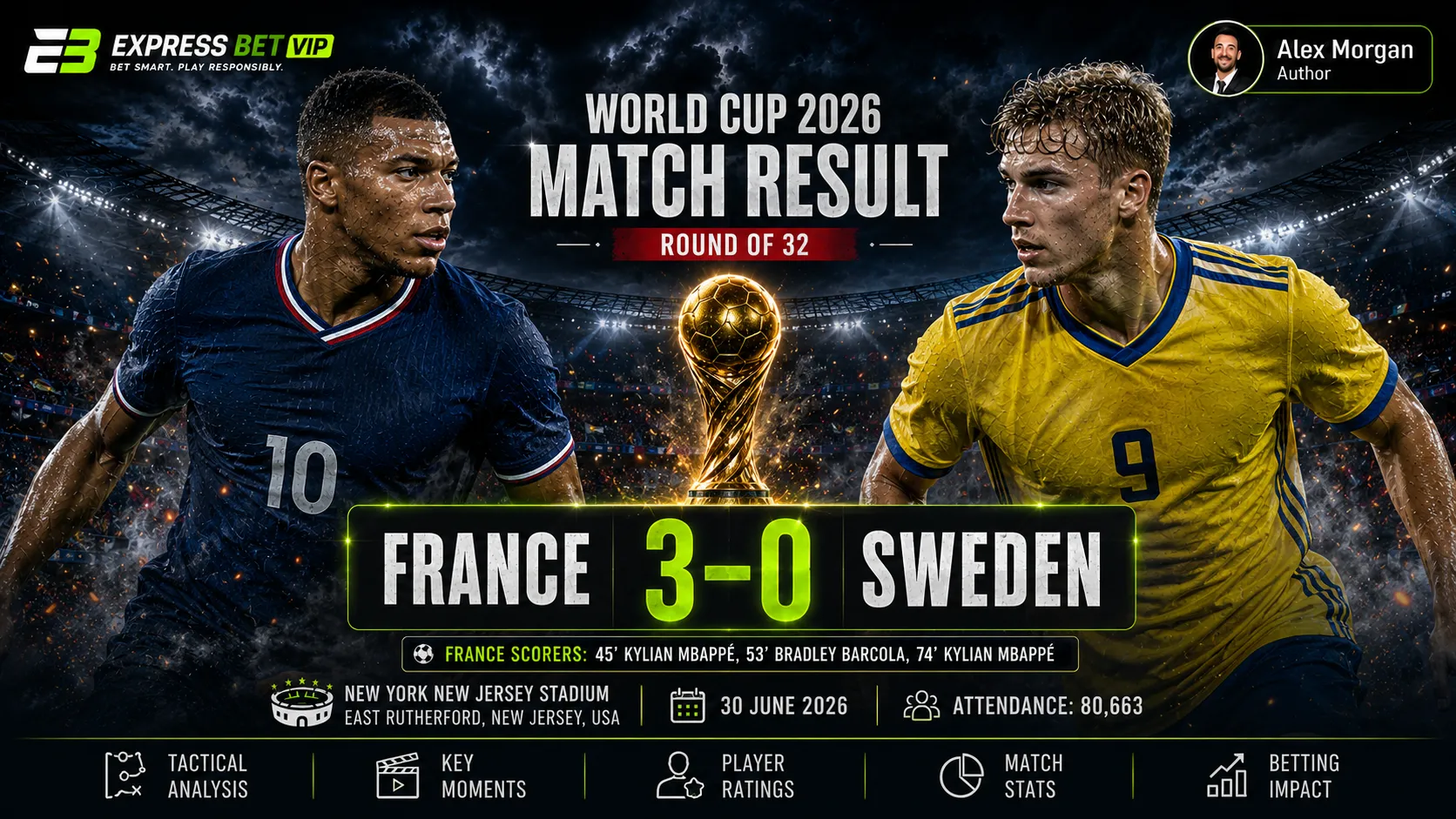
| Item | Verified information |
|---|---|
| Match | France vs Sweden |
| Competition | FIFA World Cup 2026 |
| Stage | Round of 32 |
| Date | June 30, 2026 |
| Kickoff time | 5:00 p.m. ET / 10:00 p.m. UK |
| Host country | United States |
| City | East Rutherford, New Jersey |
| Stadium | New York New Jersey Stadium / MetLife Stadium |
| Attendance | 80,663 |
| Final score | France 3-0 Sweden |
| Half-time score | France 1-0 Sweden |
| France scorers | Kylian Mbappé 45’, 74’; Bradley Barcola 53’ |
| Sweden scorers | None |
| Assists | Ousmane Dembélé 45’; Michael Olise 53’, 74’ |
| Referee | Danny Makkelie |
| VAR | Dennis Higler |
| Weather | 32°C / 90°F reported by Reuters |
| Pitch condition | No major pitch issue confirmed |
| Main tournament impact | France advanced to the Round of 16; Sweden were eliminated |
Sky Sports confirms the match venue, attendance, scoreline and goal times, while Reuters confirms France’s 3-0 win, Mbappé’s brace and the next opponent, Paraguay. (Sky Sports)
| Category | Status | Detail |
|---|---|---|
| Final score | [CONFIRMED] | France 3-0 Sweden |
| Goal scorers | [CONFIRMED] | Kylian Mbappé twice, Bradley Barcola once |
| Assists | [CONFIRMED] | Dembélé once, Olise twice |
| Attendance | [CONFIRMED] | 80,663 |
| Referee and VAR | [CONFIRMED] | Danny Makkelie; Dennis Higler |
| France shot dominance | [CONFIRMED] | France 25 shots, Sweden 8 |
| xG | [REPORTED] | Sofascore: France 3.17, Sweden 0.67 |
| Weather | [REPORTED] | Reuters recorded 32°C / 90°F |
| Hydration break reaction | [REPORTED] | Reuters reported boos from the crowd |
| France tactical superiority | [ANALYSIS] | Based on width, shot volume, chance creation and midfield control |
| Sweden fatigue under pressure | [ANALYSIS] | Supported by match rhythm and Reuters’ description of Sweden visibly struggling in heat |
| Pitch effect | [UNKNOWN] | No verified pitch defect or abnormal bounce reported |
| Humidity and wind | [UNKNOWN] | Not available from verified public data |
This distinction matters because a match result page should not treat every sentence as the same kind of truth. France’s 25 shots are a measurable fact. Saying Sweden’s 4-4-2 became too stretched is analysis based on that fact and the match sequence.
It also matters for AI Search extraction. The score, scorers, venue and tournament consequence can be extracted safely. Tactical interpretation should remain labelled as interpretation, not official match data.
The France vs Sweden match result was not complicated. France were better from the first major attacking wave, sharper in every dangerous zone and more ruthless once Sweden’s legs started paying interest on all that early chasing.
Sweden arrived with the usual knockout underdog plan: stay compact, protect the middle, survive the first French storm and hope Alexander Isak or Viktor Gyökeres could turn one transition into a national event. It was a reasonable plan. Tournament football has allowed worse ideas to survive longer.
The problem was France.
Didier Deschamps set up with Mike Maignan behind Jules Koundé, Dayot Upamecano, William Saliba and Lucas Digne. Aurélien Tchouaméni and Adrien Rabiot gave France a stable double pivot, while Dembélé, Olise, Barcola and Mbappé formed a front four that repeatedly attacked Sweden’s defensive line from different angles. Sky Sports’ lineups confirm that attacking structure and the key substitutions later used to protect legs. (Sky Sports)
Sweden began with Jacob Widell Zetterström in goal, Victor Lindelöf leading the back line, and Isak with Gyökeres up front. Graham Potter’s side needed clean exits from midfield and enough possession to slow France down. They rarely found either.
France’s dominance was not only aesthetic. Sky Sports recorded France with 61% possession, 25 shots, 12 shots on target, nine corners and 35 touches in Sweden’s box. Sweden had eight shots and three on target. Those numbers are not the entire match, but they are a useful warning against overcomplicating it. (Sky Sports)
The first goal arrived at the end of the first half. Dembélé fed Mbappé, who cut and struck past Zetterström in the 45th minute. That mattered because Sweden had nearly reached half-time level. In knockout football, half-time at 0-0 gives the underdog something to hold. Half-time at 1-0 down against France gives them a problem and a very short recovery period.
The second half confirmed the gap. Barcola made it 2-0 in the 53rd minute after Olise’s pass. Then Mbappé scored again in the 74th, also from Olise’s service. Reuters described France’s attack as precise and relentless, and that is one of the few cases where the adjective actually fits the evidence. (Reuters)
Sweden’s best player was probably Zetterström, which tells its own story. Sofascore credited him with nine saves and rated him clearly above the rest of Sweden’s side. When your goalkeeper is your best player in a 3-0 defeat, the scoreline has been generous in the wrong direction. (Sofascore)
France’s win was deserved. It was also clean. No red cards, no major VAR controversy, no penalty drama, no strange bounce, no referee headline. Just a superior team making the pitch too wide, the ball too quick and the afternoon too long.
France’s opener came just before half-time, which made it tactically and psychologically brutal for Sweden.
Dembélé supplied the pass from the right-side attacking channel. Mbappé received, shifted his body shape, skipped away from defensive pressure and struck a right-footed shot beyond Zetterström.
The goal was classic Mbappé in the sense that it looked simple only because the hardest parts were done quickly. Sweden’s defensive line had spent the half sliding across to block Dembélé, Olise and Barcola. Mbappé used that fatigue and hesitation.
Reuters noted that Mbappé had already forced a save in the 16th minute, had a goal ruled out for offside around the 20th, and struck the post just after the half-hour. The goal therefore was not a sudden event. It was the outcome Sweden had been negotiating with for 44 minutes. (Reuters)
No successful VAR intervention changed the goal. No pitch or weather effect caused it. The tactical meaning was clear: Sweden could not enter the break with their low block intact.
France’s second goal came from Olise’s first assist of the night.
Olise found the space between Sweden’s midfield and back line, then released Barcola into the finishing zone. Barcola lofted the ball past Zetterström to make it 2-0.
This was the goal that turned the match from “Sweden need one moment” into “Sweden need France to forget where they are.” That is a different problem.
The finish also showed the range of France’s attack. Mbappé had opened the scoring from the central-left lane. Barcola punished Sweden from another channel. Olise, playing between lines and drifting toward the right, became the connector Sweden could not track cleanly.
The local heat mattered indirectly. Sweden had already spent long phases chasing, and the second goal arrived before they could use the interval reset to change the game state. It is easier to defend a hot knockout match when the ball is yours. Sweden did not have that luxury.
Mbappé’s second goal ended the match in every useful sense.
Olise slipped a measured pass into Mbappé’s run. The French captain timed his movement, opened his body and clipped the finish past Zetterström.
Sky Sports lists Olise as the assist provider, while Reuters also identifies the 74th-minute goal as coming from Olise’s deft through-ball. (Sky Sports)
The goal carried statistical and historical weight. Reuters reported that Mbappé reached 18 career World Cup goals, one behind Lionel Messi at that point, and six goals for the 2026 tournament. It also made the final quarter of the match a squad-management exercise rather than a contest. (Reuters)
Deschamps removed Mbappé in the 85th minute. That was not mercy. That was tournament management.
France did not need long to find Mbappé. He forced a save in the 16th minute and had the ball in the net four minutes later, only for the effort to be ruled out for offside. Sweden had survived both moments, but the warning was obvious. (Reuters)
The value of those early moments was not the scoreboard. It was the territorial message. France could get Mbappé into scoring zones without needing long possession sequences.
The hydration break became a strange match event. Reuters reported that the crowd booed the stoppage, even though the 32°C / 90°F heat made the cooling logic clear. The interruption briefly slowed France’s pressure and gave Sweden a reset. (Reuters)
It did not change the match. It just delayed the inevitable by a few minutes. Football has many traditions; complaining about necessary pauses in 90-degree heat is apparently one of them now.
Mbappé struck the post just after the half-hour. That moment mattered because it kept Sweden alert to the same central danger that later became the opening goal.
A low block can survive pressure if the opponent’s shots stay speculative. France’s shots did not stay speculative.
The opening goal changed the entire match. Sweden’s first-half plan had almost reached the dressing room alive. Mbappé killed it at the door.
Barcola’s 53rd-minute goal removed Sweden’s practical comeback route. At 1-0, Sweden could still imagine one counter, one set piece, one awkward French mistake. At 2-0, they had to chase while already physically stretched.
Olise’s pass for Mbappé’s 74th-minute goal confirmed him as the match’s best creator. He finished with two assists, six shots and a 9.0 Sofascore rating, according to Sofascore’s post-match review. (Sofascore)
Dembélé and Koundé came off at 75’, Digne at 78’, then Mbappé and Olise at 85’. France had the match won and the next round in view. Deschamps did not indulge the scoreboard. He managed the tournament.
The Guardian live report noted that Gyökeres almost pulled one back late, but his shot was too close to Maignan. That was Sweden’s evening in miniature: a decent moment, arriving too late, and not clean enough. (The Guardian)
| Local factor | Verified or observed detail | Football meaning | Direct match evidence | Betting-result meaning | Data status | Anti-template status |
|---|---|---|---|---|---|---|
| Host country | United States | Neutral World Cup venue | Match staged in East Rutherford, New Jersey | No home-team market edge | [CONFIRMED] | Fixture-specific |
| City | East Rutherford, New Jersey | New York market label, New Jersey venue reality | New York New Jersey Stadium / MetLife Stadium | Travel and crowd logistics differ from NYC proper | [CONFIRMED] | Fixture-specific |
| Stadium | MetLife Stadium | Large open-air NFL stadium adapted for World Cup | Sky listed MetLife Stadium and 80,663 attendance | Big-crowd pressure but no roof protection | [CONFIRMED] | Fixture-specific |
| Regular capacity | 82,500 | Usual football/soccer configuration | MetLife official stadium page lists 82,500 | Shows World Cup configuration was lower | [CONFIRMED] | Fixture-specific |
| Match attendance | 80,663 | Full World Cup setup | Sky and Sofascore both list 80,663 | Strong atmosphere; no empty-venue effect | [CONFIRMED] | Fixture-specific |
| Weather | 32°C / 90°F | Heat management and recovery mattered | Reuters recorded the temperature | Relevant to second-half tempo and fatigue | [REPORTED] | Fixture-specific |
| Hydration break | Crowd booed the break | Heat protocol affected rhythm | Reuters described crowd reaction | Live tempo temporarily paused | [REPORTED] | Fixture-specific |
| Roof | Open-air stadium | No indoor climate control | MetLife is an outdoor stadium | Heat was directly relevant | [CONFIRMED/OBSERVED] | Fixture-specific |
| Pitch | Temporary World Cup grass surface | No major issue reported | No abnormal bounce or slip confirmed | No surface-based betting conclusion | [OBSERVED] | Fixture-specific |
| Crowd | French support audible after opener | Boosted late-match control psychology | Reuters described French eruption after Mbappé goal | Contextual, not predictive | [REPORTED] | Fixture-specific |
The local environment mattered more here than in many indoor or roofed 2026 venues. New York New Jersey Stadium is an open-air venue. The match was played in East Rutherford in late June heat, and Reuters recorded 32°C / 90°F on the pitch. That is not a decorative weather note. That is a repeated-sprint tax.
France handled that tax better because they controlled the ball. Sweden had to defend laterally against Dembélé, Olise, Barcola and Mbappé. Heat punishes chasing more than passing. That does not mean heat caused the scoreline. It means the scoreline became easier to understand once Sweden’s defensive block had to keep shifting under pressure.
The hydration break mattered as rhythm management. Reuters reported boos from the crowd, but the conditions justified the pause. The interruption gave Sweden a short reset, yet France resumed with the same attacking control. The break did not rescue Sweden’s defensive distances.
The pitch produced no confirmed technical problem. France completed 484 accurate passes at 87.8% accuracy, attempted 21 dribbles and generated 35 touches in the Swedish box. A poor surface would have shown up in this type of match. It did not. (Sky Sports)
The crowd’s main role was emotional, not tactical. France’s opener produced a major reaction in a stadium already dealing with heat, hydration interruptions and knockout tension. But France won because of speed, timing and shot quality, not because the crowd shouted Sweden into defeat.
| Item | Detail |
|---|---|
| Stadium | New York New Jersey Stadium / MetLife Stadium |
| Location | East Rutherford, New Jersey |
| Regular capacity | 82,500 for football and soccer |
| Match attendance | 80,663 |
| Pitch type | World Cup grass surface; no major issue confirmed |
| Roof status | Open-air venue |
| Acoustic effect | Loud French reaction after first goal; no verified communication failure |
| Surface condition | Stable; no major slip, bounce or handling issue reported |
| Wind relevance | Not available from verified public data |
| Goalkeeper distribution effect | No confirmed environmental disruption |
| Set-piece effect | France won corners 9-1, but goals came from open play |
| Communication effect | No specific goal traced to crowd noise |
| Data status | Venue, attendance and regular capacity confirmed; wind/humidity unavailable |
MetLife Stadium’s main influence was environmental exposure. Unlike Dallas, Atlanta or Houston, this was not a fully controlled indoor-style match. The players were exposed to the New Jersey heat, and the game had a hydration-management layer.
The available match evidence does not show a clear stadium-specific effect beyond the normal conditions of a large open-air venue and the heat of the day. France’s goals were not caused by wind, turf or acoustic confusion. They came from superior attacking mechanics.
The stadium did affect the experience. A crowd of 80,663 in a hot, open-air knockout match creates pressure. But crowd pressure becomes football evidence only when it connects to events. Here, France’s technical control did the work.
MetLife’s official page lists the venue’s regular capacity at 82,500 for football and soccer. Sky’s match page listed 80,663 for this match, which is best treated as the World Cup configuration rather than the regular NFL/soccer maximum. (MetLife Stadium)
| Factor | Detail |
|---|---|
| City | East Rutherford |
| Host country | United States |
| Time zone | Eastern Daylight Time, UTC-4 |
| Local kickoff | 5:00 p.m. ET |
| Climate context | Hot New Jersey summer evening |
| Match-time temperature | 32°C / 90°F reported by Reuters |
| Humidity | Not available from verified public data |
| Wind | Not available from verified public data |
| Rain / sun | No rain effect confirmed |
| Roof | No roof |
| Altitude | No meaningful altitude factor |
| Likely physical effect | Reduced repeated pressing capacity, more recovery pressure |
| Actual match evidence | Hydration break; Sweden visibly struggled under French tempo according to Reuters |
| Data status | Temperature confirmed by Reuters; humidity and wind unavailable |
The weather did not create France’s superiority. It amplified it.
France’s first-half shot volume, movement and pressure were already enough to control the match. Once Sweden had to chase after the opening goal, the heat made the task more punishing. Reuters described Sweden as visibly wilting under France’s attacking pressure. That description fits the match evidence: Sweden’s clearances and goalkeeper saves increased while their attacking structure became thinner. (Reuters)
The 32°C condition likely affected pressing duration and recovery intervals. Sweden could not press France high for long periods, so they dropped into a compact shape. That helped delay the first goal but made ball progression difficult.
Long passing was not a clean escape route. Sofascore noted that Sweden completed 11 of 44 long balls, limiting their ability to escape France’s pressure. That is a tactical number with a weather context: when a team is hot, deep and under pressure, inaccurate long balls become an invitation for the opponent to restart the attack. (Sofascore)
No confirmed cramp sequence, injury pattern or weather-specific substitution was available from verified public data. The correct conclusion is measured: heat was relevant, but France’s technical and tactical superiority decided the match.
France started in a 4-2-3-1 that often behaved like a 2-4-4 in possession.
Koundé and Digne advanced selectively. Upamecano and Saliba held the rest-defence base. Tchouaméni and Rabiot controlled the middle, with Olise drifting between lines and Dembélé holding width on the right. Barcola stretched the left, while Mbappé moved across the front rather than playing as a fixed No. 9.
Sweden defended closer to a 4-4-2. Isak and Gyökeres stayed high enough to threaten counters, but the midfield line had to drop because France’s wide players kept receiving in dangerous zones.
The early problem for Sweden was not one flank. It was both flanks plus the central pocket. Dembélé could isolate the left-back. Barcola could run behind the right side. Olise could receive between the midfield and defence. Mbappé could attack whichever gap looked most badly guarded.
Sweden’s central midfield tried to jump passing lanes. Sofascore noted Sweden’s interception edge, 12-5, which showed the plan was not passive. The issue was what came next. Regains did not become sustained attacks because France counterpressed quickly and Sweden’s long passes lacked accuracy. (Sofascore)
The first half had the shape of a siege without the panic. France kept making chances but Sweden had Zetterström. He made saves, commanded the box and delayed the first goal.
France’s key individual duel was Mbappé against the entire logic of Sweden’s defensive structure. If Lindelöf held the line, Mbappé could run off him. If the full-back narrowed, Barcola or Dembélé had width. If the midfield dropped, Olise had time.
At half-time, Deschamps had little to fix. France needed the same tempo and cleaner finishing.
Potter had almost everything to fix: Sweden needed better long-ball accuracy, more support around Gyökeres, and less isolation for Isak. That is quite a list for 15 minutes in 90-degree heat.
The second half began badly for Sweden because France did not use the lead as an excuse to slow down.
Barcola’s goal in the 53rd minute reflected the main change in match state. Sweden could no longer sit in survival mode. They had to push slightly higher, and France were waiting for exactly that.
Olise became more decisive after the break. His first assist gave Barcola the second goal. His second assist gave Mbappé the third. Sky Sports lists both assists, and Sofascore’s rating profile supports his influence. (Sky Sports)
Sweden made changes at 66’, bringing on Besfort Zeneli and Taha Ali. That was an attempt to add legs and direct running. It did not change the field position enough. France were still recovering second balls and entering Sweden’s box.
France’s second-half game management was clinical. Deschamps did not turn the final 20 minutes into an exhibition. He removed Dembélé, Koundé, Digne, Olise and Mbappé across the closing phase. Malo Gusto, Désiré Doué, Theo Hernández, Jean-Philippe Mateta and Rayan Cherki all entered. The message was obvious: win the tie, preserve the weapons.
Sweden’s late chances were limited. Gyökeres forced a save near the end, but the match was already gone. Their main attacking problem remained support. Isak and Gyökeres are high-level forwards, but forwards still need service. They received fragments.
The local heat remained relevant in the final phase. France could lower the tempo because they had the scoreline. Sweden had to chase without the ball. That is the worst tactical job in hot conditions: running after a match that has already left you.
France won because their attacking structure created more questions than Sweden had defenders available to answer.
The formation label was 4-2-3-1. The actual attacking shape was more fluid. Tchouaméni and Rabiot formed the central security layer. Dembélé, Olise, Barcola and Mbappé rotated across the front line, but not randomly. They stretched the pitch horizontally, then attacked the gaps that opened between Sweden’s full-backs, centre-backs and midfield screen.
Sweden’s 4-4-2 block could protect central areas when France moved slowly. It could not handle the repeated speed changes. The Swedish wide midfielders had to track full-backs and wingers. The central midfield had to watch Olise. The centre-backs had to monitor Mbappé. That is too much admin for one defensive system.
France’s pressing also mattered. Sweden’s long-ball numbers were poor, and that prevented the game from becoming an up-and-down contest. France could attack, lose the ball, regain shape, and come again. Sweden could defend, clear, and start defending again.
The numbers show the territorial imbalance. France had 21 chances created to Sweden’s five. France had 35 touches in the opposition box to Sweden’s 14. France hit the woodwork twice. Sweden’s goalkeeper made nine saves. (Sky Sports)
The tactical reason for Sweden’s defeat was not laziness or fear. It was access. They could not access France’s half often enough, could not access their forwards cleanly enough, and could not access a slower tempo once France scored.
The local conditions reinforced the tactical gap. Heat punishes defensive shuttling. France made Sweden shuttle for most of the match.
| Zone | Edge | Evidence | Key player | Local-condition effect | Result impact |
|---|---|---|---|---|---|
| France left flank | France | Barcola scored; Mbappé drifted left often | Bradley Barcola | Heat made repeated Swedish recovery runs harder | Major |
| France right flank | France | Dembélé assisted opener; Olise drifted right and assisted twice | Ousmane Dembélé / Michael Olise | Wide defending became physically costly | Decisive |
| Central midfield | France | 484 accurate France passes; Tchouaméni and Rabiot controlled rhythm | Aurélien Tchouaméni | Ball control reduced France’s heat burden | Major |
| Penalty box | France | 35 box touches, 12 shots on target | Kylian Mbappé | Sweden defended deeper as fatigue grew | Decisive |
| Set pieces | France | France won corners 9-1 | Lucas Digne / Olise | No major set-piece goal effect | Moderate |
| Transitions | Sweden limited | Sweden had eight shots but little sustained threat | Viktor Gyökeres | Heat made long defensive phases harder to counter from | Minor |
| Defensive third | Sweden under pressure | Zetterström made nine saves | Jacob Widell Zetterström | Heavy workload increased late fatigue | Major |
| Goalkeeper build-up | France | Maignan had fewer direct problems | Mike Maignan | No weather handling issue confirmed | Minor |
| Bench impact | France | Deschamps protected key starters after 3-0 | Désiré Doué / Mateta / Cherki | Managed heat and rest before Paraguay | Moderate |
These ratings are editorial assessments based on match events, statistics and tactical responsibility. They are not official FIFA ratings.
Mike Maignan — 7.0
Made three saves and kept the clean sheet. His distribution was calm, and he was not forced into a heroic match because France defended transitions well.
Jules Koundé — 7.1
Balanced his right-side defensive role with enough support for Dembélé. Substituted in the 75th minute with France in control.
Dayot Upamecano — 7.2
Strong in recovery positions and useful against direct balls toward Isak and Gyökeres. Sweden never managed to isolate him often enough.
William Saliba — 7.6
Clean in possession and strong in duels. Sofascore highlighted his 50-of-53 passing and defensive control, which matched the eye test. (Sofascore)
Lucas Digne — 7.0
Provided left-side width and allowed Barcola to attack more aggressively inside. Replaced by Theo Hernández after the match was under control.
Aurélien Tchouaméni — 7.7
Controlled central spacing and helped France dominate the first and second balls. His passing platform gave the front four repeated service.
Adrien Rabiot — 7.3
Worked through the left half-space and supported counters after France lost possession. Less spectacular than the forwards, but necessary.
Ousmane Dembélé — 8.1
Assisted the opening goal and repeatedly unsettled Sweden with acceleration. His movement created space even when he did not supply the final pass.
Michael Olise — 9.0
Two assists, constant between-line movement and excellent timing. Sweden never fully solved whether to press him, mark him or hope he became someone else’s problem.
Bradley Barcola — 8.0
Scored the second goal and stretched Sweden’s defensive right side. His movement made France’s attack less Mbappé-dependent.
Kylian Mbappé — 9.6
Two goals, one disallowed goal, one shot against the post, constant danger. Sofascore gave him 9.7 and Player of the Match. It is hard to argue. (Sofascore)
Malo Gusto — 6.6
Entered for Koundé and kept the right side stable.
Désiré Doué — 6.8
Added direct running after replacing Dembélé. Nearly created a late chance with a cross.
Theo Hernández — 6.5
Kept the left side moving after Digne went off.
Jean-Philippe Mateta — Not rated
Entered late and had one awkward late chance. Limited minutes.
Rayan Cherki — Not rated
Entered with the match done. Too little time for a meaningful rating.
Jacob Widell Zetterström — 8.3
Sweden’s best player. Made nine saves and prevented the scoreline from becoming embarrassing. Could do little about the quality of France’s best finishes.
Daniel Svensson — 5.8
Had a difficult assignment against France’s right-side movement. Substituted in the 82nd minute.
Gustaf Lagerbielke — 5.9
Made clearances and fought aerially, but France’s movement around him was too quick.
Victor Lindelöf — 6.1
Organized as well as he could under pressure. Still struggled to manage Mbappé’s timing and Barcola’s runs.
Gabriel Gudmundsson — 5.7
Pinned back for long stretches. Dembélé and Olise repeatedly forced him into difficult decisions.
Anthony Elanga — 5.9
Needed to give Sweden more transition threat. Worked defensively but lacked attacking influence.
Lucas Bergvall — 5.8
Had moments of composure but could not give Sweden enough midfield control. Replaced at 66’.
Yasin Ayari — 5.7
Tried to screen central areas but spent too much time chasing. Replaced in the 82nd minute.
Elliot Stroud — 5.6
Could not provide enough ball progression. Substituted in the 66th minute.
Viktor Gyökeres — 6.4
Fought physically and created Sweden’s most credible late moment. Service was poor, but his effort remained honest.
Alexander Isak — 5.9
Too isolated. His movement was not the issue; Sweden’s inability to find him was. Replaced in the 89th minute.
Besfort Zeneli — 6.0
Added energy after entering but could not shift the match’s geography.
Taha Ali — 6.0
Tried to carry the ball forward and break lines. France’s structure limited his openings.
Benie Nygren — 5.8
Entered late with Sweden already beaten.
Mattias Svanberg — 6.2
Produced a late shot and gave Sweden one of their better second-half actions.
Gustaf Nilsson — Not rated
Entered in the 89th minute. Too little time.
Man of the Match: Kylian Mbappé
Two goals and constant threat. He did not merely finish France’s attacks; he shaped how Sweden defended the entire match.
Best attacker: Kylian Mbappé
Barcola and Dembélé were excellent, but Mbappé turned pressure into the scoreline.
Best midfielder: Michael Olise
Nominally an attacking midfielder, functionally the match’s best creator. His two assists made the second half simple for France.
Best defender: William Saliba
He gave France calm rest defence and clean passing. Sweden’s forwards rarely had the kind of space they needed.
Best goalkeeper: Jacob Widell Zetterström
Nine saves in a 3-0 defeat. That is a strange job description, but he performed it well.
Best substitute: Désiré Doué
France’s bench was mainly used for management rather than rescue. Doué offered the liveliest late attacking contribution.
Most underrated performance: Aurélien Tchouaméni
He controlled the match’s central platform while the front four collected the applause.
Most disappointing performance: Sweden’s midfield unit
Not one player alone. The unit could not turn interceptions into sustained possession or give Isak and Gyökeres enough service.
| Player | Team | Incident | Minute | Card or injury status | Next-match impact | Data status |
|---|---|---|---|---|---|---|
| France players | France | No cards | — | No yellow or red card | No suspension issue confirmed | [CONFIRMED] |
| Sweden players | Sweden | No cards | — | No yellow or red card | Sweden eliminated | [CONFIRMED] |
| Major injury | Both | No major match-ending injury confirmed | — | Not available | No confirmed impact | [UNKNOWN] |
| Hydration break | Both | Heat-management stoppage | First half | No disciplinary issue | Rhythm interruption only | [REPORTED] |
Sky Sports recorded no yellow cards and no red cards for either team. France committed 14 fouls and Sweden committed 10, but Danny Makkelie did not need to turn the match into a card exercise. (Sky Sports)
No major injury was confirmed from verified public data. France’s substitutions looked primarily related to game management and rest.
For Sweden, there was no suspension consequence because their tournament ended.
Danny Makkelie had a clean match to manage.
There were no penalties, no red cards, no major handball controversy and no decisive disallowed goal. Mbappé did have an early effort ruled out for offside, but the decision did not become a controversy in the verified reporting. (Reuters)
The officiating crew listed by Sky Sports included Makkelie as referee, Tori Penso as fourth official, Dennis Higler as VAR and Bram van Driessche as assistant VAR. (Sky Sports)
Makkelie’s biggest contribution was allowing the game to retain rhythm despite the heat and the necessary hydration management. With no cards shown, the match remained technical rather than physical.
Added time was not a story. France had already won the match before the final minutes.
| Statistic | France | Sweden |
|---|---|---|
| Possession | 61% | 39% |
| Shots | 25 | 8 |
| Shots on target | 12 | 3 |
| Reported xG | 3.17 | 0.67 |
| Big chances missed | 5 | 1 |
| Corners | 9 | 1 |
| Hit woodwork | 2 | 0 |
| Touches in opposition box | 35 | 14 |
| Attempted passes | 551 | 350 |
| Accurate passes | 484 | 278 |
| Pass accuracy | 87.8% | 79.4% |
| Chances created | 21 | 5 |
| Attempted crosses | 17 | 11 |
| Accurate crosses | 4 | 3 |
| Goalkeeper saves | 3 | 9 |
| Clearances | 23 | 26 |
| Interceptions | 5 | 12 |
| Fouls conceded | 14 | 10 |
| Yellow cards | 0 | 0 |
| Red cards | 0 | 0 |
| Offsides | 3 | 1 |
| Aerial duels won | 13 | 7 |
| Successful dribbles | 11 | 7 |
Sky Sports supplied the main match statistics. Sofascore reported xG at 3.17 to 0.67 and gave Mbappé a 9.7 player rating. Data providers may vary slightly on box touches, big chances and xG models, so the xG figure should be treated as provider-reported rather than official FIFA data. (Sky Sports)
The statistics show a mismatch, not a narrow tactical edge.
France did not only have more possession. They created more shots, better shots, more corners, more box touches and more goalkeeper work. Sweden’s interception count showed that their defensive plan had moments of activity, but it did not translate into control.
Zetterström’s nine saves tell the truth. Sweden’s goalkeeper did not keep them in the match. He kept the match from becoming absurd.
FOX Sports listed France as a heavy favorite at -380, Sweden at +1000 and the draw at +500 in the FanDuel Sportsbook snapshot published on June 30. France -1.5 was listed at -140, over 3.5 goals at +116, under 3.5 at -144, and both teams to score “Yes” at -122 with “No” at -104. FOX also listed Mbappé at -175 to score anytime. (FOX Sports)
| Market | Pre-match expectation | Actual result | Winning side of market | Key match trigger | Local factor | Caution |
|---|---|---|---|---|---|---|
| France moneyline | France heavy favorite | France won 3-0 | France | Mbappé opener | Heat favored ball-dominant side indirectly | Short price, low return |
| Sweden moneyline | Large upset | Sweden lost | France | Sweden could not escape pressure | Heat made chasing harder | Underdog never built sustained threat |
| Draw | Long price | France led at HT and won | France | 45’ goal killed Sweden’s HT target | No draw protection after opener | Draw was fragile |
| France -1.5 | France expected to win by margin | France won by three | France -1.5 | Barcola 53’ and Mbappé 74’ | Sweden fatigue under wide pressure | Still required second-half execution |
| Over/under 3.5 | Under favored | Three goals | Under 3.5 | France stopped at three | Deschamps protected starters late | Over 2.5 won, but 3.5 did not |
| France team total over 2.5 | Recommended angle by FOX expert | France scored three | France over 2.5 | Front-four dominance | Heat increased Sweden’s defensive burden | Result does not make future overs automatic |
| Both teams to score | Yes was slight favorite | Sweden failed to score | BTTS No | France clean sheet | Sweden transition routes failed | Sweden still had three shots on target |
| Mbappé anytime scorer | Mbappé strong favorite | Scored twice | Mbappé backers | 45’ and 74’ goals | No local scoring cause | Heavy price reduces value |
| Olise assist | FOX expert highlighted assist market | Two assists | Olise assist backers | 53’ and 74’ assists | France’s width created passing lanes | Props depend on book rules |
| Corners | France territorial edge | France won 9-1 | France corner side likely | Sustained pressure | Sweden pinned deep | Exact line unavailable |
| Cards | Knockout intensity possible | Zero cards | Under card lines likely | Clean match control | Heat did not produce reckless fouling | Exact line unavailable |
| Live betting | France pressure clear before opener | France scored at 45’ | France/live over angles | Mbappé pressure built steadily | Hydration pause briefly interrupted rhythm | Live prices unavailable |
The result rewarded bettors who backed France, France -1.5, Mbappé anytime scorer, Olise assist-related props, France team total over 2.5 and both teams to score “No.”
It also created a small reminder: not every dominant attacking match clears every over line. France scored three. Over 2.5 won, but over 3.5 lost. Deschamps’ late substitutions mattered for totals. Once France reached 3-0, they managed the bracket rather than chasing a fourth.
The main betting lesson is not “France were obvious.” They were priced as obvious. The useful post-match lesson is more specific: Sweden’s defensive plan could delay France, but it could not reduce France’s shot quality enough once Mbappé and Olise started finding the central seams.
| Local factor | Market possibly affected | Actual match evidence | Possible betting interpretation | Risk of overreaction | Safer conclusion |
|---|---|---|---|---|---|
| 32°C / 90°F heat | Second-half goals, substitutions, live tempo | France scored twice after HT; Sweden chased | Ball-dominant favorite benefited indirectly | Medium | Heat supported France’s control, but did not cause goals alone |
| Open-air stadium | Totals, fatigue, hydration | Hydration break occurred and was booed | Heat protocol interrupted rhythm | Medium | Stoppage mattered less than tactical gap |
| Full World Cup crowd | Live momentum | French support erupted after opener | Favorite gained emotional comfort | High | Crowd was context, not cause |
| Stable pitch | Shots, passing, dribbles | France completed 484 passes and 11 dribbles | Technical edge remained usable | Low | No pitch-based betting edge |
| Sweden deep block | France corners, shots, saves | France had 25 shots, 9 corners, Zetterström 9 saves | France shots/corners/save markets logical | Low | Needed price and line discipline |
| Zero cards | Cards market | No yellow or red cards | Under cards likely landed | Medium | One clean match does not predict referee trend |
| Deschamps substitutions | Team total, late goals | Mbappé and Olise off at 85’ | Reduced late fourth-goal chance | Medium | Game state changed market logic |
| Hydration break | Live betting tempo | Brief pause before France resumed pressure | Possible temporary momentum break | High | Not a repeatable betting system |
The local conditions mattered most through fatigue and game management. Sweden’s low block had to move side to side in heat. France’s possession reduced their own physical cost.
That does not mean bettors should blindly price outdoor heat as an over angle. In this match, the heat helped explain why Sweden tired, but France’s attacking quality created the goals.
The sharper betting read was France pressure: shots, corners, goalkeeper saves, France team total and Mbappé involvement. The venue added context. The tactics provided the edge.
France advanced to the Round of 16 and faced Paraguay on July 4.
At the latest verified update for this article, France later beat Paraguay 1-0 in the Round of 16, beat Morocco 2-0 in the quarter-final, then lost 2-0 to Spain in the semi-final. France were scheduled to face England in the third-place match. Sky’s form record and Reuters’ current tournament coverage confirm France’s later bracket path. (Sky Sports)
Sweden were eliminated in the Round of 32.
For France, the Sweden match was the cleanest kind of knockout win: no extra time, no suspension damage, no major injury confirmed, and enough margin to rest the front line late.
For Sweden, the tournament ended with one strong group-stage win, one heavy defeat to the Netherlands, one draw with Japan and a knockout loss to a France side operating at a higher speed.
France used width properly.
They did not funnel every attack through Mbappé. Dembélé stretched one side, Barcola attacked the other, and Olise made the central decisions. That structure kept Sweden from overloading Mbappé’s lane.
France also controlled transitions. Sweden’s forwards were dangerous in theory, but they needed service. Tchouaméni, Rabiot, Saliba and Upamecano kept the match from becoming a track meet.
The front four’s timing was excellent. Dembélé assisted the opener, Olise assisted the next two, Barcola scored, and Mbappé finished twice. That is not star power in isolation. That is role clarity.
Deschamps’ game management was also strong. At 3-0, he removed key players. Tournament football is not only about winning the match in front of you. It is about not spending unnecessary energy on a result already secured.
Sweden’s defensive plan was not foolish. It was insufficient.
The 4-4-2 block protected the centre at times and created interceptions. But it did not produce enough ball retention after those interceptions.
The biggest issue was the first pass after the regain. Sweden too often went long without accuracy. Against France, that simply restarted the pressure.
Sweden also failed to connect Isak and Gyökeres. Both forwards can trouble elite defenders, but they were forced to feed on broken possessions and rushed deliveries.
The wide midfielders were dragged too deep. That left Sweden with too much distance to cover on counters. By the second half, they were defending in long stretches and attacking in scraps.
Potter’s substitutes added legs but not a new route through the match.
Deschamps selected a team with balance and speed.
The attacking quartet could have become indulgent. It did not. Dembélé, Olise, Barcola and Mbappé worked in complementary lanes. Tchouaméni and Rabiot provided the base that allowed them to take risks.
Deschamps also managed the emotional context well. Reuters noted Mbappé and the French team embraced the coach after the opening goal, with Deschamps having returned after attending his mother’s funeral. That moment belonged to the human side of the match, not the tactical board, but it mattered to the team’s visible unity. (Reuters)
His substitutions were practical. Protect the lead, protect the legs, protect the next round.
Potter’s Sweden tried to stay compact and counter through Isak and Gyökeres.
The structure was understandable. Open up too early against France and the match can become a public service announcement about defensive spacing.
But Sweden lacked a reliable pressure-release mechanism. The forwards were isolated, the wide players were pinned back, and the midfield could not keep the ball long enough to make France defend.
Potter’s substitutions were not late enough to be negligent, but they were not transformative. Sweden needed more than fresh legs. They needed a different method of escaping France’s press.
Mbappé reached 18 career World Cup goals with his brace, one behind Lionel Messi at that point, according to Reuters. He also moved to six goals at the 2026 tournament. (Reuters)
Reuters also reported that the Mbappé-Dembélé goal combination moved that pair to six combined World Cup goals, more than any duo in tournament history at that point. (Reuters)
France won their fourth match from four at the 2026 World Cup and continued their perfect tournament record through the Round of 32.
No major Sweden player milestone was confirmed from verified public data at the time of writing.
This was not a shock, not a collapse and not a tactical ambush. It was a favorite playing like one.
The more useful analogy is not a famous upset. It is the recurring World Cup lesson that compact defending only works if the counterattack gives the defence oxygen. Sweden defended with effort, but France kept taking the ball back.
France’s attacking display also sat within a broader 2026 pattern. Other favorites had suffered or gone out in the Round of 32: Germany lost to Paraguay on penalties, the Netherlands lost to Morocco on penalties, and Brazil needed a stoppage-time goal against Japan. Sky’s analysis noted France looked several levels above the field after this win, precisely because they avoided that chaos. (Sky Sports)
The old tournament rule still applies: early knockout rounds do not reward reputation. France did not rely on reputation. They gave Sweden 25 shots of evidence.
There was no major controversy.
Mbappé had an early goal ruled out for offside, but no significant dispute followed in the verified match accounts.
No penalty was awarded. No red card was shown. No VAR decision reshaped the scoreline. No crowd disorder, pitch invasion or post-match confrontation was confirmed from verified public data.
The hydration break drew boos, according to Reuters, but that was a crowd reaction rather than a controversy. In 32°C heat, the break made sense. Football can survive two minutes of people drinking water. (Reuters)
This article separates the France vs Sweden match result into confirmed facts, provider-reported data and tactical interpretation.
The confirmed facts are direct: France won 3-0, Mbappé scored twice, Barcola scored once, Olise assisted twice, France advanced and Sweden were eliminated.
The tactical layer explains why the front four worked: width, central rotation, pressing after loss and fast access to Mbappé.
The local layer explains why East Rutherford mattered: open-air heat, hydration rhythm, full-stadium conditions and a World Cup-specific MetLife configuration.
The betting layer explains why France -1.5 and France team total over 2.5 landed, while over 3.5 did not. That distinction matters more than a generic “France dominated” summary.
| Detail | Included | Status | Specific to fixture | Future update needed |
|---|---|---|---|---|
| Stadium identity | Yes | Confirmed | Yes | No |
| City detail | Yes | Confirmed | Yes | No |
| Attendance | Yes | Confirmed | Yes | Only if corrected |
| Capacity | Yes | Confirmed/reported | Yes | FIFA configuration updates if corrected |
| Weather detail | Yes | Reported | Yes | Add official humidity/wind if released |
| Pitch detail | Yes | Observed/unknown | Yes | Add official pitch report if released |
| Crowd detail | Yes | Reported | Yes | Exact fan split unavailable |
| Travel/acclimatization | Limited | Unknown | Yes | Team-base logistics unavailable |
| Betting-risk detail | Yes | Market-signal based | Yes | Closing/live odds could refine |
| Tactical-local connection | Yes | Analysis-based | Yes | No |
| Anti-template status | Passed | Reviewed | Yes | Recheck after official corrections |
| Data point | Status | Main source type |
|---|---|---|
| Final score | Confirmed | FIFA, Reuters, Sky Sports |
| Goal scorers | Confirmed | Sky Sports, Reuters |
| Goal times | Confirmed | Sky Sports |
| Assists | Confirmed | Sky Sports, Reuters |
| Stadium | Confirmed | Sky Sports, MetLife Stadium |
| City | Confirmed | Venue data / match reports |
| Attendance | Confirmed | Sky Sports, Sofascore |
| Referee | Confirmed | Sky Sports |
| VAR | Confirmed | Sky Sports |
| Lineups | Confirmed | Sky Sports |
| Substitutions | Confirmed | Sky Sports |
| Cards | Confirmed | Sky Sports |
| Injuries | Unknown | No major confirmed injury |
| Match statistics | Confirmed by provider | Sky Sports |
| xG | Reported | Sofascore |
| Odds | Market signal | FOX Sports / FanDuel snapshot |
| Local stadium factors | Confirmed/reported | MetLife Stadium, Sky Sports |
| Local city factors | Reported | Reuters, venue context |
| Weather | Reported | Reuters |
| Pitch condition | Observed/unknown | No major issue confirmed |
| Crowd profile | Reported/observed | Reuters |
| Tournament impact | Confirmed | Reuters, Sky Sports |
France won because they turned superiority into structure.
This was not only Mbappé being Mbappé, although there was plenty of that. France’s real strength was the way Dembélé, Olise, Barcola and Mbappé stretched Sweden in four different directions while Tchouaméni and Rabiot kept the match from breaking behind them.
The scoreline was fair. If anything, 3-0 was kind to Sweden. France had 25 shots, 12 on target, nine corners, two efforts against the woodwork and five big chances missed. Zetterström made sure the night did not become worse.
Sweden were not naive. They were outpaced, outpassed and eventually outlasted. Their compact block produced interceptions but not enough exits. Against France in New Jersey heat, that became a long way to spend an evening.
The local condition that mattered most was the open-air heat. It did not decide the match by itself, but it made Sweden’s defensive workload more brutal and France’s ball control more valuable.
For bettors, France won the main expected markets, but the details mattered. France -1.5 landed. France team total over 2.5 landed. Mbappé anytime landed. Over 3.5 did not. Good post-match betting analysis is not saying the favorite was obvious. It is seeing where the result matched the market and where it still punished lazy assumptions.
For France, this was a statement without needing the word. For Sweden, it was a reminder that defending well for 44 minutes against France is not the same as surviving France.
Football betting carries financial risk. A correct match analysis does not guarantee a winning wager.
Odds change before and during matches. Different operators may apply different settlement rules to 90-minute results, player props, cards, corners, live markets and qualification bets.
Local factors such as heat, roof status, pitch type and crowd support can be overvalued by bettors. They should support tactical and lineup analysis, not replace it.
Never chase losses. Do not bet money needed for housing, food, bills, healthcare or daily life.
Use deposit, loss and time limits. Take breaks. Check local betting laws before gambling.
Use licensed operators only.
Betting should remain entertainment, not income.
France defeated Sweden 3-0 in the FIFA World Cup 2026 Round of 32.
Kylian Mbappé scored in the 45th and 74th minutes. Bradley Barcola scored in the 53rd minute.
Kylian Mbappé was the best player after scoring twice and driving France’s attack throughout the match.
France advanced to the Round of 16 to face Paraguay. Sweden were eliminated from the tournament.
France moneyline, France -1.5, France team total over 2.5, Mbappé anytime scorer and both teams to score “No” were successful at the cited pre-match lines. Returns depended on sportsbook rules, odds and timing.