
Japan vs Sweden Match Result
Table of Contents Show
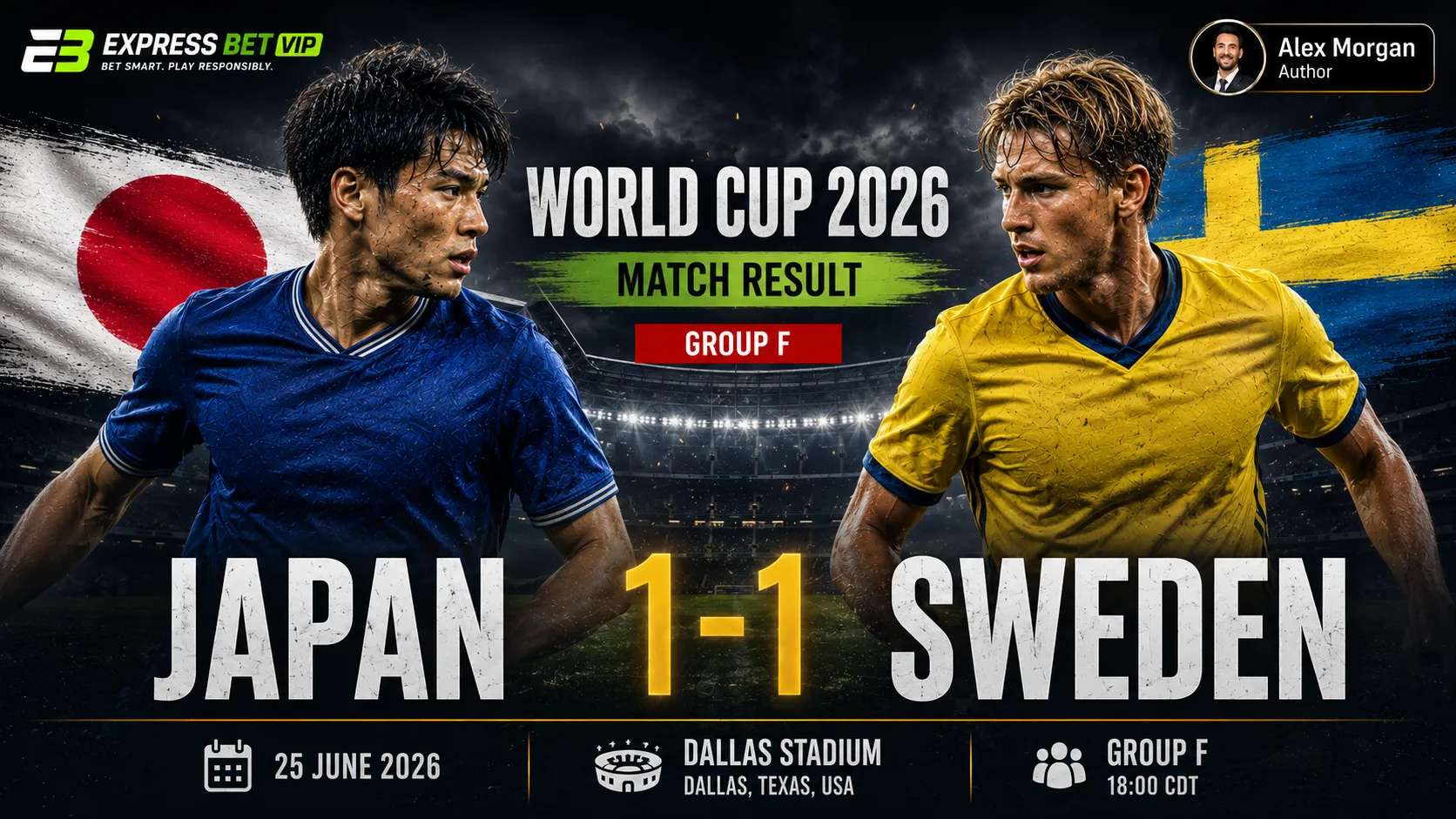
Japan and Sweden drew 1-1 at Dallas Stadium after a goalless first half. Daizen Maeda finished an excellent Japan combination in the 56th minute, but Anthony Elanga equalised six minutes later with a curling left-footed strike from outside the area. Zion Suzuki was the decisive goalkeeper, denying Alexander Isak twice late in the match, including a stoppage-time header that he pushed against the crossbar. Japan’s sharper combination play created the higher-quality chances, while Sweden’s direct attacking power made the closing stages uncomfortable. The climate-controlled stadium reduced the impact of the severe outdoor Texas heat, while FIFA’s west-end curtains removed the venue’s known sunset-glare problem. Japan finished second in Group F; Sweden qualified in third. The draw market and under 2.5 goals won, depending on the operator and timing of the wager. (Reuters)
| Item | Verified detail |
|---|---|
| Match | Japan vs Sweden |
| Competition | FIFA World Cup 2026 |
| Stage | Group stage, Matchday 3 |
| Group | Group F |
| Date | June 25, 2026 |
| Kickoff | 18:00 CDT / 23:00 UTC |
| Host country | United States |
| City | Arlington, Texas |
| Stadium | Dallas Stadium |
| Regular name | AT&T Stadium |
| Attendance | 70,137 |
| Final score | Japan 1-1 Sweden |
| Half-time score | 0-0 |
| Japan scorer | Daizen Maeda 56’ |
| Sweden scorer | Anthony Elanga 62’ |
| Assists | Ritsu Doan, Viktor Gyökeres |
| Referee | Ivan Barton |
| VAR | Not available from verified public data |
| Surface | Purpose-built hybrid natural-grass pitch |
| Roof/environment | Climate-controlled venue; west-end blackout curtains installed |
| Main tournament impact | Japan finished second; Sweden advanced in third place |
The result, goal times, assists, kickoff and venue are confirmed by FIFA, Reuters and FOX Sports. AP reported the 70,137 sellout attendance. (FIFA)
| Category | Information |
|---|---|
| [CONFIRMED] | Japan and Sweden drew 1-1 after a 0-0 first half. |
| [CONFIRMED] | Maeda scored at 56’; Elanga scored at 62’. |
| [CONFIRMED] | Japan finished second and Sweden advanced in third. |
| [REPORTED] | Attendance was 70,137. |
| [OBSERVED] | Japan controlled longer passing phases; Sweden produced the stronger late pressure. |
| [ANALYSIS] | Japan’s rotations around Doan, Ueda and Maeda opened Sweden’s central defensive line. |
| [MARKET SIGNAL] | Japan were the pre-match favourite; the total was 2.5 goals. |
| [UNKNOWN] | Complete VAR team, internal temperature, humidity, PPDA and distance covered. |
This separation matters because the score and goal minutes can be copied directly into a match database. Claims about Sweden’s defensive spacing or Japan’s superior combinations require interpretation.
The statistics also need context. Sweden took more shots and won eight corners, but FotMob assigned Japan substantially higher xG. Shot volume and chance value were not telling the same story. (Sky Sports)
Japan entered the final Group F fixture level with the Netherlands on four points. A draw would guarantee progress and preserve at least second place. Sweden had three points and needed a positive result after the 5-1 defeat to the Netherlands had damaged both its defensive reputation and goal difference. (Reuters)
That tournament context produced a cautious first half. Neither side wanted to offer the type of transition that turns a manageable qualification equation into a national inquiry.
Japan held more of the ball and tried to stretch Sweden’s back three through Yukinari Sugawara and Keito Nakamura. Sweden preferred earlier passes toward Alexander Isak and Viktor Gyökeres, with Anthony Elanga positioned behind or around the two forwards.
The first clear chance belonged to Sweden. Alexander Bernhardsson forced Zion Suzuki into a sixth-minute save. Japan responded through Doan and Maeda, but the opening half remained short of clean penalty-box actions. (FOX Sports)
Sweden were forced into an early change when Isak Hien left after 36 minutes. Lucas Bergvall entered, requiring Potter to alter the defensive and midfield relationships. Japan also lost Ko Itakura before half-time, with Shogo Taniguchi replacing him. (FOX Sports)
The best chance before the break came from Japan. Maeda laid the ball back for Keito Nakamura, whose first-time strike forced Jacob Widell Zetterström into a full-stretch save around his left post. It was the strongest technical action of a half otherwise governed by caution. (Reuters)
Japan increased the speed after the interval. Ao Tanaka shot wide, and the movement around Sweden’s centre-backs became more aggressive. In the 56th minute, Doan combined with Ayase Ueda before playing through to Maeda, who scored.
The lead survived for six minutes.
Elanga cut in from Sweden’s right and curled a left-footed shot beyond Suzuki. The goalkeeper appeared screened and reacted late, but the placement remained excellent. Sweden’s qualification position stabilised immediately. (Reuters)
Sweden then produced its best period. Isak forced Suzuki into a major save three minutes after the equaliser. Potter’s side used its physical forwards more directly and began winning corners and second balls.
Japan made attacking substitutions but became more cautious in its defensive distances. Sweden continued looking for the winner, partly because Elanga did not realise that one point was already sufficient. He later admitted that he kept running despite cramp because he thought Sweden still needed another goal. Tournament mathematics had temporarily become an optional language. (Reuters)
The final major moment arrived in stoppage time. Elanga tested Suzuki, and the goalkeeper pushed the attempt away. From the subsequent corner, Isak headed toward goal. Suzuki deflected the ball against the crossbar and then claimed it in traffic. (Reuters)
The draw was a reasonable result. Japan produced the more coherent attacking move and the higher xG. Sweden created the stronger late chances and could have won through Isak. Both sides advanced, which made the final whistle more useful than beautiful.
Ritsu Doan received the ball on the right and moved inside. He combined with Ayase Ueda, collected the return pass and threaded the ball between Sweden’s centre-backs.
Maeda timed his run from the left side of Japan’s front line, controlled Doan’s pass and finished low past Widell Zetterström. Reuters described it as a team move of the highest quality, while AP noted that Maeda controlled with his left foot before finishing with his right. (Reuters)
Assist: Ritsu Doan
Goal type: Open-play combination goal
Shot type: Right-footed low finish
VAR: No decisive intervention reported
Defensive issue: Sweden’s central defenders were separated by the Doan–Ueda exchange
Goalkeeper position: Widell Zetterström narrowed the angle but Maeda finished before he could set fully
Tactical meaning: Japan converted its right-sided overload into a central run
Emotional impact: Japan moved toward a possible Group F victory
The move showed Japan’s positional flexibility. Doan began wide, Ueda dropped toward the ball and Maeda attacked the space created behind him. Sweden’s defenders were asked three different questions in a few seconds and answered none of them quickly enough.
Viktor Gyökeres supplied the ball to Elanga on Sweden’s right. The winger moved inside onto his left foot near the corner of the penalty area and bent his shot over the defensive line and toward the far side of goal.
Suzuki appeared unsighted by the defenders in front of him. AP reported that the goalkeeper reacted late, while Reuters described the finish as a high-quality curling strike. (Reuters)
Assist: Viktor Gyökeres
Goal type: Long-range open-play goal
Shot type: Curling left-footed strike
VAR: No decisive intervention reported
Defensive issue: Japan allowed Elanga to move onto his stronger shooting foot
Goalkeeper position: Suzuki’s view was partially blocked
Tactical meaning: Sweden attacked before Japan could restore its wide defensive block
Emotional impact: Sweden returned to the qualification positions
The finish was Sweden’s second major contribution from outside the box in successive matches for Elanga. FotMob noted that Sweden had scored four goals from outside the penalty area during the group stage, more than any other team at that point. (FotMob)
Bernhardsson tested Suzuki after six minutes. The chance showed that Sweden could reach the goalkeeper through direct play before Japan established longer possession spells. (FOX Sports)
Isak Hien was booked in the 32nd minute and replaced by Lucas Bergvall around five minutes later. The substitution changed Sweden’s structure from the original back-three arrangement and removed a defender already operating under disciplinary pressure. (FOX Sports)
Japan lost Ko Itakura shortly before half-time. Taniguchi entered and later received Japan’s only confirmed yellow card. No verified post-match diagnosis for Itakura was available in the reviewed sources. (FOX Sports)
Nakamura’s first-time effort appeared destined for the corner until the Swedish goalkeeper produced a full-stretch stop. Sweden reached half-time level largely because of that save. (Reuters)
Japan did not settle for the draw immediately after half-time. Tanaka’s early attempt and the movement of Doan and Ueda increased the pressure on Sweden’s central defence.
That intent produced Maeda’s goal in the 56th minute. (Reuters)
Japan had only six minutes to enjoy the lead. Elanga’s shot changed Sweden’s emotional state and forced Japan to reassess whether chasing first place was worth exposing second place.
Three minutes after Elanga’s goal, Isak reached a strong shooting position. Suzuki’s save prevented Sweden from completing a rapid turnaround. (Reuters)
Elanga believed Sweden still needed to score again, despite the draw being sufficient. He continued making forward runs and later developed cramp. His teammates attempted to communicate the qualification situation during the closing stages. (Reuters)
Suzuki saved from Elanga and then pushed Isak’s header against the crossbar after the resulting corner. It was the sequence that confirmed Japan’s second-place finish. (AP News)
| Local factor | Verified or observed detail | Football meaning | Direct match evidence | Betting-result meaning | Data status | Anti-template status |
|---|---|---|---|---|---|---|
| Stadium | Dallas Stadium | Enclosed, climate-controlled venue | Indoor environment reduced external heat impact | Outdoor weather had limited direct influence | [CONFIRMED] | Fixture-specific |
| Attendance | 70,137 | Full crowd and sustained noise | Sold-out venue | Possible live-momentum effect | [CONFIRMED] | Fixture-specific |
| West-end curtains | Black curtains installed for this match | Removed sunset glare risk | No visible sunlight-related error | Reduced uncertainty for goalkeepers and high balls | [CONFIRMED] | Fixture-specific |
| Kickoff | 18:00 CDT | Coincided with west-facing sunset risk | Curtains used because sunset was at 20:40 | Sun-glare angle neutralised | [CONFIRMED] | Fixture-specific |
| External heat | Heat index forecast near 101°F | Major issue outside the stadium | Venue was climate-controlled | Limited direct on-field value | [REPORTED] | Fixture-specific |
| Pitch | Temporary elite-level hybrid grass | Consistent roll and bounce | No decisive surface defect observed | No clear pitch-based betting edge | [CONFIRMED] | Fixture-specific |
| Roof/air conditioning | Indoor venue with air-conditioning | More stable conditions | No weather interruption | Reduced heat-related total-goals assumptions | [CONFIRMED] | Fixture-specific |
| Crowd profile | Strong visible support for both teams | Neutral but lively atmosphere | Japanese and Swedish sections documented | No clear one-team home advantage | [OBSERVED] | Fixture-specific |
| Post-match supporter conduct | Japanese supporters cleaned seating areas | Cultural event detail | Confirmed by Dallas Sports Commission | No sporting or betting effect | [CONFIRMED] | Fixture-specific |
Dallas Stadium was a rare case where the local weather mattered more outside the building than on the pitch. Forecasts placed the outdoor heat index close to 101°F, but the stadium’s cooling system created a controlled internal environment. (climatecentral.org)
The most specific local intervention concerned sunlight. AT&T Stadium’s east-west orientation allows the setting sun to enter through its large glass end zones. For this 18:00 match, FIFA installed black curtains across the west end. Sunset was scheduled for approximately 20:40, placing the second half directly within the traditional glare window. (AP News)
No goalkeeper error or missed aerial ball could reasonably be attributed to direct sunlight. The intervention removed that variable before it became part of the match.
The pitch was another highly specific element. FIFA and turf specialists spent years developing a hybrid grass surface installed above the Cowboys’ regular artificial field. The system included a full soil profile and was maintained using suspended grow lamps because the indoor environment offered limited natural light. (Reuters)
The surface supported a normal passing rhythm. Japan completed 84.9% of its passes, Sweden 79%. No decisive slip, damaged area or irregular bounce was identified in the reviewed reporting. (Sky Sports)
The crowd remained active despite the quiet first half. AP described persistent Japanese support, while match photography and local reporting showed substantial Swedish sections. No verified source established a decisive supporter majority. (AP News)
| Stadium factor | Match detail |
|---|---|
| Stadium | Dallas Stadium |
| Regular name | AT&T Stadium |
| FIFA-listed capacity | 70,649 |
| Attendance | 70,137 |
| Pitch type | Temporary hybrid natural grass |
| Roof/environment | Indoor, climate-controlled |
| West-end condition | Blackout curtains installed |
| Acoustic effect | Strong enclosed-stadium noise |
| Surface condition | No decisive defect confirmed |
| Wind relevance | Negligible inside the venue |
| Goalkeeper distribution | No verified environmental effect |
| Set-piece effect | Sweden created eight corners but scored none |
| Communication effect | No specific breakdown conclusively linked to noise |
| Data status | Capacity, attendance, curtains and surface verified |
FIFA listed Dallas Stadium’s tournament capacity at 70,649. The reported attendance of 70,137 placed the fixture close to that World Cup configuration. (FIFA)
The curtains mattered because they eliminated a problem unique to this stadium and this kickoff time. AP reported that this was the only Dallas World Cup match where timing made west-end glare a material risk. (AP News)
Sweden’s eight corners created the most obvious stadium-wide pressure moments, particularly during stoppage time. The enclosed environment amplified the reaction, but the final outcome still depended on Suzuki’s technique rather than the building’s acoustics.
The available match evidence does not show a clear stadium-specific effect on passing, goalkeeper kicking or finishing beyond the successful removal of glare and outdoor heat.
| Factor | Detail |
|---|---|
| City | Arlington, Dallas–Fort Worth area |
| Host country | United States |
| Time zone | Central Daylight Time, UTC-5 |
| Kickoff | 18:00 local time |
| Typical June climate | Hot, with elevated heat-index risk |
| Outdoor temperature | Exact verified match-time figure unavailable |
| Forecast heat index | Approximately 101°F outside |
| Internal temperature | Not available from verified public data |
| Humidity | Not available from verified public data |
| Wind | Limited direct relevance inside stadium |
| Rain | No match interruption |
| Altitude | No meaningful altitude effect |
| Likely physical effect | External heat affected travel and supporters more than play |
| Actual match evidence | Normal second-half intensity and late Swedish pressure |
| Data status | External forecast reported; internal metrics unknown |
The external conditions did not produce an obvious decline in running intensity. Sweden’s most forceful spell came during the final half-hour, and Elanga continued running until cramp despite mistakenly believing another goal was required. (Reuters)
Japan also accelerated after half-time rather than slowing. Maeda’s goal required coordinated high-speed movement through Sweden’s defensive line.
No verified heat illness, weather-related substitution or handling error occurred. It would therefore be inaccurate to describe this as a heat-defined match.
The roof and cooling system reduced the value of outdoor-weather assumptions for total goals, pressing duration or late fatigue. Bettors using Arlington’s external temperature without considering the venue would have been analysing the wrong environment.
Japan started in a 3-4-3:
Zion Suzuki; Hiroki Ito, Ko Itakura, Ayumu Seko; Yukinari Sugawara, Ao Tanaka, Daichi Kamada, Keito Nakamura; Ritsu Doan, Ayase Ueda, Daizen Maeda.
Sweden used a 3-4-1-2 or a flexible 3-4-3:
Jacob Widell Zetterström; Gustaf Lagerbielke, Victor Lindelöf, Isak Hien; Alexander Bernhardsson, Elliot Stroud, Yasin Ayari, Gabriel Gudmundsson; Anthony Elanga; Alexander Isak, Viktor Gyökeres. (Reuters)
Japan built with its three centre-backs and allowed Sugawara and Nakamura to move high. Tanaka stayed deeper, while Kamada moved between Sweden’s midfield and defensive lines.
Sweden’s front two tried to occupy the outside centre-backs. Elanga moved underneath them, looking for second balls or opportunities to run at Japan’s back line.
Japan’s pressing was selective. Ueda screened the central pass, while Doan and Maeda closed the outside centre-backs when Sweden played toward the touchline.
Sweden’s early route was more direct. Isak dropped toward midfield, Gyökeres attacked the depth and Bernhardsson advanced from the right. That combination created the sixth-minute chance.
Japan gradually gained control through Tanaka and Kamada. Sweden struggled to apply pressure without leaving the midfield exposed, particularly once Hien departed.
The main Japanese width came from Sugawara. Doan moved inside from the right, encouraging the wing-back to overlap. On the left, Nakamura stayed closer to the touchline and Maeda attacked the half-space.
Sweden defended the box reasonably well but allowed Japan to combine near the edge of the area. Nakamura’s late first-half chance came after Maeda laid the ball into his path.
The first half’s central duel involved Tanaka and Kamada against Stroud and Ayari. Japan circulated more cleanly, but Sweden’s forwards gave every turnover a degree of danger.
Both coaches had problems at half-time. Moriyasu needed more penetration from the possession. Potter needed Sweden to close the spaces around Doan without removing the counterattacking support for Isak and Gyökeres.
Japan increased the height of its wing-backs and played more quickly through Doan after the interval.
Tanaka’s early shot signalled a change in intention. Japan no longer treated the draw as the only acceptable objective.
The opening goal demonstrated the adjustment. Doan received with support from Ueda, while Maeda attacked the channel behind Sweden’s reshaped defence. The move bypassed Sweden through timing rather than individual dribbling.
Sweden’s response was immediate and direct. Elanga began receiving wider on the right, giving him space to move onto his left foot. Gyökeres occupied the nearest centre-back and received the assist for the equaliser.
After the score reached 1-1, Sweden pushed its wing-backs higher and began targeting Isak more frequently. Japan’s back line defended deeper, particularly after Itakura’s first-half departure.
Isak’s 65th-minute chance exposed the risk. Sweden moved through Japan’s first pressure line, and the striker received inside the area. Suzuki’s save became the first major action of his match.
Moriyasu replaced Ueda and Doan with Koki Ogawa and Junya Ito. The substitutions preserved Japan’s ability to counterattack but changed the relationship that had created the goal.
Potter introduced Ken Sema and Daniel Svensson after 74 minutes, increasing Sweden’s width and crossing volume. Sweden finished with eight corners and several late deliveries. (Sky Sports)
Japan later brought on Yuto Nagatomo and Tsuyoshi Watanabe, strengthening the defensive line. The team protected second place rather than gambling it for a group victory.
Sweden’s late pressure was more than cosmetic. Elanga and Isak both forced saves during stoppage time. The draw survived because Suzuki handled the highest-pressure moments.
Japan defended in a 5-2-3 shape when Sweden had settled possession. The wing-backs dropped alongside the centre-backs, while Tanaka and Kamada protected central progression.
With the ball, Japan attacked closer to a 3-2-5. Sugawara and Nakamura supplied width. Doan and Maeda entered the half-spaces around Ueda.
That structure created the opening goal. Ueda’s movement pulled a defender forward, Doan attacked the resulting passing lane and Maeda ran behind the final line.
Sweden’s 3-4-1-2 placed Isak and Gyökeres against Japan’s three centre-backs. Elanga operated as the connecting player but frequently moved toward the right wing to receive facing goal.
Sweden’s equaliser came from that wider positioning. Japan’s left side failed to close Elanga before he reached his shooting zone.
Japan’s midfield edge was technical. Tanaka and Kamada completed more controlled sequences and gave their team 52.3% possession.
Sweden’s edge was physical and vertical. Isak and Gyökeres forced Japan’s defenders to protect depth, while Elanga supplied acceleration from behind them.
Japan’s rest defence was strongest when Tanaka remained behind the ball. It became vulnerable when both wing-backs advanced and Sweden recovered possession early.
Sweden’s defensive problem remained the space between the outside centre-backs. The Maeda goal followed the same broad weakness that Potter had identified after the heavy defeat to the Netherlands. (Reuters)
Neither coach completely solved the opposing strength. Japan created the cleaner structured goal. Sweden produced the stronger late pressure. A draw followed because both goalkeepers protected the final margin.
| Zone | Edge | Match evidence | Key player | Local-condition effect | Result impact |
|---|---|---|---|---|---|
| Japan left flank | Japan in buildup | Nakamura and Maeda combined around Bernhardsson | Daizen Maeda | No direct effect | Maeda reached scoring positions |
| Japan right flank | Japan | Doan and Sugawara overloaded the channel | Ritsu Doan | Stable surface aided combinations | Opening goal |
| Sweden left flank | Sweden late | Sema and Svensson increased crossing volume | Ken Sema | Indoor conditions kept delivery stable | Late pressure |
| Sweden right flank | Sweden | Elanga cut inside to score | Anthony Elanga | Curtains removed glare | Equalising goal |
| Central midfield | Japan | Higher passing accuracy and possession | Ao Tanaka | Climate control sustained tempo | Japan controlled longer phases |
| Penalty box | Mixed | Japan created higher xG; Sweden had late chances | Maeda / Isak | No surface anomaly | Balanced result |
| Set pieces | Sweden | Eight corners to Japan’s two | Yasin Ayari | No wind disruption | Isak hit crossbar late |
| Transitions | Sweden | Isak and Gyökeres threatened after turnovers | Alexander Isak | Normal ball flight | Forced four saves |
| Defensive third | Japan | Suzuki made four saves | Zion Suzuki | No glare or wind issue | Preserved draw |
| Goalkeeper build-up | Japan | Cleaner passing from defensive line | Zion Suzuki | Hybrid pitch behaved normally | Supported possession |
| Bench impact | Sweden slightly | Sema and Svensson improved late width | Ken Sema | Fresh legs in controlled climate | Increased pressure |
The ratings below are editorial assessments based on tactical roles, match actions and the available provider data. They are not official FIFA ratings.
Zion Suzuki — 8.5
The match’s decisive player. Saved from Bernhardsson, denied Isak after the equaliser and produced two stoppage-time interventions. His view was restricted for Elanga’s goal.
Hiroki Ito — 7.0
Passed calmly from the left side of the back three and protected the channel when Nakamura advanced.
Ko Itakura — 6.0
Started well but left before half-time. No verified diagnosis was available from public data.
Ayumu Seko — 6.5
Defended Gyökeres physically and remained disciplined until being replaced late.
Yukinari Sugawara — 7.0
Provided Japan’s right-sided width and tested Widell Zetterström from distance.
Ao Tanaka — 7.5
Controlled Japan’s central circulation and helped the team play through Sweden’s first pressure line.
Daichi Kamada — 7.0
Moved intelligently between the lines, although Sweden prevented him from matching his scoring impact from Japan’s first two matches.
Keito Nakamura — 7.0
Forced the best first-half save and supplied useful width. His movement created space for Maeda inside.
Ritsu Doan — 8.0
Created Japan’s goal through a sharp combination with Ueda and a perfectly weighted pass behind the defence.
Ayase Ueda — 7.0
His return pass helped release Doan before the opening goal. Worked between Sweden’s centre-backs without receiving many direct chances.
Daizen Maeda — 8.0
Scored with intelligent movement and a composed finish. His pace repeatedly stretched Sweden’s defensive line.
Shogo Taniguchi — 6.5
Entered unexpectedly for Itakura and handled the physical forwards reasonably well. Booked in the second half.
Koki Ogawa — 6.0
Added a central target but did not reproduce Ueda’s combination play.
Junya Ito — 6.5
Provided fresh width and took Japan’s late corner.
Yuto Nagatomo — 6.0
Helped protect the left side during Sweden’s late pressure.
Tsuyoshi Watanabe — 6.5
Added aerial strength during the closing minutes.
Jacob Widell Zetterström — 7.5
Made a major first-half save from Nakamura on his World Cup debut. Had little chance once Maeda received inside the area.
Gustaf Lagerbielke — 6.5
Defended several crosses and carried the ball forward. Japan still found space around the central line.
Victor Lindelöf — 6.5
Organised Sweden’s back line and handled Ueda physically, but could not close the passing lane before Maeda’s goal.
Isak Hien — 5.5
Booked after 32 minutes and removed shortly afterwards. Sweden’s defensive structure became less stable after his departure.
Alexander Bernhardsson — 6.5
Forced the first save and worked hard on the right before being replaced.
Elliot Stroud — 6.0
Covered ground in midfield but Japan’s combinations frequently moved around him.
Yasin Ayari — 7.0
Sweden’s main set-piece distributor and a useful link between midfield and the forwards.
Gabriel Gudmundsson — 6.5
Provided width and delivered early corners. Japan limited his access to dangerous crossing positions during the middle phase.
Anthony Elanga — 8.5
Scored Sweden’s equaliser, tested Suzuki late and continued driving forward. The confusion over qualification added an unusual final chapter to an excellent performance.
Alexander Isak — 7.5
Created Sweden’s best chances after the equaliser and struck the crossbar through Suzuki’s save in stoppage time.
Viktor Gyökeres — 7.0
Assisted Elanga and occupied Japan’s centre-backs. Booked late after a strong challenge.
Lucas Bergvall — 6.5
Entered during the first half and helped Sweden maintain midfield numbers after Hien’s departure.
Ken Sema — 6.5
Increased Sweden’s left-sided pressure after entering.
Daniel Svensson — 6.5
Produced an attempt and supported the late corner sequence.
Carl Starfelt — 6.0
Helped manage Japan’s late counterattacks.
Benjamin Nygren — 6.0
Entered too late to make a substantial impact.
Editorial Man of the Match: Zion Suzuki
Elanga scored the best individual goal, but Suzuki prevented Sweden from winning through three major second-half interventions.
Best attacker: Anthony Elanga
He scored, produced two shots on target and remained Sweden’s most dynamic attacker. (FOX Sports)
Best midfielder: Ritsu Doan
Doan supplied the technical action that created Japan’s goal and repeatedly moved inside Sweden’s midfield line.
Best defender: Hiroki Ito
He remained calm in possession and handled Sweden’s direct attacks without a major error.
Best goalkeeper: Zion Suzuki
Four saves, including the stoppage-time intervention against Isak. (Sky Sports)
Best substitute: Ken Sema
His introduction gave Sweden additional width during its strongest sustained spell.
Most underrated performance: Ao Tanaka
Japan’s possession structure depended on his positioning behind Kamada and the front three.
Most disappointing performance: Elliot Stroud
Sweden needed greater control in midfield, but Japan passed around the central pairing too easily.
| Player | Team | Incident | Minute | Status | Next-match impact | Data status |
|---|---|---|---|---|---|---|
| Isak Hien | Sweden | Yellow card | 32’ | Booked | No suspension confirmed | [CONFIRMED] |
| Isak Hien | Sweden | Replaced | 37’ | Reason not fully confirmed | No diagnosis available | [UNKNOWN] |
| Ko Itakura | Japan | Replaced | 39’ | Apparent physical issue | Diagnosis unavailable | [OBSERVED] |
| Shogo Taniguchi | Japan | Strong challenge | 77’ | Yellow card | No suspension confirmed | [CONFIRMED] |
| Viktor Gyökeres | Sweden | Strong foul | 85’ | Yellow card | No suspension confirmed | [CONFIRMED] |
| Anthony Elanga | Sweden | Cramp late in match | Added time | Completed match | Recovered before next fixture | [REPORTED] |
FOX recorded three yellow cards and no dismissals. Hien’s first-half withdrawal and Itakura’s replacement occurred before halftime, but no verified public diagnosis was available in the sources reviewed. (FOX Sports)
The match remained competitive without becoming uncontrolled. Ivan Barton allowed physical contact but penalised the most obvious late challenges.
Ivan Barton of El Salvador refereed the match. Complete verified VAR details were not available from the public sources reviewed. (FIFA)
No penalty, red card or disallowed goal materially affected the contest.
Hien’s yellow card came during a difficult first-half period for Sweden’s defence. Gyökeres and Taniguchi were booked during the closing phase as the match became more direct.
No prolonged VAR review interrupted either goal. Maeda remained onside during Japan’s combination, and Elanga’s strike involved no disputed contact or handball.
Added time gave Sweden two significant chances. Barton allowed the final corner sequence to complete before ending the match.
The referee influenced the physical threshold but not the final result.
| Statistic | Japan | Sweden |
|---|---|---|
| Possession | 52.3% | 47.7% |
| Shots | 8 | 11 |
| Shots on target | 3 | 5 |
| Expected goals | 1.31 | 0.42 |
| Big chances missed | 1 | 1 |
| Corners | 2 | 8 |
| Touches in opposition box | 11 | 13 |
| Accurate passes | 378 | 312 |
| Pass accuracy | 84.9% | 79.0% |
| Goalkeeper saves | 4 | 2 |
| Yellow cards | 1 | 2 |
| Red cards | 0 | 0 |
| Offsides | 3 | 2 |
| Hit woodwork | 0 | 1 |
| PPDA | Not available | Not available |
| Distance covered | Not available | Not available |
Sky Sports supplies the possession, shooting, passing, corner, save and disciplinary totals. FotMob supplies the xG figures. (Sky Sports)
The statistics explain why both teams could consider the result slightly incomplete.
Japan created the better-quality chances. Its 1.31 xG came from only eight attempts, including Maeda’s finish and Nakamura’s first-half opportunity.
Sweden produced more shots, more shots on target and six additional corners. Much of that volume came after Elanga equalised, when Japan accepted a deeper defensive position.
Sweden’s 0.42 xG appears low in relation to Isak’s late opportunities, but provider models classify angles, defensive pressure and shot location differently.
The passing numbers support Japan’s territorial control. Sweden’s corner and save totals support the conclusion that Potter’s side finished more aggressively.
FOX listed Japan at approximately -120, Sweden at +350 and the draw at +250. The total was 2.5 goals, with the over around -134 and the under around +110. FanDuel snapshots varied slightly by publication time. (FanDuel)
| Market | Pre-match expectation | Actual result | Winning side | Key trigger | Local factor | Caution |
|---|---|---|---|---|---|---|
| Match winner | Japan favourite | 1-1 draw | Draw | Elanga equaliser | Climate-controlled venue neutralised weather | Prices varied |
| Japan -0.5 | Japan expected to win | Failed | Sweden +0.5 | Japan held lead for six minutes | No direct local cause | Favourite status did not guarantee control |
| Sweden moneyline | Sweden needed a strong result | Failed | Losing market | Suzuki’s late saves | No verified venue effect | Sweden still qualified |
| Over/under 2.5 | Over slightly favoured | Two goals | Under 2.5 | Goalkeepers and cautious first half | Indoor conditions did not create a high total | One additional goal changes settlement |
| Both teams to score | Yes heavily supported | Both scored | BTTS Yes | Elanga response | No clear local effect | Market price was short |
| Correct score | 1-1 | 1-1 | Correct-score backers | Six-minute goal exchange | No direct effect | High-variance market |
| First goalscorer | Ueda and Isak among shorter prices | Maeda | Maeda backers | Doan combination | No local causal link | Player odds varied |
| Anytime Elanga | Elanga started after scoring vs Netherlands | Elanga scored | Elanga backers | Right-to-left movement | Curtains removed glare, not defenders | Lineup confirmation mattered |
| Corners | Sweden expected to attack directly | Sweden won 8-2 | Sweden corner markets | Late wide pressure | Stable indoor delivery | Handicap line unknown |
| Goalkeeper saves | Sweden’s forwards expected to shoot | Suzuki made four | Suzuki over-save markets | Isak and Elanga late chances | No weather interference | Exact prop lines unavailable |
| Live betting | Japan led 1-0 | Sweden equalised quickly | Draw/live Sweden positions | Elanga’s 62’ goal | No clear venue cause | Live prices moved rapidly |
The draw rewarded bettors who treated the group situation as relevant without assuming the match would become passive for 90 minutes.
The under 2.5-goals market survived despite both teams scoring during a six-minute period. The quiet first half and late saves were decisive.
Both teams to score landed, but the short pre-match price reflected Sweden’s attacking talent and Japan’s seven-goal group campaign.
Sweden’s corner advantage was stronger than its possession share. Potter’s team became increasingly direct after the equaliser, creating eight corners and several goalkeeper-save opportunities.
This result does not establish that qualification-friendly draws offer automatic betting value. Sweden nearly won in stoppage time, and Japan created enough xG to score more than once.
| Local factor | Market possibly affected | Actual match evidence | Possible betting interpretation | Risk of overreaction | Safer conclusion |
|---|---|---|---|---|---|
| Climate control | Total goals, second-half tempo | Both teams maintained intensity | External heat was largely neutralised | Using outdoor temperature as match temperature | Analyse internal venue conditions |
| West-end curtains | Goalkeeper saves, long balls | No glare-related incident | Reduced visibility uncertainty | Assuming curtains favoured one team | FIFA removed a known stadium risk |
| Hybrid grass | Passing and finishing | Japan passed at 84.9% | Surface supported combination play | Claiming pitch created Maeda’s goal | Technique and movement mattered more |
| Enclosed stadium | Crowd and communication | Strong noise during late corners | Increased psychological pressure | Treating noise as a guaranteed error source | No confirmed communication failure |
| Sweden’s qualification confusion | Live winner markets | Elanga kept chasing a second goal | Sweden remained aggressive late | Assuming all players know live permutations | Tournament information can affect behaviour |
| Eight Sweden corners | Corners and save props | Suzuki made late saves | Sweden’s direct phase created volume | Equating corners with goal quality | Corner pressure still required finishing |
| First-half injuries | Live substitution markets | Both teams changed defenders | Structural uncertainty increased | Predicting goals purely from substitutions | Goals came after tactical combinations |
The local factor that genuinely mattered was the curtain installation. It removed a documented visibility problem from the west end before the second half reached sunset.
The external heat should not be used as the principal explanation for the under. Dallas Stadium was climate-controlled, and both teams produced their most intense football late.
The surface supported Japan’s passing, but the same pitch also supported Elanga’s clean long-range strike. It offered consistency rather than a one-team advantage.
| Position | Team | Points | Goal difference | Outcome |
|---|---|---|---|---|
| 1 | Netherlands | 7 | Positive | Qualified as group winner |
| 2 | Japan | 5 | Positive | Qualified |
| 3 | Sweden | 4 | Negative | Qualified as best third-placed team |
| 4 | Tunisia | 0 | Negative | Eliminated |
The Netherlands beat Tunisia 3-1 in the simultaneous fixture and finished two points above Japan. Sweden’s four points were sufficient for advancement through the third-place ranking. (FIFA)
Japan advanced unbeaten from the group stage and faced Brazil in Houston on June 29. Brazil won 2-1 through a late Gabriel Martinelli goal. (FIFA)
Sweden faced France in the Round of 32 and lost 3-0. Potter’s team therefore advanced but did not solve the defensive weakness exposed by the Netherlands and Japan. (Sky Sports)
Japan’s second-place finish was its third consecutive progression from a World Cup group. Sweden maintained its record of reaching the knockout phase in every World Cup appearance since 1994. (AP News)
Japan controlled the central passing game without becoming excessively passive.
Tanaka and Kamada gave the team stable possession. Doan moved inside to create overloads rather than remaining fixed on the wing.
Ueda’s movement created the space for Maeda. Japan’s goal was not an isolated defensive mistake; it was the product of coordinated positioning.
The back line adapted after losing Itakura. Taniguchi entered without preparation and helped withstand Sweden’s direct forwards.
Suzuki managed the decisive moments. His late saves converted a potentially damaging defeat into second place.
Japan also understood the tournament situation during the closing phase. The team retained enough counterattacking threat to discourage Sweden but did not expose the defensive line unnecessarily.
Sweden’s midfield struggled to control Japan’s rotations.
Stroud and Ayari were required to protect wide and central spaces at the same time. Japan moved Doan and Maeda inside, leaving Sweden’s wing-backs uncertain about when to follow.
The defensive line remained vulnerable between the centre-backs. Maeda’s goal followed one direct pass through that channel.
Sweden also relied heavily on individual attacking quality. Elanga’s goal came from a difficult long-range finish rather than sustained penalty-box construction.
The team created eight corners but did not convert one. Its late pressure was substantial, yet the finishing and first-contact quality remained inconsistent.
The confusion over qualification was avoidable. Elanga’s continued pursuit of a winner created ambition, but it also exposed a communication failure between the bench and the field.
Moriyasu made three changes after the 4-0 win against Tunisia. Sugawara, Seko and Maeda entered the starting XI. Maeda’s selection produced the goal. (Reuters)
The 3-4-3 gave Japan width without sacrificing central numbers. Doan’s freedom was especially important.
Moriyasu handled Itakura’s early departure with Taniguchi rather than changing the formation.
The second-half substitutions reduced Japan’s attacking cohesion but increased defensive security. Ogawa and Ito preserved counterattacking options, while Nagatomo and Watanabe protected the final phase.
Japan did not win the group, but Moriyasu secured progression without losing.
Potter started Elanga after his goal against the Netherlands. That decision rescued Sweden’s tournament. (Reuters)
Sweden’s original 3-4-1-2 placed significant attacking quality around Isak and Gyökeres. The problem remained defensive protection.
Hien’s early exit required an improvised change. Bergvall helped midfield circulation, but Sweden’s centre remained vulnerable.
Potter’s late changes were effective. Sema and Svensson increased width and supported the corner pressure.
Sweden advanced, but the performance remained unstable. Potter obtained the required point without restoring the defensive control Sweden historically associated with tournament football.
Daizen Maeda’s goal was Japan’s seventh of the tournament, setting a new national record for goals scored at a single World Cup. The previous record was six in 2018. (AP News)
Japan completed an unbeaten World Cup group stage for only the second time, after the 2002 tournament. (FotMob)
Ten Japanese players had registered a direct goal contribution by the end of the group stage, equalling Germany for the most in the tournament at that point. (FotMob)
Elanga became the first Swedish player to score in consecutive World Cup matches since Martin Dahlin and Kennet Andersson in 1994. (FotMob)
Widell Zetterström made his World Cup debut and produced an important first-half save. (Reuters)
Japan and Sweden had previously met seven times. Japan’s only earlier victory came at the 1936 Olympic tournament, while their most recent senior meeting before 2026 was a 1-1 friendly draw in 2002. (Wikipedia)
The 2026 result repeated the score but carried far greater tournament value.
Japan’s progression continued a modern pattern. Since co-hosting in 2002, the national team has developed from an occasional knockout participant into a regular group-stage survivor.
Sweden’s route was more familiar in a different way. Potter’s team survived qualification through the Nations League route, then survived the group despite conceding six goals in three matches.
This was not a match where either team controlled everything. Japan controlled the combinations. Sweden controlled the closing pressure. The draw reflected two incomplete forms of superiority.
The most unusual local incident occurred before kickoff rather than during play. FIFA installed black curtains at the west end of Dallas Stadium to prevent sunset glare. The decision contrasted with the Dallas Cowboys’ refusal to use similar curtains during NFL games. (AP News)
No major penalty or VAR controversy affected the match.
Elanga’s misunderstanding of Sweden’s qualification situation became the primary post-match talking point. He believed Sweden required another goal and continued attacking through cramp. Isak later said he had scolded him during the confusion. (Reuters)
Japanese supporters remained after the match to collect rubbish from the seating areas, continuing a practice associated with the team’s travelling fan base. (Dallas Sports Commission)
This report separates the verified score and event data from tactical interpretation.
It explains how Doan, Ueda and Maeda created Japan’s goal through coordinated movement.
It identifies Elanga’s equaliser as a product of Sweden changing his receiving position toward the right.
It compares Sweden’s higher shot and corner volume with Japan’s higher xG.
It connects Dallas Stadium’s blackout curtains, east-west alignment, climate control and temporary hybrid pitch to this specific fixture.
It explains how Sweden’s misunderstanding of the live qualification position affected its late attacking behaviour.
It interprets the draw, under-2.5, corner and goalkeeper-save markets without treating the outcome as predictable.
| Detail | Included | Status | Specific to fixture | Later update required |
|---|---|---|---|---|
| Stadium identity | Yes | Confirmed | Yes | No |
| World Cup capacity | Yes | Confirmed | Yes | Only if FIFA revises it |
| Attendance | Yes | Confirmed | Yes | No |
| Roof/climate control | Yes | Confirmed | Yes | No |
| West-end curtains | Yes | Confirmed | Yes | No |
| Outdoor heat | Yes | Reported | Yes | Replace with official observation if published |
| Internal temperature | No | Unknown | Yes | Update if verified |
| Hybrid pitch | Yes | Confirmed | Yes | No |
| Surface behaviour | Yes | Observed | Yes | Update if an official pitch report appears |
| Crowd split | Qualified | Observed | Yes | Update if official fan-distribution data appears |
| Japanese fan cleanup | Yes | Confirmed | Yes | No |
| Travel/acclimatisation | Limited | Analysis-based | Yes | Update if federation data appears |
| Betting-risk detail | Yes | Analysis-based | Yes | Add consensus closing odds if archived |
| Tactical-local connection | Yes | Analysis-based | Yes | Reassess if tracking data becomes available |
| Anti-template status | Passed | Reviewed | Yes | Recheck after editing |
| Data point | Status | Main source type |
|---|---|---|
| Final score | Confirmed | FIFA, Reuters, AP, FOX |
| Half-time score | Confirmed | FIFA, FOX |
| Goalscorers | Confirmed | FIFA, Reuters |
| Goal times | Confirmed | FIFA, FOX |
| Assists | Confirmed | FOX, Reuters |
| Stadium | Confirmed | FIFA |
| City | Confirmed | FIFA, AP |
| Attendance | Confirmed | AP |
| Referee | Confirmed | FIFA, Reuters photography |
| VAR | Unknown | Not available from verified public data |
| Starting lineups | Confirmed | Reuters |
| Formations | Provider interpretation | FOX |
| Substitutions | Confirmed | FOX |
| Yellow cards | Confirmed | FOX |
| Injuries | Observed, diagnoses unknown | FOX, match reporting |
| Possession | Confirmed | Sky Sports |
| Shots | Confirmed | Sky Sports |
| xG | Provider model | FotMob |
| Corners | Confirmed | Sky Sports |
| Odds | Market snapshots | FOX, FanDuel, CBS |
| External weather | Reported | Local forecast sources |
| Internal conditions | Unknown | Not publicly verified |
| Pitch construction | Confirmed | FIFA pitch manager, Reuters |
| Curtains/glare control | Confirmed | AP |
| Crowd behaviour | Confirmed/observed | AP, Dallas Sports Commission |
| Group outcome | Confirmed | FIFA, Reuters |
| Knockout opponents | Confirmed | FIFA |
Review the article if:
Last updated: July 15, 2026
Japan and Sweden reached the same destination through different football.
Japan built the better goal. Doan, Ueda and Maeda moved with the timing of players who understood where the next pass would go before Sweden’s defenders had finished reacting to the previous one.
Sweden produced the better individual finish. Elanga’s equaliser required technique, confidence and enough space to make Japan regret allowing him onto his left foot.
Japan’s higher xG suggests that its attacking structure created the cleaner opportunities. Sweden’s five shots on target, eight corners and stoppage-time pressure show why the draw cannot be described as fortunate for Potter’s side.
Suzuki decided the final margin. Without his saves from Isak and Elanga, Japan would have finished third rather than second.
Dallas Stadium’s local conditions were unusually specific. FIFA neutralised the west-end sunlight with blackout curtains, while air-conditioning reduced the effect of the severe outdoor heat. The temporary hybrid pitch behaved normally.
The environment removed excuses rather than creating the result.
Japan advanced unbeaten and looked tactically prepared for stronger opposition. Sweden advanced despite continuing to defend with alarming softness between its centre-backs.
For bettors, the draw and under 2.5 goals won, while both teams to score also landed. Those outcomes depended on six minutes of second-half scoring and several late saves.
Both teams qualified. Neither team left entirely satisfied. That is often the correct emotional grammar of a final group-stage draw.
Football betting carries financial risk. Correct tactical analysis does not guarantee a successful wager.
Odds change before and during matches. Prices can differ materially between licensed operators.
Local conditions can be overvalued. Outdoor heat, stadium acoustics or pitch type do not create a dependable betting system by themselves.
Never chase losses or gamble with money required for housing, food, healthcare, debt payments or other daily expenses.
Set financial and time limits. Take breaks and stop when betting no longer remains entertainment.
Check the gambling laws in your jurisdiction and use licensed operators only. Betting should remain entertainment, not income.
Japan and Sweden drew 1-1 at Dallas Stadium.
Daizen Maeda scored for Japan in the 56th minute. Anthony Elanga scored for Sweden in the 62nd minute.
Zion Suzuki was the editorial Man of the Match after making four saves, including decisive late interventions against Alexander Isak and Anthony Elanga.
Japan finished second in Group F with five points. Sweden finished third with four points and advanced as one of the best third-placed teams.
The draw, under 2.5 goals and both teams to score — Yes won. Returns depended on the bookmaker and the time the wager was placed.