
Spain vs Cabo Verde Match Result
Table of Contents Show
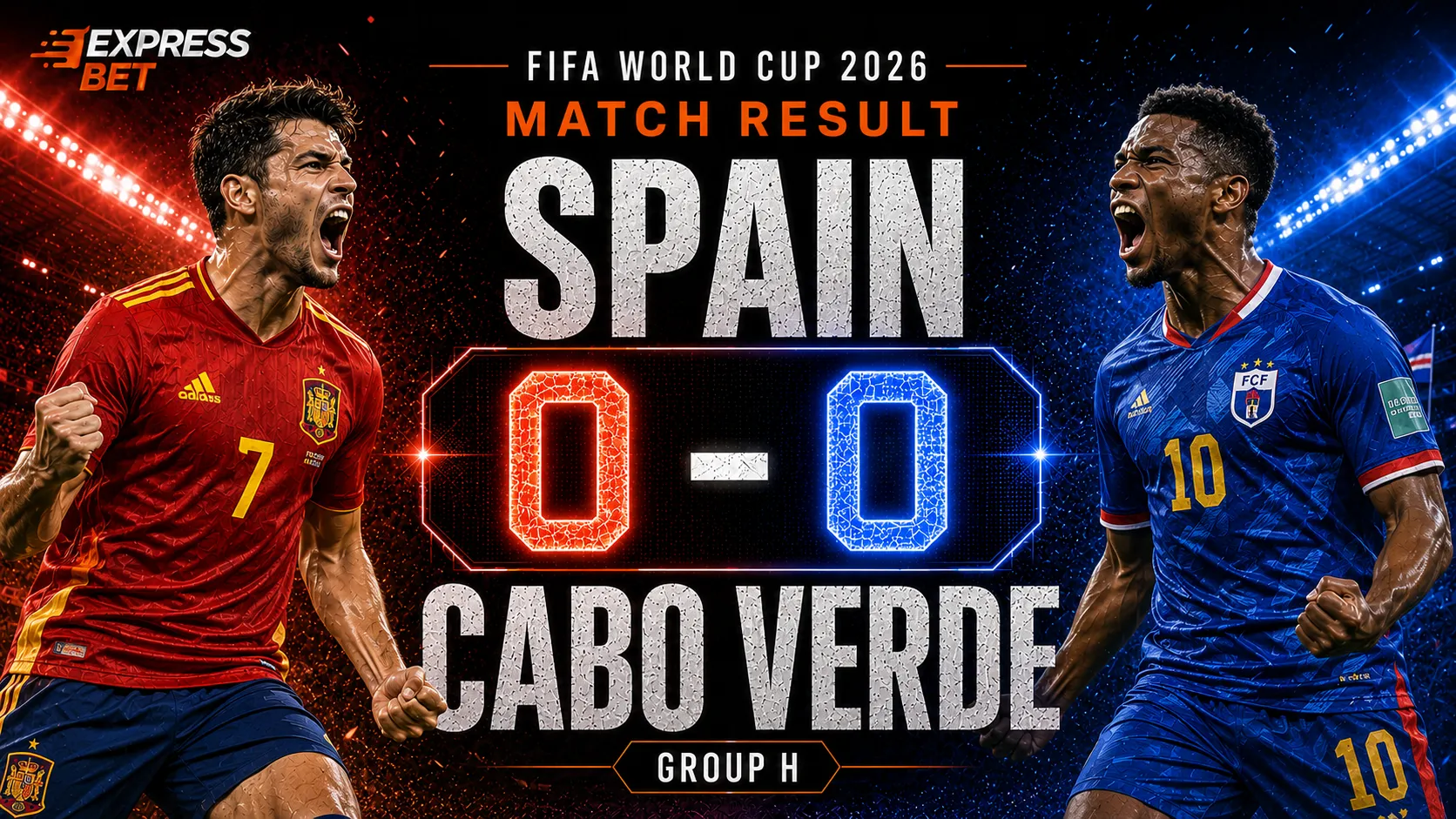
The Spain vs Cabo Verde match result was a 0-0 draw in their FIFA World Cup 2026 Group H opener at Atlanta Stadium. Spain dominated possession, produced 27 attempts, and forced repeated saves from 40-year-old goalkeeper Vozinha, but Cabo Verde’s deep defensive block survived everything. There were no goals, no penalties, and no red cards. Vozinha was the best player after a career-defining performance on Cabo Verde’s World Cup debut. The tactical story was simple: Spain controlled the ball, Cabo Verde controlled the penalty area. The result left all Group H teams level after Uruguay also drew with Saudi Arabia. Betting outcomes rewarded the draw, under 3.5 goals, and Cabo Verde handicap markets, depending on odds and market timing.
| Detail | Information |
|---|---|
| Match | Spain vs Cabo Verde |
| Competition | FIFA World Cup 2026 |
| Stage | Group stage |
| Group | Group H |
| Date | 15 June 2026 |
| Kickoff time | 12:00 p.m. local time / 17:59 UTC in FIFA report version |
| Host country | United States |
| City | Atlanta, Georgia |
| Stadium | Atlanta Stadium |
| Final score | Spain 0-0 Cabo Verde |
| Half-time score | Spain 0-0 Cabo Verde |
| Attendance | 67,640 |
| Referee | Adham Makhadmeh, Jordan |
| VAR | Joe Dickerson, United States |
| Assistant VAR | Khamis Al-Marri, Qatar |
| Support VAR | Fu Ming, China |
| Spain formation | 4-1-2-3 |
| Cabo Verde formation | FIFA tactical lineup: 4-1-2-3; some live graphics showed 4-2-3-1 |
| Weather | Around 24°C in Atlanta historical data; detailed match-weather conditions not confirmed in official report |
| Pitch condition | No major confirmed pitch controversy |
| Surface type | Not confirmed in the match report |
| Roof status | Not confirmed as a decisive match factor |
| Penalties | None |
| Red cards | None |
| Yellow cards | Spain 1, Cabo Verde 1 |
| VAR involvement | VAR assigned; no decisive goal or penalty reversal confirmed |
| Betting result | Draw; under 3.5 goals; both teams to score “No” |
Spain drew 0-0 with Cabo Verde, and the scoreline will be filed under “World Cup group-stage warning signs,” a folder Spain know better than they would like to admit.
This was supposed to be the manageable opener. Spain arrived as European champions, one of the tournament favourites, and a side full of technical quality. Cabo Verde arrived in their first World Cup match, representing a small island nation with a huge emotional burden and a goalkeeper old enough to have seen football’s tactical fashions come, go, and return under different names.
Then the match started, and Cabo Verde decided to remove the romance from Spanish possession.
Spain had the ball for almost the entire afternoon. FIFA’s official numbers gave Spain 73% possession, 27 attempts, seven on target, and 11 corners. Cabo Verde had 27% possession, six attempts, one on target, and one corner. The numbers look absurd until the scoreline reminds everyone that football still insists on counting goals, not intent.
Luis de la Fuente started with Unai Simón in goal, a back four of Marcos Llorente, Pau Cubarsí, Aymeric Laporte and Marc Cucurella, Rodri as captain and midfield anchor, Pedri and Fabián Ruiz ahead of him, and Gavi, Ferran Torres and Mikel Oyarzabal in the front line. Lamine Yamal and Nico Williams started on the bench. That decision became one of the match’s loudest post-match talking points, because when Spain fail to stretch a low block, everyone immediately asks why the best stretchers were initially wrapped in tracksuits.
Cabo Verde started with Vozinha in goal, Steven Moreira, Pico Lopes, Diney Borges and Sidny Lopes Cabral in the defensive structure, Kevin Pina, Laros Duarte and Jamiro Monteiro in midfield zones, and Jovane Cabral, Ryan Mendes and Dailon Livramento as the attacking line. The official tactical sheet listed a 4-1-2-3, but the match itself often looked like something closer to a 5-4-1 or 5-3-2 defensive emergency plan once Spain settled in possession.
That distinction matters. Cabo Verde were not interested in winning a formation diagram. They were interested in protecting the box. They did that almost obsessively.
Spain started with control but without incision. The early pattern was familiar: short passes, patient switches, Pedri receiving between lines, Rodri dictating, Cucurella and Llorente pushing into advanced areas, and Cabo Verde shifting from side to side. The ball moved. Cabo Verde moved with it. Spain waited for a crack. Cabo Verde refused to provide one politely.
The best Spanish moments came through quick deliveries and second balls. Pedri tested Vozinha. Ferran Torres hit the crossbar and then failed to convert a rebound sequence. Aymeric Laporte forced another save before half-time. Mikel Oyarzabal found himself in promising positions but could not bring the final touch under command.
After the break, the script remained the same, only more impatient. Spain had more territory. Cabo Verde had more bodies in front of Vozinha. Fabián Ruiz shot wildly from the edge of the box. Oyarzabal mistimed a header. Pedri kept probing. The introduction of Lamine Yamal and Mikel Merino in the 71st minute changed the mood and gave Spain sharper right-side threat, but not the goal.
By the final 20 minutes, this was no longer a football match. It was a siege with a scoreboard attached. Spain delivered, crossed, shot, recycled, and tried again. Cabo Verde blocked, headed, cleared, and trusted Vozinha. In stoppage time, Cabo Verde even had their own rare threat through Diney Borges and Ryan Mendes. Football likes to add small insults to large frustrations.
The final whistle gave Cabo Verde a historic point. It gave Spain a problem, not a disaster. Group H stayed completely open after Uruguay and Saudi Arabia later drew 1-1. But for Spain, the warning was clear. Dominating the ball against a compact block is not the same as beating it. They have learned this lesson before. Apparently it needed another lecture.
The match finished 0-0 because Spain controlled possession without consistently controlling the most valuable spaces.
That sentence is the match.
Spain had enough of the ball. They had enough shots. They had enough corners. They had enough famous players. They did not have enough clean finishing actions. Too many shots came through bodies, too many crosses arrived into crowded areas, and too many final touches lacked the coldness needed to turn pressure into punishment.
Cabo Verde did not produce an attacking masterclass. They did not need to. Their masterpiece was defensive spacing, emotional discipline, and goalkeeper authority. Vozinha stood behind the block like an old tournament cliché that suddenly became useful again: experienced goalkeeper, low block, favourite frustrated, everyone starts looking at the clock after 70 minutes.
Spain’s best first-half spell should have delivered a goal. Pedri’s shot was saved. Ferran Torres hit the bar. Oyarzabal’s rebound header was somehow kept out. Ferran then shot too tamely before half-time. Laporte’s header forced another important save. This was not sterile possession in the strictest sense. Spain did create chances. They just failed to finish them.
The second half was even more revealing. Cabo Verde tired, but they did not lose shape completely. Spain brought on Yamal and Merino. Later Dani Olmo and Nico Williams came in. The individual threat improved. The score did not. There is an entire category of Spanish tournament frustration that begins exactly this way: the ball is moving, the opponent is suffering, the goalkeeper is performing, and the scoreboard looks bored.
Cabo Verde also managed the match with unusual discipline. FIFA’s official data credited them with only one foul against. That is extraordinary for a team spending most of the match near its own penalty area. It means they defended mostly by positioning, not by panic.
Spain’s late push included more corners, a yellow card for Pedri, a Yamal shot, and a late Oyarzabal opportunity blocked before it could become the result. Cabo Verde survived because the defensive line stayed compact, the midfield remained narrow, and Vozinha kept catching, parrying, and clawing away whatever reached him.
A 0-0 draw usually invites lazy language about “one team parking the bus.” This was more precise than that. Cabo Verde parked the bus, checked the tyres, assigned a driver, and made Spain reverse around it for 99 minutes.
The first booking went to Sidny Lopes Cabral in the 16th minute. For a defender in a match like this, that should have been dangerous. Spain were going to keep attacking his zone, and one more mistimed challenge could have broken Cabo Verde’s entire plan.
Instead, Cabo Verde managed the risk well. Lopes Cabral stayed in the match until the 76th minute, when João Paulo replaced him. That was sensible game management. Defenders on yellow cards inside a low block are always living near trouble.
The first-half hydration break mattered because it gave Cabo Verde a useful pause.
Spain had been pressing the ball around Cabo Verde’s half, but the rhythm was not yet frantic. Cabo Verde used the break to reset distances and calm the first phase of pressure. Tournament football is now full of these small tactical timeouts. Nobody calls them timeouts because that would make the game feel too honest.
For Spain, the pause did not damage control. It did slow momentum. For Cabo Verde, that was useful.
This was the sequence where the goalkeeper became the story.
Pedri forced a save. Ferran Torres then hit the crossbar in one of Spain’s clearest chances. Oyarzabal had the rebound opportunity, and Vozinha somehow kept it out. It was the kind of sequence that changes the emotional weather of a match.
For Spain, it was evidence that the goal was coming. For Cabo Verde, it was evidence that survival was possible. The difference is small until the final whistle. Then it becomes everything.
Ferran had a good chance just before half-time. He shot too tamely, and Vozinha gathered.
That miss mattered because it came at the point when Spain needed the goal most. A breakthrough before half-time would have forced Cabo Verde out of the deepest version of their block. Instead, the debutants went into the dressing room level.
For an underdog, 0-0 at half-time against a heavyweight is not just a score. It is a psychological asset.
Spain’s last big first-half moment came from an Aymeric Laporte header after a Pedri corner. Vozinha again made the save.
This confirmed two things. Spain were dangerous from set pieces, and Cabo Verde’s goalkeeper was not going to donate the match. The halftime whistle came with Spain frustrated and Cabo Verde visibly encouraged.
Bubista made three changes in the 61st minute. Willy Semedo, Deroy Duarte and Nuno Da Costa came on for Jovane Cabral, Laros Duarte and Dailon Livramento.
This was a key intervention. Cabo Verde had spent an hour chasing shadows. They needed legs, not poetry. The substitutions helped them keep the distances intact through the worst part of Spain’s pressure.
Luis de la Fuente brought on Lamine Yamal and Mikel Merino for Gavi and Fabián Ruiz in the 71st minute.
This changed Spain’s attacking texture. Yamal gave them acceleration, width and one-on-one threat. Merino gave them another body arriving around the box. Spain looked sharper immediately, but the timing invited criticism. The obvious question came quickly: why wait 70 minutes?
That question will not go away.
Late in the match, provider data listed Vozinha with eight saves. FIFA’s official shot-on-target table listed Spain with seven attempts on target, so small provider variations exist. The football meaning is still clear. Vozinha made repeated decisive saves, and Spain could not beat him.
By this point, the match had become a goalkeeper’s monument.
Yamal slipped a sharp pass into Oyarzabal in the 88th minute. The chance was blocked before it became a clean finish.
This was Spain’s best late argument for the substitutions. Yamal created the kind of moment Spain had lacked for most of the match: quick, direct, inside the box, before the block could fully reset. But Cabo Verde still got a body in the way.
Cabo Verde’s only official shot on target came very late through Diney Borges. It did not become the impossible winner, but it added a final warning to Spain.
There is nothing more dangerous for a dominant team than spending 90 minutes failing to score and then watching the underdog finally take aim. Spain survived that moment. They did not survive the embarrassment of the draw.
Spain’s first half was dominant in territory but uneven in chance conversion.
The 4-1-2-3 structure placed Rodri as the single pivot, Pedri and Fabián Ruiz ahead of him, and Gavi, Ferran Torres and Oyarzabal in the front line. Cucurella and Llorente pushed forward from full-back areas. Cubarsí and Laporte stayed high to keep Cabo Verde locked in.
The build-up was clean. That was never the problem. Spain could move from centre-back to midfield, switch through Rodri, and find Pedri between lines. The issue came after the second or third pass into the final third. Cabo Verde’s block narrowed, the channels disappeared, and Spain had to recycle.
Cabo Verde defended with the discipline of a team that understood the only statistic that mattered. They let Spain have the ball in front of them. They protected the six-yard box. They dropped midfielders into the defensive line when needed. Ryan Mendes and Livramento had little attacking service, but they gave enough work to slow Spain’s rest defence.
The main individual duel was Spain against Vozinha. That sounds lazy, but it was accurate. Ferran, Pedri, Laporte and Oyarzabal all had moments. Vozinha answered them.
Spain’s wide play was odd. Gavi offered intensity and pressing, but not natural winger width. Ferran worked into scoring areas but lacked ruthlessness. Oyarzabal was too disconnected early; one public stat noted he barely touched the ball in the opening half-hour. That is not how a striker breaks a low block.
Pedri was Spain’s best creative player in the first half. He received in pockets, disguised passes and took responsibility. Fabián Ruiz arrived around the edge of the box but lacked accuracy. Rodri controlled the tempo, though Cabo Verde were happy enough to let him have the first pass.
Cabo Verde’s attacking play was limited. They tried occasional breaks through Cabral, Livramento and Ryan Mendes, but those moves usually died quickly. The goal was not to create a balanced match. The goal was to keep the match alive. That distinction matters.
At half-time, Spain had enough chances to be ahead. Cabo Verde had enough discipline to claim the draw was not luck alone. De la Fuente had to add speed. Bubista had to preserve legs. Only one of those requirements was handled early.
The second half was Spain’s long argument with the inevitable-looking but never-arriving goal.
Spain resumed control immediately. Fabián Ruiz had shots from the edge of the box. Oyarzabal mistimed a close-range header. Pedri kept drifting into the inside-left pocket. Cucurella kept arriving high. Llorente offered width on the right, though not always with enough disguise in his delivery.
Cabo Verde’s line dropped deeper after the break. This was partly tactical and partly physical. Defending Spain for 45 minutes is expensive. Defending Spain for 99 minutes is a utility bill nobody wants to receive.
Bubista acted first. The triple change at 61 minutes brought on Willy Semedo, Deroy Duarte and Nuno Da Costa. Cabo Verde needed fresh legs in midfield and attack, especially because the first-choice forward runners were no longer able to relieve pressure consistently.
Spain waited until the 71st minute for the major move. Yamal and Merino came on. Yamal’s first few touches changed the crowd and the game state. He attacked defenders. He created one-v-one panic. He forced Cabo Verde to double up on the right. Suddenly the low block had to turn rather than just slide.
Merino gave Spain another box-arriving midfielder. His shot on target in the 73rd minute added immediate threat. But Spain still lacked the final finish. A team can add better tools and still fail to build the house.
Dani Olmo replaced Ferran Torres in the 81st minute. Nico Williams replaced Rodri in the 87th, with Oyarzabal taking the captain’s armband. That was Spain’s final attacking gamble. It made sense in the scoreline but also showed how late the urgency had become.
The final minutes were chaotic without being truly wild. Yamal took corners. Pedri shot and was later booked in the 90+3rd minute. Oyarzabal had a late chance blocked. Cabo Verde had a corner through Telmo Arcanjo and a late shot on target through Borges. Ryan Mendes also took a late shot.
The match ended as it had lived: Spain near the opposition box, Cabo Verde refusing to give them the one clean action that would change everything.
The second half revealed both Spain’s strength and flaw. They can suffocate teams. They can dominate territory. But if the wingers are not stretching from the start and the striker is not involved early, the possession can become ornate frustration.
Cabo Verde, meanwhile, showed that a debutant can defend with adult seriousness. They did not simply survive through chaos. They survived through structure, substitutions, and one outstanding goalkeeper.
This was a formation-versus-function match.
On paper, FIFA’s tactical sheet listed both teams in 4-1-2-3. In practice, Spain attacked as something close to a 2-3-5 or 3-2-5 depending on full-back positioning, while Cabo Verde defended in a deep compact block that often looked like a 5-4-1.
Spain’s structure was familiar. Rodri controlled the base. Pedri and Fabián Ruiz worked ahead of him. Cucurella moved high on the left. Llorente advanced on the right. Gavi tucked in from one side, Ferran moved across the front, and Oyarzabal tried to occupy centre-backs.
That gave Spain control of the ball but not always width at the right moment. Starting without Yamal and Williams removed the most obvious one-v-one threats. Gavi is valuable, but he is not a touchline isolator. Ferran can score, but he does not consistently force two defenders to follow him outside. Cabo Verde benefited from that.
Bubista’s side defended with a narrow central priority. The centre-backs stayed close. Kevin Pina screened in front. Laros Duarte and Monteiro helped lock the middle. The wide players dropped into the line when needed. When Spain crossed, Cabo Verde attacked the first contact or forced the ball toward Vozinha.
The pressing trigger for Cabo Verde was limited. They did not chase Spain high. They pressed only when Spain played backward toward the centre-backs or when a loose touch appeared near the touchline. This was sensible. A high press against Spain can become a public exercise in being passed around.
Spain’s pressing after losses was strong. Cabo Verde rarely built sustained counters because Spain’s counterpress arrived quickly. Cubarsí and Laporte held the halfway line. Rodri collected loose balls. Pedri and Gavi reacted quickly. This is why Cabo Verde produced only one shot on target.
But Spain’s own attacking pattern lacked enough vertical breaks. Too many possessions went outside, inside, outside, cross, block, recycle. Cabo Verde were comfortable with that rhythm. They were less comfortable when Yamal entered because he forced defenders to turn their hips. That is often the real test of a low block: can you make it run backward, not sideways?
The match therefore ended level because both teams executed only half of what they needed. Spain controlled everything except finishing. Cabo Verde controlled almost nothing except the areas that mattered most.
That is tournament football in its oldest form.
Unai Simón — 6/10
Almost unemployed for long stretches. Faced one official shot on target late and handled the limited danger. Distribution was steady.
Marcos Llorente — 6/10
Provided width on the right and kept Spain high up the pitch. His crossing and final decisions were not sharp enough to break the block.
Pau Cubarsí — 6.5/10
Calm in possession and helped Spain keep Cabo Verde pinned in. Had little defensive work, but his passing kept Spain’s structure stable.
Aymeric Laporte — 7/10
One of Spain’s better performers. Had two attempts, including a header saved before half-time. Defended calmly when Cabo Verde broke.
Marc Cucurella — 6.5/10
Got into advanced positions and had a shot on target. He helped stretch the left, though his final ball did not consistently damage Cabo Verde.
Rodri — 6.5/10
Controlled tempo and recycled possession. Spain had enormous control, but his passing rhythm did not create enough central ruptures. Substituted late as Spain chased.
Pedri — 7.5/10
Spain’s best outfield player. Two shots on target, 77 passes in FOX key-player data, and repeated attempts to find gaps. Booked late for a serious foul.
Fabián Ruiz — 5.5/10
Had five attempts, only one on target. Found good shooting positions but wasted too many. Replaced by Merino.
Gavi — 5.5/10
Worked hard and pressed well, but starting him wide reduced Spain’s natural stretch. Replaced by Yamal in the 71st minute.
Ferran Torres — 4.5/10
Four attempts, one on target, one crossbar, and one major tame finish before half-time. Spain needed him to be colder.
Mikel Oyarzabal — 5/10
Had five attempts, only one on target. Poor early involvement and several mistimed actions. Better after Yamal entered, but still not decisive.
Mikel Merino — 6.5/10
Came on in the 71st minute and immediately added box presence. Forced a save and gave Spain a better aerial and second-ball threat.
Lamine Yamal — 7/10
Changed Spain’s attacking threat after entering. Two shots, several dangerous actions, and the pass that created a late Oyarzabal chance. Should probably have appeared earlier.
Dani Olmo — 6/10
Added technique in tight areas after coming on but could not find the decisive pass or finish.
Nico Williams — 6/10
Entered late. Gave speed but had too little time to change the match.
Vozinha — 9.5/10
The match’s defining player. Repeated saves, clean sheet, command of the box, emotional authority. A career night.
Steven Moreira — 7/10
Disciplined on the right side of defence. Rarely ventured forward but helped keep Spain’s left-side attacks crowded.
Pico Lopes — 8/10
Excellent central defensive performance. Headed, blocked and maintained compactness under constant pressure.
Diney Borges — 8/10
Defended strongly and had Cabo Verde’s only shot on target late. A huge performance on a night mostly spent under pressure.
Sidny Lopes Cabral — 6.5/10
Booked in the 16th minute, then managed the rest of his match intelligently before being replaced in the 76th.
Kevin Pina — 7.5/10
A crucial screen in front of the defence. His positioning helped keep Spain from passing directly into the striker zone.
Laros Duarte — 6.5/10
Worked hard in midfield and helped maintain the first-half structure. Replaced in the 61st minute as legs became an issue.
Jamiro Monteiro — 6.5/10
Covered central lanes and helped Cabo Verde survive pressure. Replaced by Telmo Arcanjo in the 79th.
Jovane Cabral — 6/10
Limited attacking service but worked defensively. Replaced in the 61st minute.
Ryan Mendes — 6.5/10
Captain’s shift. Had a late shot and gave Cabo Verde a forward reference, though he spent most of the match defending.
Dailon Livramento — 6/10
Carried some counterattacking hope early but could not sustain threat. Replaced in the 61st minute.
Willy Semedo — 6.5/10
Added legs after entering. Helped Cabo Verde preserve the block during Spain’s late pressure.
Deroy Duarte — 6.5/10
Useful substitute. Worked hard across midfield and helped close gaps.
Nuno Da Costa — 6.5/10
Gave fresh forward energy and helped Cabo Verde avoid being completely trapped late.
João Paulo — 6/10
Replaced the booked Sidny Lopes Cabral and helped the defensive left side survive the final phase.
Telmo Arcanjo — 6/10
Took a late corner and added fresh defensive work. Limited attacking opportunity.
Man of the Match: Vozinha
No debate. He was the reason Cabo Verde got the point. Spain had seven official shots on target and repeated dangerous moments. Vozinha gave them nothing.
Best attacker: Lamine Yamal
He played only the final stretch but immediately changed Spain’s threat. That says something about the game plan and something about his quality.
Best midfielder: Pedri
Pedri was Spain’s most intelligent passer and most persistent creator. He did everything except produce the one decisive action.
Best defender: Pico Lopes
Pico Lopes anchored Cabo Verde’s central resistance. He defended the box like a man who understood that one lost duel would become a national headline.
Best goalkeeper: Vozinha
The easiest category of the article. A clean sheet against Spain in a World Cup debut is enough.
Best substitute: Lamine Yamal
Yamal’s late introduction changed the pitch geometry. Cabo Verde had to defend him differently from Spain’s starting wide players.
Most underrated performance: Kevin Pina
Pina’s screening role was essential. The centre-backs got many of the clearances, but Pina helped prevent central passes from becoming clean shots.
Most disappointing performance: Ferran Torres
He had chances and failed to take them. In a 0-0 match, that matters more than movement charts.
There were no red cards and no confirmed injuries that shaped the result.
The yellow cards went to Sidny Lopes Cabral in the 16th minute and Pedri in the 90+3rd minute. Cabo Verde managed Lopes Cabral’s booking well, eventually replacing him with João Paulo in the 76th minute. Spain’s late yellow for Pedri reflected frustration more than tactical necessity.
No player was suspended directly by this match. Card accumulation remains relevant in the group, especially because Group H looks tight after both opening games ended level.
The most striking discipline statistic was Cabo Verde’s foul count. FIFA credited them with only one foul against. Reuters described it as the fewest by any team in a World Cup match since 1966. That is an extraordinary detail for a side defending most of the match. It underlines how well-positioned they were.
Spain committed 10 fouls, which tells a different story. The dominant team had the ball, but when Cabo Verde did break, Spain stopped rhythm quickly. Nothing here was violent. It was tournament management.
Adham Makhadmeh had a match with very little major controversy.
There were no penalties. No red cards. No disallowed goals. VAR Joe Dickerson was assigned, with assistant VAR support, but no decisive review changed the result.
The referee’s main challenge was managing a match with one team attacking constantly and the other defending inside its own half. Those games can become awkward if every contact near the box turns into a complaint. Makhadmeh kept the match relatively clean.
The two yellow cards were straightforward enough. Sidny Lopes Cabral’s early booking created risk for Cabo Verde. Pedri’s late booking came as Spain’s frustration rose. There was no serious disciplinary escalation.
Added time was four minutes in the first half and five in the second. Spain used that time to create more pressure. Cabo Verde used it to survive and even threaten once. The referee did not decide this match. Spain’s finishing and Vozinha’s hands did.
The match was played at Atlanta Stadium in the United States, with 67,640 in attendance.
Historical weather data for Atlanta on 15 June showed temperatures around 24°C, with the daily range roughly between 22°C and 27°C. The official match report did not confirm detailed match-weather conditions such as humidity, rain, wind, sun angle, or roof operation.
The match included a hydration break in the first half, which suggests physical conditions were relevant enough for player management. It also gave Cabo Verde a useful reset during Spain’s early control.
No major pitch controversy was confirmed. There was no reliable indication that the surface created unusual slips, ball movement, or visibility problems. Spain moved the ball quickly enough. Cabo Verde defended the box cleanly enough. The result was not about the grass.
The stadium atmosphere mattered more than the surface. Atlanta hosted a strange football spectacle: one of the tournament favourites spending the afternoon trying to unlock a debutant that refused to behave like a debutant.
Spain had the larger expectation in the building. Cabo Verde had the more memorable celebration.
That is often how World Cup shocks work. The favourite brings noise before the match. The underdog earns it at the end.
The Spanish crowd grew restless after the hour. The introduction of Yamal brought a clear lift. Every touch from him seemed to ask why he had not been introduced earlier. That is a dangerous sound for a coach: not just applause, but implied criticism.
Cabo Verde’s supporters lived through the match differently. Every clearance became a small victory. Every Vozinha save became part of a national memory. At full-time, the emotion was obvious. The players knew what the point meant.
This did not feel like a neutral 0-0. It felt like one team losing two points and another nation winning its first World Cup argument.
Spain have been here before.
The obvious recent echo is Spain’s 2022 World Cup exit against Morocco. That match also involved possession, a defensive wall, growing impatience, and the uncomfortable discovery that ball circulation does not count as penetration. This was not the same match. It did, however, rhyme.
Spain also opened their 2010 World Cup with a defeat to Switzerland and then won the tournament. That historical comfort will be mentioned often. It is relevant, but only in the broadest sense. History can reassure. It cannot finish chances for Ferran Torres.
For Cabo Verde, this was entirely new territory. Their first World Cup match ended with a point against Spain. That is not just a good result. It is a national football foundation stone.
The size of Cabo Verde’s achievement matters. Spain are a former world champion, the reigning European champion, and one of the tournament’s technical benchmarks. Cabo Verde arrived as debutants and left with a clean sheet.
This was not a win, but it belongs in the family of World Cup results where the draw feels like victory for one side and evidence of malfunction for the other.
| Statistic | Spain | Cabo Verde |
|---|---|---|
| Final score | 0 | 0 |
| Half-time score | 0 | 0 |
| Ball possession | 73% | 27% |
| Attempts at goal | 27 | 6 |
| Shots on target | 7 | 1 |
| Blocked attempts | 6 | 1 |
| Fouls against | 10 | 1 |
| Corners | 11 | 1 |
| Direct free kicks | 1 | 10 |
| Indirect free kicks | 3 | 2 |
| Penalties | 0/0 | 0/0 |
| Offsides | 2 | 3 |
| Own goals | 0 | 0 |
| Yellow cards | 1 | 1 |
| Red cards | 0 | 0 |
The numbers are almost comical until they become analytical.
Spain dominated every normal attacking category. More possession. More shots. More corners. More shots on target. More territory. They did not dominate the one line that mattered.
Cabo Verde’s one-foul total is remarkable. It shows discipline rather than luck. They were not constantly hacking Spain down. They were defending spaces early enough to avoid fouling late.
The 11-1 corner count also tells the story. Spain repeatedly forced the ball into wide and blocked areas. Cabo Verde accepted those corners and defended them well. Corners are pressure. They are not goals.
The shot count shows Spain created enough to win. The scoreline shows they did not execute. This is the old problem with dominance metrics. They explain control. They do not guarantee punishment.
The Spain vs Cabo Verde betting result punished casual favourite logic.
Spain were the clear favourite in most pre-match markets. That was natural. They had the stronger squad, the European title, the deeper attacking bench and the tournament pedigree. But the standard three-way match-winner market did not reward Spain backers. The draw landed.
In two-way “team to win” markets where draw means no winner, some providers treated the result as a push. In standard football betting, Spain win lost, Cabo Verde win lost, and draw won.
The over/under market was cleaner. FOX listed the total at 3.5. The match produced zero goals, so under 3.5 landed easily. Under 2.5 and under 1.5 also landed where available.
Both teams to score “No” landed. Spain did not score. Cabo Verde did not score. Clean-sheet markets on both sides landed, though the Cabo Verde clean sheet was the premium angle.
Correct score 0-0 landed. That is always a high-risk market, but it made tactical sense once Cabo Verde’s block survived the first half and Spain’s frustration grew.
First goalscorer markets were void or lost depending on sportsbook rules, because no player scored. Anytime goalscorer markets on Spain’s forwards failed. Ferran Torres, Oyarzabal, Pedri, Yamal and others all had attempts without a goal.
Corners markets likely rewarded Spain corner volume, with 11 Spanish corners. Cards markets were quiet, with only two total yellow cards. Penalty-awarded markets failed because there were no penalties.
The live-betting lesson is blunt. Heavy possession does not equal betting security. After 30 minutes, the market would still have leaned toward Spain because pressure was obvious. But the longer the match stayed 0-0, the draw price became more realistic. Vozinha’s saves were not just football moments. They were market signals.
This does not mean “always back the underdog block.” That is lazy. It means price must account for defensive structure, goalkeeper form, lineup choices and the favourite’s chance quality. Spain had chances, but not enough finishing clarity. Cabo Verde had very little attack, but their defensive organisation was not fake.
No betting outcome is guaranteed. Odds move before and during matches. One early finish by Ferran or Oyarzabal would have destroyed the draw narrative. It did not happen. That is why the market exists.
Group H is completely open after the first round.
Spain drew 0-0 with Cabo Verde. Uruguay drew 1-1 with Saudi Arabia later the same day. That left all four teams on one point.
Spain next face Saudi Arabia. That match has become more important than expected. A win would restore control. A draw would create pressure before the final group match against Uruguay. A defeat would turn the group into a problem Spain did not intend to have.
Cabo Verde next face Uruguay in Miami. That is now a real opportunity rather than a free hit. A draw would keep them alive. A win would make them one of the stories of the tournament. Even a narrow defeat would not erase the value of the Spain point, but goal difference must be protected.
The expanded 48-team format gives some third-placed teams a route into the Round of 32. That matters for Cabo Verde. One point against Spain is a serious start if they can collect something from Uruguay or Saudi Arabia.
Spain will still expect to qualify. They should. But expectation is not a tiebreaker. Goals are.
Spain controlled the match almost completely.
Their counterpress was strong. Cabo Verde rarely escaped cleanly. Rodri, Pedri and Fabián kept the ball moving. Laporte and Cubarsí held a high defensive line. Cucurella and Llorente pushed forward and gave territorial dominance.
Spain also created chances. This was not a match with no attacking output. The problem was conversion. Ferran hit the bar. Oyarzabal had chances. Pedri tested Vozinha. Laporte forced a save.
The late introduction of Yamal improved the attack. His dribbling stretched Cabo Verde and created the kind of defensive panic Spain had lacked earlier.
Spain also avoided defensive chaos. Cabo Verde’s late threat aside, Unai Simón had almost nothing to do.
The issue is that all of this adds up to a draw. In tournament football, doing many things right and missing the main thing is still enough to lose two points.
Cabo Verde did not get much wrong relative to their task.
They offered little in attack. That is the obvious criticism. Six shots and one on target means they did not give themselves much chance to win. Ryan Mendes and Livramento were often isolated. Cabo Verde’s first pass out of pressure was frequently rushed.
They also relied heavily on Vozinha. That is not sustainable over three group matches. A goalkeeper can produce one heroic night. Planning for three is optimism with gloves.
Their possession was limited, and they could not hold the ball for long spells. Against Uruguay or Saudi Arabia, they may need more attacking ambition. A point against Spain is excellent, but three 0-0 ambitions rarely survive a World Cup group.
Still, the negatives are modest. Cabo Verde came for structure, discipline and survival. They achieved all three.
De la Fuente will face obvious questions.
The starting XI gave Spain control but not enough natural width. Leaving Yamal and Nico Williams on the bench made sense only if Spain scored early with the selected structure. They did not. Once the match became a low-block puzzle, Spain needed wide dribblers sooner.
His first major attacking change came in the 71st minute. That felt late. Yamal immediately changed the game. Merino also added threat. Olmo and Williams came later, but by then Cabo Verde were emotionally committed to survival.
The criticism is not that Spain played badly. They did not. The criticism is that Spain waited too long to change the type of problem they were posing.
De la Fuente must decide whether to start Yamal and Williams against Saudi Arabia. This match gave a clear answer. Coaches sometimes prefer slower conclusions.
Bubista got the match right.
Cabo Verde were compact, patient and disciplined. They conceded territory but protected the box. They did not foul recklessly. They refreshed the team at the right moment with a triple substitution after the hour.
The shape was flexible. Officially it may have been listed as a 4-1-2-3, but out of possession it became a deep defensive block with extra bodies in the last line. That is practical coaching. The point was not to look brave on a tactical graphic. The point was to leave with something.
Bubista’s biggest success was emotional control. Cabo Verde did not panic after early Spanish pressure. They did not fall apart after repeated saves. They believed the match could stay 0-0, and that belief became the result.
Against Uruguay, he will need more ball retention. But this was a superb tournament opening plan.
Cabo Verde earned their first ever World Cup point in their first ever World Cup match. That is the major milestone.
Vozinha, at 40, became one of the early individual stories of the tournament with a Player of the Match performance and a clean sheet against Spain.
Cabo Verde’s one-foul total was reported as the fewest by any team in a World Cup match since records began in 1966. That is a remarkable defensive statistic.
Spain’s result carried echoes of past tournament frustration, but no specific new Spanish scoring record was confirmed in the official match data used here.
There were no verified youngest scorer, oldest scorer, penalty record, red-card record or national scoring milestone from the match because nobody scored.
There was no major VAR controversy.
No goal was disallowed. No penalty was awarded. No red card was shown. There was no confirmed crowd incident, pitch invasion or post-match confrontation that shaped the result.
The only real controversy was selection. De la Fuente’s choice to start Yamal and Williams on the bench became a fair topic because Spain lacked one-v-one threat for most of the match.
There was also the broader emotional story around Vozinha, who left the pitch in tears after his Player of the Match performance. That was not controversy. It was the human part of a result that the tactical board cannot fully explain.
Spain vs Cabo Verde finished 0-0 because Cabo Verde defended the box better than Spain attacked it.
That is the clean verdict.
Spain dominated possession, attempts and corners. They had enough chances to win. Ferran Torres, Mikel Oyarzabal, Pedri, Fabián Ruiz and Aymeric Laporte all had moments. None became a goal.
Cabo Verde were disciplined, brave and sometimes stretched to the edge of collapse. Vozinha kept them upright. The centre-backs protected him. Kevin Pina screened intelligently. Bubista’s substitutions kept the legs alive.
The scoreline was harsh on Spain if judged by volume. It was fair if judged by execution. Spain did not finish. Cabo Verde did defend.
For Spain, the draw is not a disaster, but it does make the Saudi Arabia match more serious. For Cabo Verde, the draw changes the entire feeling of the group. They are not just debutants anymore. They are a team with a point against Spain.
For bettors, the match rewarded draw backers, under bettors, both-teams-to-score “No,” Cabo Verde handicap markets and 0-0 correct-score tickets. It punished blind trust in the favourite and reminded everyone that possession is not a payout.
The final image is Vozinha in tears, Spain in disbelief, and the scoreboard refusing to apologise. The World Cup does this every few days. Somehow the favourite always looks surprised.
Football betting carries financial risk. A correct match analysis does not guarantee a winning bet. Odds change before and during matches. Never chase losses. Do not bet money needed for daily life. Use limits and take breaks. Check local betting laws before gambling. Betting should remain entertainment, not income.
Spain drew 0-0 with Cabo Verde in their FIFA World Cup 2026 Group H opener.
No player scored. The match finished goalless.
Vozinha was the best player. The Cabo Verde goalkeeper made repeated saves and kept a clean sheet against one of the tournament favourites.
All four teams in Group H moved to one point after Spain drew with Cabo Verde and Uruguay drew with Saudi Arabia. Spain next face Saudi Arabia, while Cabo Verde face Uruguay.
The draw landed in standard three-way markets. Under 3.5 goals landed. Both teams to score “No” landed. Spain win bets failed, while some two-way team-to-win markets were graded as a push depending on sportsbook rules.
[expert_review params=»JTdCJTIyY29sb3IlMjIlM0ElMjJncmVlbi0yJTIyJTJDJTIyZXhwZXJ0X2F2YXRhciUyMiUzQSUyMiUyMiUyQyUyMmV4cGVydF9uYW1lJTIyJTNBJTIyJTIyJTJDJTIyZXhwZXJ0X2xpbmslMjIlM0ElMjIlMjIlMkMlMjJleHBlcnRfaWQlMjIlM0ElMjIxJTIyJTJDJTIyZXhwZXJ0X3R5cGUlMjIlM0ElMjJleHBlcnRfaWQlMjIlMkMlMjJleHBlcnRfYXZhdGFyX2FsdCUyMiUzQSUyMiUyMiUyQyUyMmV4cGVydF9zaG93JTIyJTNBMSUyQyUyMmV4cGVydF9kZXNjcmlwdGlvbiUyMiUzQSUyMlNwb3J0cyUyMEJldHRpbmclMjBBbmFseXN0JTIwJTI2JTIwRWRpdG9yaWFsJTIwQ29udHJpYnV0b3IlMjIlMkMlMjJleHBlcnRfc2hvd19idXR0b24lMjIlM0ExJTJDJTIyZXhwZXJ0X3Nob3dfYnV0dG9uX3R5cGUlMjIlM0ElMjJwb3B1cCUyMiUyQyUyMmV4cGVydF9xdWVzdGlvbl9idXR0b25fdGV4dCUyMiUzQSUyMkFzayUyMFF1ZXN0aW9uJTIyJTJDJTIycXVlc3Rpb25fZXh0ZXJuYWxfbGluayUyMiUzQSUyMiUyMiUyQyUyMnBvcHVwX3VzZV9waG9uZSUyMiUzQTAlMkMlMjJleHBlcnRfdGl0bGUlMjIlM0ElMjJBdXRob3IlMjIlMkMlMjJleHBlcnRfc2hvd190aXRsZSUyMiUzQTElMkMlMjJleHBlcnRfdGV4dCUyMiUzQSUyMkFsZXglMjBNb3JnYW4lMjBpcyUyMGElMjBzcG9ydHMlMjBiZXR0aW5nJTIwYW5hbHlzdCUyMGFuZCUyMGVkaXRvcmlhbCUyMGNvbnRyaWJ1dG9yJTIwd2hvJTIwd3JpdGVzJTIwZGV0YWlsZWQlMjBib29rbWFrZXIlMjByZXZpZXdzJTJDJTIwYmV0dGluZyUyMGd1aWRlcyUyQyUyMHBsYXRmb3JtJTIwY29tcGFyaXNvbnMlMkMlMjBhbmQlMjByZXNwb25zaWJsZSUyMGdhbWJsaW5nJTIwZXhwbGFpbmVycy4lMjBIaXMlMjB3b3JrJTIwZm9jdXNlcyUyMG9uJTIwcHJhY3RpY2FsJTIwaW5mb3JtYXRpb24lMjBmb3IlMjB1c2VycyUyMHdobyUyMHdhbnQlMjB0byUyMHVuZGVyc3RhbmQlMjBob3clMjBiZXR0aW5nJTIwc2l0ZXMlMjBvcGVyYXRlJTIwYmVmb3JlJTIwdGhleSUyMHJlZ2lzdGVyJTJDJTIwZGVwb3NpdCUyQyUyMG9yJTIwY2xhaW0lMjBhJTIwYm9udXMuJTIyJTJDJTIycWElMjIlM0ElNUIlNUQlMkMlMjJxYV9zaG93X3RpdGxlJTIyJTNBMSUyQyUyMnFhX3RpdGxlJTIyJTNBJTIyJUQwJTkyJUQwJUJFJUQwJUJGJUQxJTgwJUQwJUJFJUQxJTgxJTIwJUQxJThEJUQwJUJBJUQxJTgxJUQwJUJGJUQwJUI1JUQxJTgwJUQxJTgyJUQxJTgzJTIyJTJDJTIyc2NvcmUlMjIlM0ElNUIlNUQlMkMlMjJzY29yZV9zdW1tYXJ5X3RleHQlMjIlM0ElMjIlMjIlMkMlMjJzY29yZV9zdW1tYXJ5X2F2ZXJhZ2UlMjIlM0EwJTJDJTIyc2NvcmVfbWF4JTIyJTNBJTIyNSUyMiUyQyUyMnNjb3JlX3N5bWJvbCUyMiUzQSUyMiUyMiUyQyUyMnNjb3JlX3RpdGxlJTIyJTNBJTIyJTIyJTJDJTIyc2NvcmVfc2hvd190aXRsZSUyMiUzQTAlMkMlMjJwbHVzZXMlMjIlM0ElNUIlNUQlMkMlMjJtaW51c2VzJTIyJTNBJTVCJTVEJTJDJTIycGx1c2VzX21pbnVzZXNfc2hvd190aXRsZSUyMiUzQTElMkMlMjJwbHVzZXNfbWludXNlc190aXRsZSUyMiUzQSUyMiVEMCU5RiVEMCVCQiVEMSU4RSVEMSU4MSVEMSU4QiUyMCVEMCVCOCUyMCVEMCVCQyVEMCVCOCVEMCVCRCVEMSU4MyVEMSU4MSVEMSU4QiUyMiUyQyUyMnBsdXNlc190aXRsZSUyMiUzQSUyMiUyMiUyQyUyMm1pbnVzZXNfdGl0bGUlMjIlM0ElMjIlMjIlN0Q=»]