
Türkiye vs USA Match Result
Table of Contents Show
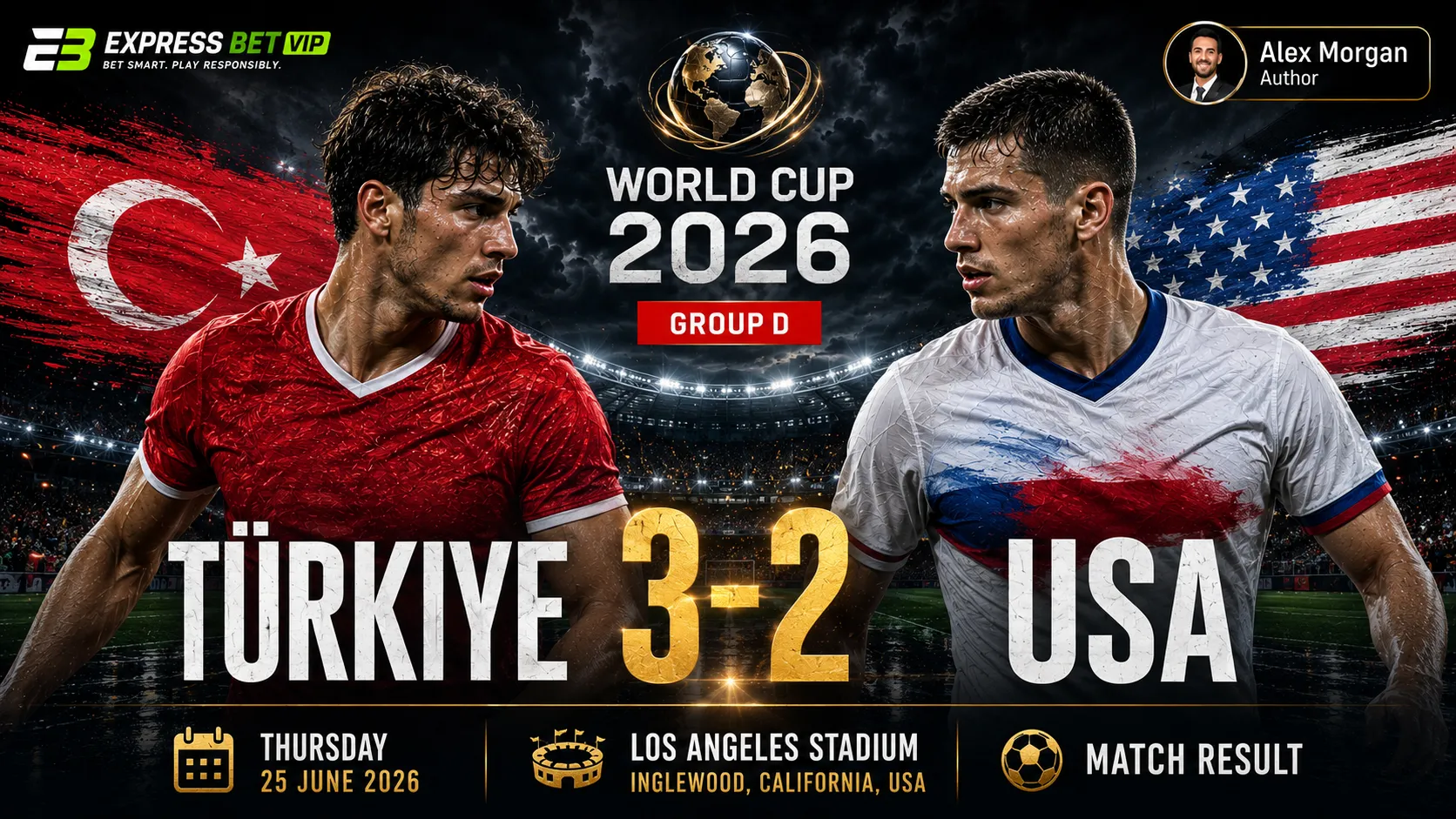
Türkiye beat USA 3-2 at Los Angeles Stadium after Kaan Ayhan scored with the final attack in the 98th minute. Auston Trusty put the Americans ahead after 134 seconds, but Arda Güler equalised before FIFA-recorded scorer Barış Alper Yılmaz gave Türkiye a 2-1 half-time lead. Sebastian Berhalter levelled shortly after the restart. Ayhan then converted Can Uzun’s late delivery after a deflection inside the six-yard box. Arda Güler was the central creative influence, while Uğurcan Çakır’s five saves prevented USA from turning 18 shots into a winning margin. Türkiye created fewer attempts but won the Opta xG comparison 2.71 to 2.06. The covered, warm Los Angeles venue produced no clear weather or surface distortion. Türkiye’s moneyline and over 2.5 goals landed, subject to the operator and timing of the wager. USA still won Group D; Türkiye were eliminated.
| Item | Verified detail |
|---|---|
| Match | Türkiye vs USA |
| Competition | FIFA World Cup 2026 |
| Stage | Group stage, Matchday 3 |
| Group | Group D |
| Date | June 25, 2026 local time |
| Kickoff | 19:00 PDT / 02:00 UTC on June 26 |
| Host country | United States |
| City | Inglewood, California |
| Stadium | Los Angeles Stadium |
| Regular name | SoFi Stadium |
| Attendance | 70,492 |
| Final score | Türkiye 3-2 USA |
| Half-time score | Türkiye 2-1 USA |
| USA scorers | Auston Trusty 3’, Sebastian Berhalter 49’ |
| Türkiye scorers | Arda Güler 10’, Barış Alper Yılmaz 31’, Kaan Ayhan 90+8’ |
| Referee | Mustapha Ghorbal |
| VAR | Antonio García, supported by Mahmoud Ashour and Juan Lara |
| Weather | Warm evening; exact readings unavailable |
| Pitch | Temporary natural-grass World Cup surface |
| Roof | Fixed translucent ETFE canopy |
| Main impact | USA won Group D; Türkiye finished fourth and were eliminated |
FIFA confirmed the result and official scoring attribution. U.S. Soccer supplied the lineups, officials, attendance-linked match data and detailed statistical totals. FIFA listed the tournament capacity at 70,492. (FIFA)
| Category | Information |
|---|---|
| [CONFIRMED] | Türkiye won 3-2 after leading 2-1 at half-time. |
| [CONFIRMED] | Trusty, Güler, Berhalter and Ayhan scored. |
| [CONFIRMED] | FIFA credits Türkiye’s 31st-minute goal to Barış Alper Yılmaz. |
| [DISPUTED] | U.S. Soccer credits the 31st-minute goal to Orkun Kökçü. |
| [CONFIRMED] | USA attempted 18 shots to Türkiye’s nine. |
| [CONFIRMED] | Türkiye led Opta xG 2.71 to 2.06. |
| [OBSERVED] | USA’s rotated defence struggled when Türkiye attacked the spaces around its full-backs. |
| [ANALYSIS] | Türkiye’s lower shot volume was offset by superior access to close-range scoring positions. |
| [MARKET SIGNAL] | USA were priced around -110 to -115; Türkiye were around +260 before kickoff. |
| [UNKNOWN] | Exact match temperature, humidity, wind, PPDA and distance covered. |
The distinction is necessary because a final score is an event fact, while an explanation of defensive spacing is editorial analysis. It also prevents a disputed scoring attribution from being repeated as uncontested information by search systems. (ussoccer.com)
The competitive stakes were uneven before kickoff. USA had already secured first place in Group D after victories over Paraguay and Australia. Türkiye had lost its opening two matches, failed to score from 62 attempts and had already been eliminated.
That encouraged both coaches to rotate. Mauricio Pochettino changed nine starters, the largest number of changes the USMNT had ever made between two World Cup matches. Vincenzo Montella changed seven. The result was a match with reduced tournament pressure but abundant individual incentive. Reserve players rarely consider a World Cup appearance meaningless merely because the table has completed its paperwork. (ussoccer.com)
USA began with the urgency of a team that had supposedly little to gain. Sebastian Berhalter delivered a third-minute corner toward Auston Trusty at the far post. Trusty controlled the ball and drove a low left-footed finish beyond Uğurcan Çakır.
The goal arrived after 134 seconds. It was the second-fastest USMNT goal in World Cup history, behind Clint Dempsey’s 30-second strike against Ghana in 2014. It was also Trusty’s first senior international goal. (ussoccer.com)
Türkiye’s response was notably different from its first two group matches. Instead of accumulating another collection of unrewarded shots, Montella’s side scored with each of its first two attempts.
Arda Güler equalised in the 10th minute after combining with Barış Alper Yılmaz. Güler ran into the centre of the penalty area and finished beneath Matt Turner from approximately eight yards. The sequence gave Türkiye its first goal of the tournament and appeared to release several matches’ worth of attacking tension at once. (ussoccer.com)
USA briefly believed it had regained the lead when Mark McKenzie converted after another Berhalter corner. The goal was disallowed for offside. The decision mattered because set pieces were the Americans’ most reliable attacking route during the opening phase.
Türkiye then moved ahead in the 31st minute. FIFA identifies Barış Alper Yılmaz as the scorer. U.S. Soccer identifies Orkun Kökçü. What is not disputed is the structure: a passing move opened USA’s left defensive channel, Eren Elmalı reached the byline area, and a low ball was converted from close range. (FIFA)
The USA reacted with greater shot volume but lacked Türkiye’s penalty-box precision. Ricardo Pepi occupied the central defenders, Brenden Aaronson and Timothy Weah attacked from the sides, and Gio Reyna attempted to connect midfield with the front line. Türkiye still reached half-time with a 2-1 lead.
The second half began almost exactly as the first had. USA scored within four minutes.
McKenzie launched a long throw into the area. Türkiye cleared only as far as Berhalter near the edge of the box. He kept his body over the ball and drove a low shot through several players into the bottom-left corner. It was his first World Cup goal and completed a goal-and-assist performance. (ussoccer.com)
Pochettino introduced Christian Pulisic in the 58th minute for his first appearance since a calf issue forced him off at half-time against Paraguay. The crowd response was one of the loudest moments of the evening.
Pulisic immediately increased the pace of USA’s left-sided attacks. He produced two chances within five minutes, forced Çakır to make a strong save and later curled another effort wide. His presence attracted defenders and created more room for the surrounding attackers. (Opta Analyst)
USA appeared more likely to score during much of the final half-hour. It finished with twice as many attempts, seven shots on target and nine corners. Türkiye survived because Çakır saved five attempts and because its deeper block remained organised around Abdülkerim Bardakçı and Ozan Kabak.
Montella’s substitutes then decided the match.
Can Uzun entered in the 84th minute. Kaan Ayhan followed four minutes later. With the match reaching its final scheduled action, Uzun controlled a long pass at the far post and played the ball across goal. Alex Freeman’s attempted clearance deflected it into Ayhan’s path. The midfielder slid in and scored at 97:50. (ussoccer.com)
The final score was not an obvious reflection of shot volume, but it was defensible through chance quality. USA produced 18 attempts; Türkiye produced nine. Opta nevertheless calculated 2.71 xG for Türkiye and 2.06 for USA. Türkiye’s chances were fewer and closer to goal. The Americans owned more activity. Türkiye owned the cleaner finishes. (Opta Analyst)
Berhalter delivered an inswinging corner from the left. Trusty arrived at the far side of the six-yard box, controlled the ball and struck a low left-footed shot inside the near post.
Assist: Sebastian Berhalter
Goal type: Corner-kick second phase
Shot type: Controlled touch followed by a driven left-footed finish
Goalkeeper position: Çakır shifted toward the cross and could not recover toward the near post
VAR: No decisive intervention reported
Tactical meaning: USA targeted the far-post zone behind Türkiye’s central marking
Match impact: USA led after 134 seconds
The move rewarded Berhalter’s delivery and Trusty’s decision not to head an awkward ball. His first touch improved the angle and turned a difficult aerial situation into a controlled shot. (ussoccer.com)
Türkiye circulated possession on the right before Barış Alper Yılmaz released Güler into the central penalty area. Güler received while running toward goal and finished beneath Turner.
Assist: Barış Alper Yılmaz
Goal type: Open-play combination
Shot type: Right-footed close-range finish
Goalkeeper position: Turner advanced but left space beneath his arm
VAR: No decisive intervention reported
Tactical meaning: Güler attacked the gap between USA’s midfield and central defence
Match impact: Türkiye scored its first tournament goal
Güler’s movement was more important than the final touch. He began outside the defensive line, arrived late and received facing goal. At 21 years and 120 days, he became Türkiye’s youngest World Cup scorer. (ussoccer.com)
FIFA records Barış Alper Yılmaz as the scorer. U.S. Soccer’s official report instead credits Orkun Kökçü, assisted by Eren Elmalı.
The attack moved through the left side of USA’s box. Elmalı overlapped toward the byline and delivered low into the central area, where the ball was converted from close range.
Official FIFA scorer: Barış Alper Yılmaz
Alternative U.S. Soccer attribution: Orkun Kökçü
Goal type: Open-play cutback
Data status: [DISPUTED]
VAR: No decisive intervention reported
Defensive issue: USA failed to track both the overlap and the central runner
Match impact: Türkiye completed a first-half comeback
The disagreement does not change the tactical cause. USA’s midfield pressure was bypassed, the left channel opened and the central defenders were forced to retreat toward their own goal. (FIFA)
McKenzie sent a long throw into Türkiye’s box. The first defensive contact pushed the ball toward the edge of the area. Berhalter struck through a crowded penalty box and found the bottom-left corner.
Assist: None officially confirmed
Goal type: Set-piece second ball
Shot type: Low right-footed strike from approximately 18 yards
Goalkeeper position: Çakır’s view was restricted by several players
VAR: No decisive intervention reported
Tactical meaning: USA positioned midfielders around Türkiye’s clearance zone
Match impact: USA equalised immediately after half-time
The shot required controlled technique. Berhalter did not attempt to lift the ball through the crowd. He kept it low, using the bodies between him and the goalkeeper as a visual screen. (ussoccer.com)
Türkiye worked the ball toward the right before switching play to Uzun at the far post. Uzun controlled and passed across goal. Turner moved toward him, Freeman attempted to intercept and the deflection left Ayhan with an open section of the net.
Build-up: Can Uzun
Goal type: Open-play far-post second ball
Shot type: Sliding right-footed finish
Official time: 90+8’
Opta timestamp: 97:50
VAR: No decisive intervention reported
Tactical meaning: Türkiye kept both far-post and central runners alive during the final attack
Match impact: Decisive final action
It was the second-latest World Cup winning goal recorded by Opta since 1966, excluding extra time. The final whistle followed almost immediately. A draw had survived most of the second half. It did not survive the final pass. (ussoccer.com)
Trusty’s early goal could have deepened Türkiye’s tournament frustration. Instead, Güler equalised seven minutes later.
That response prevented USA from settling into a lower-risk possession game and forced the rotated American back line to defend open play rather than merely protect a lead.
USA appeared to score from another Berhalter corner, but McKenzie was ruled offside.
The incident confirmed Türkiye’s vulnerability at defensive set pieces while denying USA the scoreboard advantage needed to exploit it. (ussoccer.com)
Türkiye entered after failing to score from 62 attempts against Australia and Paraguay. Against USA, the first two attempts produced two goals.
The change was not mysterious finishing magic. Both chances came from central positions inside the penalty area rather than repeated speculative attempts. (Opta Analyst)
Berhalter’s goal removed Türkiye’s ability to defend a narrow lead and gave USA the momentum of scoring inside the first four minutes of both halves.
USA became the first team since Nigeria against Argentina in 2014 to score that early in each half of a World Cup match. (Opta Analyst)
Pulisic entered in the 58th minute and immediately produced two chances. Türkiye’s right side began retreating earlier, and USA attacked with greater speed around the box.
Çakır’s save from Pulisic was among the actions that preserved the level score before Ayhan’s winner. (Opta Analyst)
Trusty went down near full time with an apparent hamstring injury and was carried off. A verified diagnosis was not publicly available in the immediate match reporting.
The incident reduced USA’s defensive organisation during the closing moments, although it cannot be treated as the sole cause of the winning goal. (Reuters)
Uzun and Ayhan had entered only minutes earlier. Uzun created the final cross-goal action; Ayhan finished it.
This was a direct bench contribution rather than a symbolic substitution made after the competitive story was over.
| Local factor | Verified or observed detail | Football meaning | Direct match evidence | Betting-result meaning | Status | Anti-template status |
|---|---|---|---|---|---|---|
| Venue | Los Angeles Stadium in Inglewood | Large, covered World Cup venue | Full 70,492 attendance | Strong home environment for USA | [CONFIRMED] | Fixture-specific |
| Roof | Fixed ETFE canopy, 60% transparent | Reduced direct sun and weather exposure | No rain or glare incident | Limited weather-based market value | [CONFIRMED] | Fixture-specific |
| Environment | Climate-controlled stadium | More stable than an open bowl | High second-half intensity remained possible | Outdoor temperature should not be used alone | [CONFIRMED] | Fixture-specific |
| Weather | Warm Southern California evening | Hydration and recovery remained relevant | No verified heat-related collapse | Weak standalone betting signal | [REPORTED] | Fixture-specific |
| Surface | Temporary natural grass | Different from the stadium’s regular artificial field | No decisive slip or bounce reported | No clear surface-derived edge | [CONFIRMED] | Fixture-specific |
| Crowd | Sold out and strongly pro-USA | Increased acoustic pressure on Türkiye | Loud ovation for Pulisic and USA chants | Supported momentum but not final result | [OBSERVED/REPORTED] | Fixture-specific |
| Team context | USA group winners; Türkiye eliminated | Different risk incentives | Both coaches heavily rotated | Increased lineup and live-market volatility | [CONFIRMED] | Fixture-specific |
| Travel | USA remained near its Southern California base | Reduced travel disruption before kickoff | No verified physical edge | Limited standalone value | [CONFIRMED/ANALYSIS] | Fixture-specific |
Los Angeles Stadium’s fixed canopy prevented the match from operating like a conventional exposed outdoor fixture. SoFi Stadium states that 60% of the roof is transparent and that the venue is climate-controlled. Outdoor heat therefore provided only part of the environmental picture. (sofistadium.com)
The temperature was described as warm, but exact pitch-level readings were not available from verified public data. There was no documented heat illness, cramp sequence or major reduction in pressing that could be directly assigned to the weather. (Reuters)
The World Cup surface was temporary natural grass. Reuters later reported that the Los Angeles pitch received positive reviews during the tournament, despite the venue normally operating with artificial turf and presenting difficult long-term growing conditions. No decisive slip, irregular bounce or goalkeeper-handling problem was identified in this match. (Reuters)
Crowd influence was easier to observe. USA received persistent vocal support, and Pulisic’s introduction produced a major ovation. The noise increased the emotional pressure during USA’s second-half attacks but did not prevent Türkiye from organising the final move.
The most meaningful local betting factor was not temperature or grass. It was the combination of a home crowd, extreme rotation and uneven tournament incentives. Those factors increased volatility without identifying the eventual winner.
| Stadium factor | Match detail |
|---|---|
| Stadium | Los Angeles Stadium |
| Regular name | SoFi Stadium |
| Capacity | 70,492 |
| Attendance | 70,492 |
| Pitch type | Temporary natural grass |
| Roof status | Fixed translucent ETFE canopy |
| Internal environment | Climate-controlled |
| Acoustic effect | Strong pro-USA noise, especially after Pulisic entered |
| Surface condition | No decisive defect reported |
| Wind relevance | Reduced compared with a fully open stadium |
| Goalkeeper distribution | No clear venue-related problem |
| Set-piece effect | USA scored twice after dead-ball situations |
| Communication effect | No specific error conclusively caused by noise |
| Data status | Capacity, roof and surface confirmed; exact internal conditions unavailable |
FIFA listed Los Angeles Stadium at its full tournament capacity of 70,492. The regular venue describes itself as an indoor-outdoor stadium beneath a fixed canopy. (FIFA)
Set pieces mattered, but not because of stadium architecture. USA scored through a corner and a long-throw second ball. Its disallowed goal also followed a corner. Berhalter’s deliveries and Türkiye’s clearance structure were more relevant than the roof or acoustics.
The available match evidence does not show a clear stadium-specific effect on ball flight, goalkeeper kicking or tackle timing. The venue supplied stable playing conditions and a loud home crowd. Türkiye still won.
| Factor | Detail |
|---|---|
| City | Inglewood, Greater Los Angeles |
| Host country | United States |
| Time zone | Pacific Daylight Time, UTC-7 |
| Kickoff | 19:00 local time |
| June climate | Typically warm and dry |
| Match temperature | Not available from verified public data |
| Humidity | Not available from verified public data |
| Wind | Not available from verified public data |
| Rain | None reported |
| Roof | Fixed canopy |
| Altitude | No meaningful altitude issue |
| Likely physical effect | Moderate hydration and recovery demand |
| Actual evidence | High attacking tempo continued late |
| Data status | Warm conditions reported; measurements unavailable |
The first half contained three goals and repeated changes of possession. The second half remained open enough for USA to create 18 total shots and for Türkiye to score in the 98th minute. That pattern does not support a claim that warm conditions suppressed the match.
Both teams used five substitutions. Rotation and the game state offer stronger explanations than weather. USA were protecting players before the knockout phase; Türkiye were distributing minutes during their final tournament appearance.
Long passes, corners and throws remained important throughout. No verified wind effect interfered with Berhalter’s deliveries, McKenzie’s throw or Uzun’s final cross.
Türkiye began in a 4-2-3-1:
Uğurcan Çakır; Zeki Çelik, Ozan Kabak, Abdülkerim Bardakçı, Eren Elmalı; Salih Özcan, Orkun Kökçü; Oğuz Aydın, Arda Güler, Kenan Yıldız; Barış Alper Yılmaz.
USA used a flexible 4-1-2-3:
Matt Turner; Joe Scally, Miles Robinson, Mark McKenzie, Auston Trusty; Sebastian Berhalter, Weston McKennie, Gio Reyna; Timothy Weah, Ricardo Pepi, Brenden Aaronson. (ussoccer.com)
USA’s opening structure placed Berhalter closest to the defence, with McKennie and Reyna advancing between the lines. Aaronson and Weah moved inside when the full-backs progressed.
Türkiye defended in a compact 4-4-1-1. Güler stayed near Kökçü’s passing lane and became the first receiving option after possession was recovered. Barış occupied both centre-backs through central runs and movements toward the right.
USA’s early set-piece advantage was immediate. Berhalter’s delivery found Trusty, and another corner created McKenzie’s disallowed goal. Türkiye’s far-post marking was uncertain, particularly when USA crowded Çakır and attacked the second ball.
In open play, the American midfield was less secure. The rotated defence advanced without consistent protection from Berhalter’s position. Once Türkiye passed through the first pressure line, Güler and Kökçü could attack a back four that lacked familiar distances.
The equaliser demonstrated that problem. Güler moved beyond the midfield screen, Barış supplied the pass and neither central defender stepped early enough to prevent the reception.
Elmalı created width on the left. Kenan Yıldız moved inward, pulling Scally toward the half-space and leaving room for Elmalı’s overlaps. The 31st-minute goal developed through that channel.
USA attempted to respond through Pepi’s central movement and Weah’s direct pace. Kabak and Bardakçı generally protected the centre, allowing Çelik and Elmalı to defend the wide players without excessive support.
At half-time, Pochettino needed improved protection behind his attacking midfielders. Montella needed Türkiye to defend set pieces more cleanly and prevent Berhalter from controlling second balls.
USA made no immediate personnel change, but its midfield line moved higher after the interval. McKennie occupied a more advanced position, allowing Berhalter to attack the clearance zone outside Türkiye’s box.
The adjustment produced the equaliser. Türkiye won the first contact from McKenzie’s throw but failed to control the second. Berhalter had time to set his body and shoot.
Türkiye responded by defending deeper. Güler remained available for transitions, while Barış attempted to hold the ball against Robinson and McKenzie. The approach reduced USA’s access through the centre but conceded more territory.
Pulisic’s entrance changed the left side. He received facing goal, attacked Çelik directly and forced Türkiye’s midfield to slide earlier. Dest later added an overlapping threat from the opposite side.
The Americans created more shots, but Türkiye protected the most valuable central zones. Çakır saved five attempts, including a difficult intervention from Pulisic. USA’s volume increasingly came from crowded or wider positions.
Montella’s late changes were more decisive. Uzun replaced Yıldız and provided fresh movement near the far post. Ayhan replaced Kökçü and attacked the penalty area rather than remaining as a conventional holding midfielder.
The winning move emerged after USA’s structure had expanded. Freeman had moved forward from right-back, Turner left his line toward Uzun and the central defenders were drawn toward the ball. Ayhan attacked the vacant second zone.
USA’s late pressure was real, not cosmetic. The team had more shots and appeared more likely to score for long periods. It failed because Türkiye’s goalkeeper protected the draw and the substitutes converted the last transition into a winner.
Türkiye defended in a 4-4-1-1 but attacked closer to a 3-2-5.
Çelik often remained deeper, while Elmalı moved forward on the left. Kökçü and Özcan formed the midfield base. Güler, Yıldız and Aydın occupied the spaces behind Barış.
That structure gave Türkiye five attacking lanes:
USA’s full-backs faced difficult choices. When Scally followed Yıldız inside, Elmalı received outside. When Trusty or McKenzie stepped toward Güler, Barış attacked the space behind.
USA’s possession shape resembled a 2-3-5. Scally and Trusty advanced around Berhalter, while McKennie and Reyna moved behind Türkiye’s midfield.
The problem was transition protection. Berhalter could not simultaneously support the attack and cover every counter. Robinson and McKenzie were repeatedly asked to defend running toward their own goal.
Türkiye’s pressing triggers included:
USA’s main strength was set-piece volume. Berhalter supplied the opening assist, McKenzie had a goal disallowed, and the equaliser followed a long throw. The Americans generated different dead-ball situations but did not convert enough of the remaining open-play pressure.
The statistical contradiction is useful. USA led shots 18-9 and shots on target 7-3. Türkiye led xG 2.71-2.06. The Americans produced more actions. Türkiye repeatedly reached higher-value finishing areas.
The winning plan worked because Türkiye accepted a smaller attacking volume without becoming passive. The losing plan failed because USA’s rotations and aggressive positioning created chances at both ends.
| Zone | Edge | Match evidence | Key player | Local-condition effect | Result impact |
|---|---|---|---|---|---|
| Türkiye left flank | Türkiye | Elmalı’s overlaps opened USA’s right side | Eren Elmalı | Stable surface supported low deliveries | Second-goal sequence |
| Türkiye right flank | USA late | Pulisic attacked Çelik after entering | Christian Pulisic | Crowd increased momentum | Forced saves |
| Central midfield | Mixed | USA had volume; Türkiye had better transitions | Arda Güler | No clear local effect | Türkiye’s first goal |
| Penalty box | Türkiye | 2.71 xG from nine shots | Barış Alper Yılmaz | Surface behaved normally | Three goals |
| Set pieces | USA | Two goals or goal sequences from dead balls | Sebastian Berhalter | Roof reduced wind uncertainty | Both USA goals |
| Transitions | Türkiye | Güler and Barış attacked gaps behind midfield | Arda Güler | Stable conditions sustained late tempo | First-half comeback |
| Defensive third | Türkiye | Çakır made five saves | Uğurcan Çakır | No handling disruption | Preserved level score |
| Goalkeeper build-up | USA | Turner supported possession but left line for winner | Matt Turner | No venue effect | Late empty space |
| Bench impact | Türkiye | Uzun created and Ayhan scored winner | Kaan Ayhan | Fresh legs late | Decisive |
The ratings below are editorial assessments based on tactical role, execution and available match data. They are not official FIFA ratings.
Uğurcan Çakır — 8.5
Made five saves and was the primary reason USA did not convert its second-half pressure into a lead. He had little chance with Trusty’s near-post strike or Berhalter’s screened shot.
Zeki Çelik — 6.5
Defended Weah reasonably well but faced greater difficulty once Pulisic entered. Offered limited attacking support and was replaced late.
Ozan Kabak — 6.5
Won several central contacts against Pepi. USA’s set pieces caused problems around him, but he was stronger in open play.
Abdülkerim Bardakçı — 7.0
Protected the centre and helped force USA toward wider shooting positions. His positioning improved during the final half-hour.
Eren Elmalı — 7.5
Supplied constant left-sided width and was directly involved in the disputed 31st-minute goal sequence.
Salih Özcan — 6.5
Covered behind Güler and Kökçü. His defensive work allowed Türkiye’s creative players to remain higher.
Orkun Kökçü — 7.5
Helped Türkiye pass through USA’s first pressure line and was central to the second-goal sequence. U.S. Soccer credits him with the goal; FIFA does not.
Oğuz Aydın — 6.5
Maintained width and kept Trusty occupied. His influence reduced as Türkiye defended deeper.
Arda Güler — 8.5
Scored the equaliser and became Türkiye’s main connection between midfield and attack. His movement repeatedly exposed the space behind Berhalter.
Kenan Yıldız — 6.5
Created room for Elmalı through inward movement. His finishing influence was limited, but the positional work mattered.
Barış Alper Yılmaz — 8.0
Assisted Güler and received FIFA’s official credit for Türkiye’s second goal. His central running prevented USA’s defenders from stepping comfortably into midfield.
Çağlar Söyüncü — 6.0
Added defensive strength during the closing phase.
Can Uzun — 7.5
Entered in the 84th minute and created the winning goal by controlling at the far post and returning the ball across the six-yard box.
Kaan Ayhan — 8.0
Played only a few minutes but scored the decisive goal with the final attack. Tournament football occasionally reduces an entire player rating to one well-timed slide.
İrfan Can Kahveci — Not rated
Entered too late for a meaningful assessment.
Mert Müldür — Not rated
Played only the final stoppage-time phase.
Matt Turner — 5.5
Conceded three from three shots on target. The finishes came from close range, but his decision to leave the goal toward Uzun contributed to the open area before Ayhan’s winner.
Joe Scally — 5.5
Struggled with Yıldız’s inside movement and Elmalı’s overlaps. USA’s right defensive channel was Türkiye’s most productive route.
Miles Robinson — 5.5
Defended several direct balls but lacked coordination with a heavily rotated back line. Türkiye repeatedly entered central positions.
Mark McKenzie — 6.5
Had a goal disallowed and initiated Berhalter’s equaliser with a long throw. His attacking contribution exceeded his defensive control.
Auston Trusty — 7.0
Scored an excellent early goal and competed strongly before leaving on a stretcher. He should not be reduced to the late defensive collapse.
Sebastian Berhalter — 8.5
USA’s best player. Assisted Trusty, scored the equaliser, delivered dangerous set pieces and became the first USMNT player on record since 1966 to register a goal and assist in the same World Cup match.
Weston McKennie — 6.5
Captained the rotated team and supported second-ball pressure. His advanced movement left Berhalter with a large defensive area to protect.
Gio Reyna — 6.0
Found occasional spaces between Türkiye’s lines but did not consistently convert possession into clear chances.
Brenden Aaronson — 6.0
Pressed energetically and combined around the box. His final delivery was less effective than Berhalter’s.
Ricardo Pepi — 6.0
Occupied the central defenders and created space for midfield runners. Received few clean opportunities.
Timothy Weah — 5.5
Threatened through speed but produced limited end product before Pulisic replaced him.
Christian Pulisic — 7.5
Immediately increased USA’s attacking level, forced a major save and created repeated danger after returning from injury.
Sergiño Dest — 6.0
Added attacking width but also contributed to USA’s increasingly open transition structure.
Alex Freeman — 5.0
Attempted to stop Uzun’s final ball, but the deflection fell toward Ayhan. A difficult late cameo ended with the decisive defensive incident.
Alex Zendejas — 6.0
Added movement around the right half-space without producing a decisive action.
Malik Tillman — Not rated
Entered too late for a full assessment.
Editorial Man of the Match: Arda Güler
Güler scored Türkiye’s first tournament goal and controlled the most important attacking spaces between USA’s midfield and defence.
Best attacker: Barış Alper Yılmaz
He supplied the assist for Güler and received FIFA’s official credit for Türkiye’s second goal.
Best midfielder: Sebastian Berhalter
One goal, one assist and repeated set-piece quality made him USA’s most influential player.
Best defender: Eren Elmalı
His forward movement created Türkiye’s main width and opened the 31st-minute scoring sequence.
Best goalkeeper: Uğurcan Çakır
Five saves against a team that produced 18 shots.
Best substitute: Kaan Ayhan
He entered in the 88th minute and scored at 97:50.
Most underrated performance: Orkun Kökçü
The scoring attribution is disputed, but his passing and movement were central to Türkiye’s improved attacking quality.
Most disappointing performance: Matt Turner
He faced only three shots on target and conceded all three. The defence offered poor protection, but the final outcome still leaves the goalkeeper with an uncomfortable statistical line.
| Player | Team | Incident | Minute | Status | Next-match impact | Data status |
|---|---|---|---|---|---|---|
| Sebastian Berhalter | USA | Foul | 19’ | Yellow card | No suspension reported | [CONFIRMED] |
| Christian Pulisic | USA | Returning from calf injury | Entered 58’ | Completed match | Available for knockout stage | [CONFIRMED] |
| Auston Trusty | USA | Apparent hamstring injury | Stoppage time | Carried off on stretcher | Diagnosis initially unavailable | [REPORTED] |
| Cristian Roldan | USA | Pre-match injury | Before kickoff | Unavailable | Not involved | [CONFIRMED] |
| Other cards | Both teams | None confirmed | — | — | — | [CONFIRMED] |
| Red cards | Both teams | None | — | — | — | [CONFIRMED] |
U.S. Soccer recorded 13 fouls by each team and only one caution. The match was open and occasionally physical without becoming a disciplinary contest. (ussoccer.com)
Trusty’s late injury was the main medical concern. Reuters described it as an apparent hamstring problem, but a confirmed diagnosis was not available in the immediate public record. (Reuters)
Algerian referee Mustapha Ghorbal controlled the match with one yellow card.
The principal officiating decision was McKenzie’s disallowed first-half goal for offside. No reliable source reported a prolonged VAR controversy surrounding the call.
None of Türkiye’s goals required an overturn. The disputed identity of the 31st-minute scorer is a data-attribution issue, not a referee or VAR controversy.
The match continued deep into stoppage time, and Ayhan scored at 97:50. The amount of added time was not identified as a major post-match dispute.
Antonio García served as lead VAR, supported by Mahmoud Ashour and Juan Lara. (ussoccer.com)
| Statistic | Türkiye | USA |
|---|---|---|
| Final score | 3 | 2 |
| Shots | 9 | 18 |
| Shots on target | 3 | 7 |
| Expected goals | 2.71 | 2.06 |
| Saves | 5 | 0 |
| Corners | 2 | 9 |
| Fouls | 13 | 13 |
| Yellow cards | 0 | 1 |
| Red cards | 0 | 0 |
| Offsides | 2 | 5 |
| Possession | Provider figures varied | Provider figures varied |
| Pass accuracy | Not available from verified public data | Not available from verified public data |
| PPDA | Not available | Not available |
| Distance covered | Not available | Not available |
U.S. Soccer supplied the shots, shots on target, saves, corners, fouls and offside totals. Opta supplied the expected-goal figures. (ussoccer.com)
USA’s 18-9 shot advantage did not represent an equivalent chance-quality advantage. Türkiye’s average shot carried approximately twice the xG value of the average American attempt.
The goalkeeper statistics are equally clear. Çakır made five saves. Turner made none. Türkiye converted every shot on target.
USA’s nine corners explain the importance of Berhalter and the dead-ball phases. They also show that territorial pressure does not automatically become goals. Seven corners ended without a legal finish.
Pre-match market snapshots generally made USA the favourite. FanDuel listed USA around -110, the draw around +310 and Türkiye around +260. Other market reports placed USA near -115. The total was commonly set at 2.5 goals. (FanDuel)
| Market | Pre-match expectation | Actual result | Winning market side | Key trigger | Local factor | Caution |
|---|---|---|---|---|---|---|
| Match winner | USA favourite | Türkiye won 3-2 | Türkiye moneyline | Ayhan 90+8’ | Home crowd did not decide result | Prices varied |
| Draw | Plausible after rotation | No draw | Losing market | Final attack | Late volatility | Draw survived until 97:50 |
| USA -0.5 | USA expected to win | USA lost | Türkiye +0.5 | Defensive transition failures | Crowd support insufficient | Rotation mattered |
| Over/under 2.5 | Over favoured | Five goals | Over 2.5 | Three first-half goals | Stable venue conditions | One match is not a system |
| Over/under 3.5 | Market-dependent | Five goals | Over 3.5 | Berhalter equaliser and Ayhan winner | No clear weather restriction | Exact price varied |
| Both teams to score | Both had attacking talent | Both scored | BTTS Yes | Trusty and Güler early goals | No direct local cause | Exact odds unavailable |
| Correct score | 3-2 Türkiye | 3-2 | Correct-score backers | Final-kick winner | Extreme variance | High-risk market |
| First goalscorer | USA forwards received attention | Auston Trusty | Trusty backers | Berhalter corner | Home set-piece pressure | Price unavailable |
| Anytime Güler | Türkiye’s chief creator | Güler scored | Güler backers | Central run | No local effect | Lineup confirmation mattered |
| Corners | USA expected territorial edge | USA won 9-2 | USA corner positions | Set-piece dominance | Crowd supported pressure | Handicap unknown |
| Goalkeeper saves | USA expected more shots | Çakır made five | Çakır over-save positions | Pulisic and USA volume | No handling issue | Prop lines unavailable |
| Cards | Moderate physical match | One yellow | Under-card positions, line-dependent | Controlled officiating | Covered venue had no clear effect | Exact line unknown |
The result rewarded bettors who backed Türkiye at underdog prices. It punished the assumption that USA’s home setting and group form would automatically overcome nine starting changes.
The over market was settled by the 49th minute at a 2.5 line. The later winner mattered for the moneyline, draw and correct-score markets rather than the basic total.
Live prices changed sharply several times: after Trusty’s opener, after Türkiye’s two-goal response, after Berhalter’s equaliser and during USA’s Pulisic-led pressure.
This does not make the match retrospectively predictable. The draw remained one touch away from settlement until the final attack.
| Local factor | Market possibly affected | Actual evidence | Possible interpretation | Risk of overreaction | Safer conclusion |
|---|---|---|---|---|---|
| Covered stadium | Totals and weather markets | Five goals, sustained tempo | Stable conditions supported attack | Assuming every covered match is high scoring | Tactics created the goals |
| Warm evening | Substitution and fatigue markets | Ten substitutes used | Fresh legs became important | Claiming heat caused the winner | Rotation and game state mattered more |
| Temporary grass | Passing and goalkeeper props | No decisive surface error | Surface behaved reliably | Treating temporary grass as unstable | No match-specific defect confirmed |
| Pro-USA crowd | USA live markets | Strong pressure after Pulisic entered | Momentum favoured USA temporarily | Equating noise with victory | Türkiye handled the final phase |
| USA rotation | Match winner and player props | Nine lineup changes | Reduced defensive familiarity | Assuming every reserve side is weak | USA still created 18 shots |
| Türkiye elimination | Attacking totals | Türkiye played with freedom | Reduced tournament caution | Treating eliminated teams as automatic overs | Execution remained necessary |
| Set-piece volume | Corners and scorer markets | USA scored twice from dead-ball phases | Berhalter delivery carried value | Expecting every corner to produce a goal | USA converted only part of its pressure |
| Late substitutes | Live winner market | Uzun created, Ayhan scored | Bench roles mattered | Predicting every late substitute goal | This was a specific tactical combination |
The roof and climate control reduced uncertainty. They did not create the 3-2 score.
The crowd supported USA during its strongest period, but the home side’s defensive spacing remained vulnerable. Atmosphere can influence psychology; it cannot provide transition protection.
The most useful post-match betting lesson is that heavy rotation should be analysed by unit, not merely counted. USA’s reserve attack produced chances. Its unfamiliar defensive relationships proved more expensive.
| Position | Team | Points | Outcome |
|---|---|---|---|
| 1 | USA | 6 | Qualified as group winner |
| 2 | Australia | 4 | Qualified |
| 3 | Paraguay | 4 | Advanced through third-place ranking |
| 4 | Türkiye | 3 | Eliminated |
USA finished first despite the defeat. Türkiye earned its only points but remained fourth after losing the opening two matches. (The Guardian)
The Americans advanced to face Bosnia and Herzegovina on July 1. They won the Round-of-32 match 2-0 before losing 4-1 to Belgium in the Round of 16. The campaign still included USA’s first World Cup knockout victory since 2002 and a national tournament record of 11 goals. (ussoccer.com)
Türkiye returned home after recording a final-match victory but failing to recover from defeats against Australia and Paraguay.
The result therefore changed pride more than qualification. It also exposed USA’s defensive depth before the knockout rounds, an issue that became relevant again against Belgium.
Türkiye attacked the spaces rather than the scoreboard.
After conceding early, Montella’s team did not force low-probability shots. It circulated until Güler or Kökçü could receive behind USA’s midfield.
Elmalı’s overlaps gave Türkiye a consistent left-sided advantage. Barış and Yıldız moved inside, forcing Scally and the nearest centre-back to defend two directions.
Türkiye also converted chance quality. Three shots on target produced three goals. That level of finishing will not repeat automatically, but the locations justified a better return than the previous 62 tournament attempts.
Çakır managed the period of American pressure. His saves allowed Montella to keep an attacking substitute available rather than using every late change to defend.
The final substitutions were purposeful. Uzun attacked the far post. Ayhan attacked the second ball. The winning move used both roles.
USA’s rotation weakened defensive familiarity.
Scally, Robinson, McKenzie and Trusty had not operated together as the established tournament back line. Their distances expanded whenever McKennie and Reyna moved forward.
Berhalter provided an excellent attacking performance but carried too much defensive territory alone. Türkiye repeatedly received behind or beside him.
USA’s full-backs struggled to coordinate with the wide attackers. Scally was pulled inward by Yıldız, leaving Elmalı outside. Later, Freeman advanced and left greater recovery space before the winner.
The home side also failed to match shot volume with shot value. Eighteen attempts generated 2.06 xG. Türkiye’s nine generated 2.71.
Turner’s late positioning was aggressive and understandable, but once Uzun returned the ball across goal, USA had insufficient protection behind him.
Montella changed seven starters after elimination. The selection retained enough technical quality through Güler, Kökçü and Yıldız while giving other players tournament minutes.
The 4-2-3-1 attacked USA’s defensive spacing intelligently. Güler received centrally, Elmalı advanced and Barış moved across the front line.
Montella did not react to USA’s second-half pressure by removing every attacking option. Uzun and Ayhan entered with the match level and combined for the winner.
The plan was more balanced than Türkiye’s previous two performances. Chance selection improved, and the team stopped confusing shot volume with attacking quality.
Pochettino’s nine changes were rational. USA had already won the group, and four players were carrying yellow cards.
The rotated side still produced 18 shots, seven efforts on target and nine corners. The attacking structure was functional.
The defensive structure was not. Several players were making their first tournament appearances, and the back line lacked established coordination against Türkiye’s rotations.
Introducing Pulisic improved the attack. Dest and Zendejas added further energy. Those changes also moved the match toward greater transition risk.
Pochettino protected his principal starters but accepted the possibility of losing rhythm and defensive familiarity. The final score represented that trade-off.
Auston Trusty scored after 134 seconds, the second-fastest USMNT World Cup goal behind Clint Dempsey’s 30-second goal against Ghana in 2014. It was Trusty’s first senior international goal. (ussoccer.com)
Arda Güler became Türkiye’s youngest World Cup scorer at 21 years and 120 days. (Opta Analyst)
Sebastian Berhalter became the first USA player on record since 1966 to score and assist in the same World Cup match. (ussoccer.com)
USA completed the group stage with eight goals, a national record at that point. The team later finished the tournament with 11. (ussoccer.com)
Ayhan’s goal at 97:50 was the second-latest winning World Cup goal in Opta’s records since 1966, excluding extra time. (Opta Analyst)
USA and Türkiye had met in a June 2025 friendly, which Türkiye won 2-1 after recovering from an early American goal. The World Cup match repeated the broad structure: USA scored first, Türkiye responded and won. The context and lineups were different, but the defensive lesson was familiar.
Opta noted that USA had won only one of its previous 20 World Cup matches against European opposition after this result. (Opta Analyst)
The match was not a classic group-stage survival contest. One side had already qualified; the other had already been eliminated.
It instead demonstrated another old World Cup principle: reduced table pressure does not necessarily produce a quiet match. Sometimes it removes caution and leaves the defenders to complete the paperwork.
The principal data controversy concerns the 31st-minute goal.
FIFA, Reuters and Opta credit Barış Alper Yılmaz. U.S. Soccer credits Orkun Kökçü, assisted by Eren Elmalı. The article follows FIFA because it is the competition organiser. (FIFA)
McKenzie’s disallowed goal was the main on-field decision. It was ruled offside without creating a prolonged public dispute.
Pulisic exchanged words with Türkiye players after a late challenge, but the incident did not escalate into a card or confrontation. (Reuters)
Trusty’s apparent hamstring injury created concern near full time. No verified evidence linked the injury to the temporary grass surface.
This report:
| Detail | Included | Status | Fixture-specific | Later update required |
|---|---|---|---|---|
| Stadium identity | Yes | Confirmed | Yes | No |
| FIFA capacity | Yes | Confirmed | Yes | Only if corrected |
| Attendance | Yes | Confirmed | Yes | Only if corrected |
| Roof design | Yes | Confirmed | Yes | No |
| Climate control | Yes | Confirmed | Yes | No |
| Exact temperature | No | Unknown | Yes | Add if official data appears |
| Humidity | No | Unknown | Yes | Add if verified |
| Wind | No | Unknown | Yes | Add if verified |
| Temporary grass | Yes | Confirmed | Yes | No |
| Surface behaviour | Yes | Observed/reported | Yes | Update if pitch report appears |
| Crowd profile | Yes | Reported/observed | Yes | No |
| Travel context | Yes | Confirmed/analysis | Yes | No |
| Rotation context | Yes | Confirmed | Yes | No |
| Betting-risk detail | Yes | Confirmed/analysis | Yes | Add consensus closing odds |
| Tactical-local link | Yes | Analysis-based | Yes | Reassess if tracking data appears |
| Anti-template status | Passed | Reviewed | Yes | Recheck after editing |
| Data point | Status | Main source type |
|---|---|---|
| Final score | Confirmed | FIFA, U.S. Soccer, Reuters |
| Half-time score | Confirmed | U.S. Soccer |
| Trusty goal | Confirmed | FIFA, U.S. Soccer |
| Güler goal | Confirmed | FIFA, U.S. Soccer |
| 31st-minute scorer | Disputed | FIFA vs. U.S. Soccer |
| Berhalter goal | Confirmed | FIFA, U.S. Soccer |
| Ayhan goal | Confirmed | FIFA, U.S. Soccer, Opta |
| Goal times | Confirmed with minor live-feed variation | FIFA, U.S. Soccer |
| Stadium | Confirmed | FIFA |
| City | Confirmed | FIFA, Reuters |
| Attendance | Confirmed | FIFA capacity and match reporting |
| Referee | Confirmed | U.S. Soccer |
| VAR | Confirmed | U.S. Soccer |
| Lineups | Confirmed | U.S. Soccer, Reuters |
| Substitutions | Confirmed | U.S. Soccer |
| Cards | Confirmed | U.S. Soccer |
| Trusty injury | Reported | Reuters |
| Shots | Confirmed | U.S. Soccer, Opta |
| xG | Provider model | Opta |
| Odds | Market snapshots | FanDuel and published market reports |
| Exact weather | Unknown | Not available |
| Roof | Confirmed | SoFi Stadium |
| Pitch | Confirmed | SoFi Stadium, Reuters |
| Crowd profile | Reported/observed | Reuters, U.S. Soccer |
| Group outcome | Confirmed | FIFA, U.S. Soccer |
| Knockout results | Confirmed | FIFA, U.S. Soccer |
Review this article if:
Last updated: July 15, 2026
Türkiye won because it finally converted possession into high-quality penalty-box actions.
The first two group matches had produced 62 shots and no goals. Against USA, the first two attempts went in. That difference was not random alone. Güler and the disputed second scorer finished from central, close-range positions.
USA created more. It shot more, won more corners and produced sustained pressure after Pulisic entered. Türkiye created better.
The decisive tactical mismatch appeared around USA’s full-backs. Elmalı’s overlaps and Güler’s inward runs repeatedly forced the rotated defence to choose between width and central protection.
Berhalter gave USA an exceptional individual performance. His delivery created the opener, and his second-ball strike equalised. Çakır prevented that work from becoming a winning performance.
The stadium conditions were stable. The fixed canopy, climate control and temporary grass removed most obvious environmental excuses. The home crowd increased pressure without deciding the match.
The scoreline was narrow but not indefensible. Türkiye led xG despite taking half as many shots.
For USA, the defeat revealed the cost of extreme rotation without changing the group position. The team still reached the Round of 16 before Belgium ended its campaign.
For Türkiye, the victory arrived after elimination. It could not repair the group stage, but it prevented the tournament from ending with three defeats and no goals.
For bettors, Türkiye’s underdog moneyline and the goal overs won. The path included an early USA lead, a comeback, an equaliser and a winner at 97:50. That is not evidence that the result was easy to foresee. It is evidence that a market can remain unsettled until football has exhausted every available minute.
Football betting carries financial risk. Correct tactical analysis does not guarantee a winning wager.
Odds change before and during matches. Prices and settlement rules can differ between licensed operators.
Local factors such as crowd support, climate control, weather and pitch type can be overvalued. They do not create a dependable betting system.
Never chase losses or bet money needed for housing, food, healthcare, debt payments or other daily expenses.
Use financial and time limits. Take breaks and stop when gambling no longer remains entertainment.
Check the betting laws in your jurisdiction and use licensed operators only. Betting should remain entertainment, not income.
Türkiye defeated USA 3-2 at Los Angeles Stadium.
Auston Trusty and Sebastian Berhalter scored for USA. FIFA credits Türkiye’s goals to Arda Güler, Barış Alper Yılmaz and Kaan Ayhan.
Arda Güler was the editorial Man of the Match after scoring and repeatedly creating danger between USA’s midfield and defence.
USA remained first with six points and advanced as group winners. Türkiye finished fourth with three points and were eliminated.
Türkiye’s underdog moneyline, over 2.5 goals and both teams to score won. Returns depended on the operator, odds and time the wager was placed.