
Australia vs Türkiye Match Result: Final Score, Goals, Key Moments, and Tactical Analysis
Table of Contents Show
Views 170
Australia vs Türkiye Match Result
Australia beat Türkiye 2-0 in their FIFA World Cup 2026 Group D opener at BC Place in Vancouver. Nestory Irankunda scored in the 27th minute after Paul Okon-Engstler released him down the left channel, and Connor Metcalfe sealed the result with a long-range strike in the 75th minute. Türkiye dominated the ball and produced 30 attempts, but Patrick Beach made eight saves and Australia’s defensive block refused to crack. The main turning point was Beach’s save from Abdülkerim Bardakci shortly after the first goal. Irankunda, Beach, and Metcalfe were the headline players. Betting markets rewarded Australia moneyline, under 2.5 goals, and both teams to score “No,” depending on odds and timing.
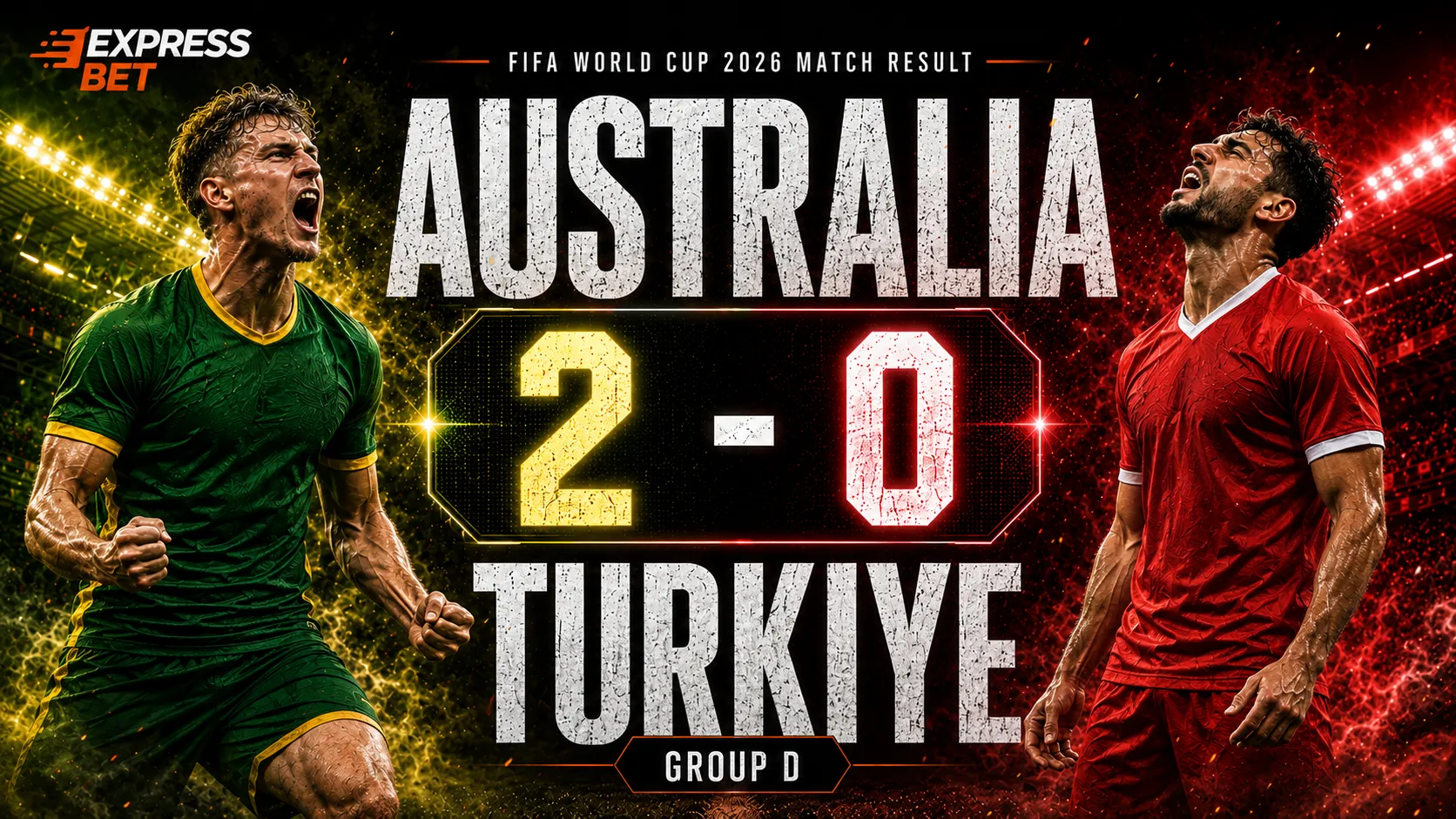
Match Information
| Detail | Information |
|---|---|
| Match | Australia vs Türkiye |
| Competition | FIFA World Cup 2026 |
| Stage | Group D, Matchday 1 |
| Date | 13 June 2026 local time / 14 June in some broadcast regions |
| Kickoff time | 9:00 p.m. PT |
| Host country | Canada |
| City | Vancouver, British Columbia |
| Stadium | BC Place Vancouver |
| Final score | Australia 2-0 Türkiye |
| Half-time score | Australia 1-0 Türkiye |
| Attendance | Not confirmed in the sources used for this article |
| Referee | Jesús Valenzuela |
| Weather | Detailed match-time weather not confirmed |
| Pitch condition | No major confirmed pitch controversy |
| Australia formation | 5-4-1 |
| Türkiye formation | 4-2-3-1 |
| Goals | Nestory Irankunda 27’, Connor Metcalfe 75’ |
| Assists | Paul Okon-Engstler assisted Irankunda’s goal |
| Penalties | None confirmed |
| Red cards | None |
| Yellow cards | Yunus Akgün 86’ for Türkiye |
| VAR | No decisive VAR incident confirmed |
| Betting result | Australia win; under 2.5 goals; both teams to score “No” |
| Group impact | Australia moved to three points in Group D |
Final Score and Match Summary
The Australia vs Türkiye match result was 2-0, and it landed with the quiet violence of a tournament result that almost nobody priced correctly.
Türkiye had the ball. Türkiye had the shots. Türkiye had Arda Güler, Hakan Çalhanoğlu, Kerem Aktürkoğlu, Ferdi Kadıoğlu, Merih Demiral, and enough technical reputation to make pre-match previews sound fairly confident. Australia had a defensive block, Patrick Beach in goal, one teenage lightning bolt in Nestory Irankunda, and the old Socceroos habit of treating international doubt as free fuel.
The scoreboard preferred Australia’s argument.
Tony Popovic’s side won with 22% of the ball, if we use the possession figure quoted after the match by Türkiye coach Vincenzo Montella. That is not usually a recipe. It is usually a cry for help. But football is not a possession spreadsheet. It remains stubbornly attached to goals, saves, blocks, and the occasional forward who runs into space as if the match has personally insulted him.
Australia started with a 5-4-1 shape that told the story immediately. This was not a team trying to outpass Türkiye. It was a team trying to survive central pressure, deny clean shooting lanes, and attack quickly when space opened. The plan looked cautious. Then Irankunda scored, and it looked intelligent. That is how football punditry works.
Türkiye were not passive. They created wave after wave of pressure. Güler shot early. Çalhanoğlu tested the goalkeeper. Bardakci nearly equalised with a brilliant strike. Zeki Çelik found space in the second half. Kerem Aktürkoğlu had a close-range effort saved. Kenan Yıldız came on and tried to change the rhythm. Still, the goal never came.
Australia defended with unusual calm for a side with ten World Cup debutants in the starting XI. Harry Souttar and Cameron Burgess were strong in the middle. Alessandro Circati defended with composure. Jordan Bos and Jacob Italiano worked hard in the wide channels. Aiden O’Neill and Paul Okon-Engstler sat in front of the back line and made Türkiye play through traffic. Patrick Beach, only 22, gave the whole system credibility.
The first goal came in the 27th minute. Okon-Engstler played Irankunda into the left channel. Irankunda carried the ball forward, cut inside, and finished past Uğurcan Çakır. The goal was quick, direct, and cold. Türkiye had barely finished asking questions at the other end.
The second arrived in the 75th minute. Metcalfe picked up a loose ball outside the box and struck low from distance. It bounced through the traffic and found the net. At that point, Türkiye’s possession became less a strength than an accusation. All that ball, all those attempts, and still Australia led by two.
The final whistle gave Australia one of their most significant World Cup wins. It also gave Group D a new shape. The United States had beaten Paraguay 4-1. Australia joined them on three points. Türkiye, expected by many to fight near the top of the group, suddenly had no points and a problem.
Tournament football is often cruel to beautiful ideas. This was one of those nights.
Goal Timeline
27’ — Nestory Irankunda, Australia, open-play goal
Australia’s first goal came from the type of situation Tony Popovic clearly wanted: quick release, space behind the full-back, and Irankunda running at defenders before Türkiye could reset.
The move began with Paul Okon-Engstler. The young midfielder played forward early, sending the ball into the left channel. Irankunda used his pace to get beyond the defensive line, controlled the ball, cut inside, and finished past Uğurcan Çakır.
It was a clean forward’s action. No ornament. No wasted touch. No committee meeting at the edge of the box. Just receive, attack, finish.
The tactical meaning was obvious. Türkiye had been pushing players forward and controlling territory. Australia accepted that imbalance and waited for the space it created. The Turkish back line had to defend a player running at speed, and that is rarely a relaxing business.
The emotional meaning was larger. Irankunda’s goal gave Australia belief and turned Türkiye’s possession into pressure. Before the goal, Türkiye were controlling the match. After it, they were chasing it.
For Irankunda, it was his first World Cup goal. For Australia, it was evidence that a young team could do more than defend and hope. It could hurt a favourite.
75’ — Connor Metcalfe, Australia, long-range goal
Connor Metcalfe’s goal was the sentence that ended Türkiye’s argument.
The ball broke loose outside the penalty area after Türkiye failed to secure a defensive phase. Metcalfe collected it, shifted onto his left foot, and struck from distance. The shot bounced low and found the corner.
It was not a goal from sustained Australian pressure. It was worse for Türkiye than that. It was a goal that came after Türkiye had spent most of the match attacking and still had not solved Australia’s defensive block.
Metcalfe’s strike made it 2-0, and at that point the match moved from upset possibility to result management. Türkiye had time, but not rhythm. They had shots, but not certainty. They had Güler, Çalhanoğlu, and attacking options, but they did not have the one thing Australia already had twice: a finished chance.
The tactical meaning was again clear. Australia did not need many attacks. They needed efficient attacks. The shot also punished Türkiye’s loose defensive transition. A side chasing the game must still protect the space in front of its box. Türkiye did not.
Key Moments That Changed the Match
Güler’s early warning
Arda Güler had Türkiye’s first real sight of goal in the seventh minute. His effort flew over, but the point was already made: Türkiye would run much of their attacking game through him.
Güler’s involvement set the pattern. He demanded the ball, found pockets, and carried the creative burden. The problem was that Australia were willing to let Türkiye have possession as long as the shots came through bodies or from low-percentage areas.
Beach saves from Güler before Australia score
In the 27th minute, Güler forced Patrick Beach into a save. Seventeen seconds later, Australia were scoring at the other end.
That sequence was the match in miniature. Türkiye threatened. Australia survived. Australia countered. Australia scored.
It also showed the psychological difference between pressure and punishment. Türkiye were applying pressure. Australia delivered punishment.
Irankunda scores the opener
Irankunda’s goal changed everything. Türkiye could no longer control the match at their preferred tempo. They had to chase.
This suited Australia. Popovic’s team could sink deeper, defend the middle, and use Irankunda, Mohamed Toure, and later substitutes to attack space.
Beach’s save from Bardakci
Three minutes after the opener, Abdülkerim Bardakci nearly equalised with a swerving left-footed strike. Beach produced a superb fingertip save, turning it onto the post.
This was arguably the turning point of the match. If Türkiye equalise quickly, the first goal becomes a temporary disturbance. Instead, Australia survived the response, and Türkiye began to feel the frustration of a match refusing to follow the script.
Türkiye’s half-time change
Kenan Yıldız replaced Barış Alper Yılmaz at half-time. The change made sense. Türkiye needed more direct threat and better connection in the final third.
Yıldız gave them energy, but not a goal. Australia’s block stayed intact.
Güler and Çalhanoğlu continue to shoot
Türkiye kept attacking after the break. Güler shot repeatedly. Çalhanoğlu tested Beach. Zeki Çelik found space. Aktürkoğlu forced another save.
But the shots did not become goals. That is the hard border between attacking volume and attacking quality.
Metcalfe makes it 2-0
Metcalfe’s goal in the 75th minute was the second decisive wound. Türkiye had been chasing an equaliser. Suddenly they needed two.
That is a different sport emotionally. A one-goal deficit keeps a team hopeful. A two-goal deficit after 75 minutes makes every missed chance feel like evidence.
Beach reaches eight saves
By the 89th minute, Beach had eight saves. That number tells part of the story. It also explains why Australia could win despite conceding so much territory.
Goalkeepers are often asked to be invisible when a defensive plan works. Beach was not invisible. He was necessary.
First Half Analysis
Australia began in a 5-4-1 shape.
Patrick Beach started in goal. Jacob Italiano, Alessandro Circati, Harry Souttar, Cameron Burgess, and Jordan Bos formed the defensive line. Nestory Irankunda, Aiden O’Neill, Paul Okon-Engstler, and Connor Metcalfe worked across midfield. Mohamed Toure led the line.
Türkiye started in a 4-2-3-1. Uğurcan Çakır was in goal. Zeki Çelik, Merih Demiral, Abdülkerim Bardakci, and Ferdi Kadıoğlu formed the back four. İsmail Yüksek and Hakan Çalhanoğlu sat in midfield. Arda Güler, Orkun Kökçü, Kerem Aktürkoğlu, and Barış Alper Yılmaz formed the attacking line.
The tactical contrast was immediate. Türkiye wanted the ball. Australia wanted the correct spaces. Türkiye moved through Güler and Çalhanoğlu. Australia defended the centre and waited for Irankunda’s acceleration.
The first half had a strange shape. Türkiye looked like the side with more football. Australia looked like the side with a clearer trap.
Popovic’s back five stayed narrow enough to block central lanes but flexible enough to release the wing-backs when counterattacking moments appeared. Souttar and Burgess were central to that. Circati gave cover. Italiano and Bos had to defend wide areas, then make recovery runs when Türkiye recycled possession.
Okon-Engstler’s role was especially important. He was not there to produce a glossy possession performance. He was there to screen, win second balls, and release the first forward pass when Australia had a transition chance. His assist for Irankunda did exactly that.
Türkiye had more of the ball, but their possession was not always clean. Güler was dangerous, yet he often received with Australian shirts around him. Çalhanoğlu could switch play, but Australia were happy to concede some width if they protected the penalty spot and the top of the box.
Irankunda’s goal in the 27th minute rewarded Australia’s patience. It also punished Türkiye’s defensive line for being too exposed during an attacking phase.
The next major moment was Bardakci’s shot. It was struck well and could have changed the match quickly. Beach saved it onto the post, and that save probably did as much for Australia’s belief as the goal itself.
After that, Türkiye controlled territory for the rest of the half. Australia created less, but their lead gave the first half its real meaning.
At half-time, Australia led 1-0. The scoreboard was slightly absurd if judged by possession. It was completely logical if judged by execution.
Second Half Analysis
The second half began with Türkiye trying to increase speed and variety.
Kenan Yıldız came on for Barış Alper Yılmaz at half-time. Türkiye wanted another player who could carry the ball, combine around the box, and test Australia’s compact shape.
Australia still threatened early after the break. Mohamed Toure found space in behind and laid the ball off to Jordan Bos, whose shot was deflected for a corner. That moment mattered because it showed Australia were not only defending. They were still capable of making Türkiye think about the space behind them.
Then the match became a Turkish siege.
Güler hit a free kick that Beach saved. Çelik found space in behind and had an effort from a tight angle. Aktürkoğlu tested Beach from close range. Çalhanoğlu shot on target. Yıldız tried to force the issue late. Türkiye were not short of attempts.
They were short of precision.
Australia’s defensive spacing held. The back five rarely lost its shape. The midfield line dropped when necessary. O’Neill and Okon-Engstler worked across the centre until the latter was replaced late. Metcalfe did heavy defensive work before scoring the second.
The first Australian change came in the 61st minute. Nishan Velupillay replaced Irankunda, who left to a standing ovation. It was a sensible move. Irankunda had given Australia the goal and had run hard. The team needed fresh legs to keep counterattacking threat alive.
In the 73rd and 74th minutes, Popovic brought on Jason Geria and Tete Yengi for Jacob Italiano and Mohamed Toure. The changes gave Australia more defensive balance and a new forward outlet. Türkiye continued to push.
Then Metcalfe scored.
The second goal changed the final phase. Türkiye had to throw even more forward. Australia could introduce Aziz Behich and Jackson Irvine in the 84th minute, adding experience to protect the result. That was not glamorous. It was practical. Winning tournament football often involves adding older legs to defend younger miracles.
The final minutes included Turkish shots, corners, and one yellow card to Yunus Akgün. Australia blocked, cleared, and trusted Beach.
The second half confirmed the match’s real story. Türkiye had the ball and the chances. Australia had the defensive structure, the goalkeeper, and the finishing.
Tactical Picture: Why Australia Won and Türkiye Lost
Australia won because their defensive structure made Türkiye’s possession less dangerous than it looked.
The 5-4-1 gave Australia three central defenders, two wing-backs, and four midfielders shielding the middle. Against Türkiye’s 4-2-3-1, that mattered. Güler wanted to operate between the lines. Çalhanoğlu wanted time to dictate. Kökçü wanted to connect midfield to attack. Australia denied clean central access.
The block did not press high for long periods. It retreated into useful zones. That was not cowardice. It was risk management. Türkiye had more individual technicians. Australia had more interest in controlling where those technicians could receive.
The key defensive decision was to pack the middle and concede some wide space. Türkiye could cross, recycle, and shoot from angles. Australia preferred that to allowing Güler or Çalhanoğlu repeated central shots from perfect zones.
Beach’s performance made the plan viable. A low block without a good goalkeeper is just a waiting room for disaster. Beach gave Australia the saves that turned the strategy from brave into successful.
In attack, Australia were minimal but sharp. Irankunda’s speed created the first goal. Metcalfe’s long-range strike created the second. They did not need sustained possession because Türkiye’s own attacking commitment left transition spaces.
Türkiye lost because they did not convert dominance into clean chances. Thirty attempts sounds overwhelming. Eight on target sounds busy. But much of that work came against a set defence, through traffic, or from positions Australia were prepared to defend.
Montella’s system had enough talent but not enough variation. Güler was bright. Çalhanoğlu passed and shot. Aktürkoğlu threatened. But Türkiye rarely disorganized Australia completely. They attacked the wall, then complained that the wall behaved like a wall.
The second goal also exposed Türkiye’s transition discipline. Chasing the game does not excuse leaving the top of the box unsecured. Metcalfe punished the lapse.
Australia’s win was not luck. It was uncomfortable efficiency. Türkiye’s defeat was not a mystery. It was possession without penalty-box authority.
Player Ratings and Individual Performances
These ratings are editorial assessments based on confirmed events, tactical role, available statistics, and match influence.
Australia Player Ratings
Patrick Beach — 9/10
The key player. Eight saves, a clean sheet, and a performance that justified a bold selection. His stop from Bardakci shortly after the first goal was the match’s defining save.
Jacob Italiano — 6.5/10
Worked hard in the wing-back role and defended his side under constant Turkish pressure. Replaced by Jason Geria after 73 minutes.
Alessandro Circati — 7.5/10
Calm in a demanding defensive structure. Had to track movement between the lines and deal with crosses into crowded areas.
Harry Souttar — 8/10
Captained the defence with authority. Strong in the air, disciplined in the box, and central to the clean sheet.
Cameron Burgess — 8/10
Excellent alongside Souttar. Blocked, covered, and handled the physical side of Türkiye’s late pressure.
Jordan Bos — 7/10
Defended for long periods and still found moments to break forward. Nearly created danger early in the second half.
Nestory Irankunda — 8.5/10
Scored the opener with composure and pace. His goal changed the match. Replaced after an hour, but his work was already done.
Aiden O’Neill — 7/10
Important screening role. Not always visible, which is sometimes exactly the point for a midfielder protecting a low block.
Paul Okon-Engstler — 8/10
Assisted the first goal and gave Australia disciplined midfield work. A major World Cup debut performance.
Connor Metcalfe — 8.5/10
Scored the second goal and worked defensively throughout. His long-range finish sealed the result and turned a narrow lead into a famous win.
Mohamed Toure — 6.5/10
Led the line with difficult service. His running helped keep Türkiye’s centre-backs honest.
Nishan Velupillay — 6/10
Came on for Irankunda and gave fresh running.
Jason Geria — 6.5/10
Helped Australia close down wide areas late.
Tete Yengi — 6/10
Gave Australia a forward outlet after replacing Toure.
Aziz Behich — 6.5/10
Added experience in the final minutes.
Jackson Irvine — 6.5/10
Came on late to protect the midfield and help close the match.
Türkiye Player Ratings
Uğurcan Çakır — 5.5/10
Beaten twice. Could do little about Irankunda’s sharp finish, but Metcalfe’s bouncing strike will still sting.
Zeki Çelik — 6/10
Had a second-half chance from a tight angle but could not beat Beach. Defensively exposed at times.
Merih Demiral — 5.5/10
Struggled with Irankunda’s speed on the first goal. Won some duels but could not keep the back line secure.
Abdülkerim Bardakci — 6.5/10
Nearly scored a brilliant equaliser. Defensively had difficult moments, but his shot was one of Türkiye’s best chances.
Ferdi Kadıoğlu — 6/10
Provided width and involvement but did not break Australia’s shape decisively.
İsmail Yüksek — 5.5/10
Worked in midfield but was involved in the loose-ball phase before Metcalfe’s goal. Replaced late.
Hakan Çalhanoğlu — 7/10
Had 85 passes and two shots on target according to FOX’s key-player data. Tried to dictate the game but could not force the breakthrough.
Arda Güler — 7.5/10
Türkiye’s best attacking player. Had three shots on goal in FOX’s key-player data and was central to almost everything Türkiye tried. The performance was good. The result was not.
Orkun Kökçü — 5.5/10
Could not impose himself enough between Australia’s midfield and defence. Replaced after 61 minutes.
Kerem Aktürkoğlu — 6/10
Forced Beach into a save and kept moving, but lacked the final touch. Replaced late.
Barış Alper Yılmaz — 5/10
Could not give Türkiye the first-half impact needed. Replaced at half-time.
Kenan Yıldız — 6/10
Added energy after the break. Had late attempts but could not change the score.
Yunus Akgün — 5.5/10
Booked in the 86th minute. Tried to bring extra attacking movement but did not solve the block.
Mert Müldür — 6/10
Late substitute. Limited time to affect the game.
Salih Özcan — 6/10
Entered late as Türkiye chased. Could not shift the balance.
Deniz Gül — 6/10
Late attacking substitute with little time to change the result.
Best Players of the Match
Man of the Match: Patrick Beach
Irankunda and Metcalfe scored the goals, but Beach protected the result. Eight saves and a clean sheet in a World Cup opener make a strong case. His save from Bardakci was the match’s hinge.
Best attacker: Nestory Irankunda
The first goal was ruthless. His pace gave Australia the outlet their defensive plan needed.
Best midfielder: Connor Metcalfe
Scored the second and worked in the defensive structure. A midfielder who scores and suffers without the ball is useful in tournament football.
Best defender: Harry Souttar
Led the back line and dominated enough aerial and box defending to keep Türkiye goalless.
Best goalkeeper: Patrick Beach
No debate. The clean sheet belongs heavily to him.
Best substitute: Kenan Yıldız
He improved Türkiye’s attacking edge after half-time, even if the final result did not change.
Most underrated performance: Paul Okon-Engstler
His assist for Irankunda and his defensive discipline were both vital. A World Cup debut with real substance.
Most disappointing performance: Barış Alper Yılmaz
Taken off at half-time after failing to provide the attacking impact Türkiye needed.
Injuries, Suspensions, Cards, and Discipline
There were no red cards and no confirmed penalties.
The only confirmed yellow card in the match summary used here went to Yunus Akgün in the 86th minute for Türkiye. Australia’s official match summary listed no yellow cards for the Socceroos.
There were no confirmed major injuries that shaped the result. The substitutions were tactical and fatigue-based rather than publicly confirmed injury changes.
The discipline story was therefore not about cards. It was about defensive control. Australia defended under heavy pressure without making the match chaotic. Türkiye, despite chasing, did not turn the game into a disciplinary mess either.
Suspension risk is minimal after this match, but the group stage is short. One unnecessary yellow can matter later, especially for players who defend aggressively in wide or midfield zones.
Referee and VAR Analysis
Jesús Valenzuela was assigned to the match, with a reputation for firm control and experience in major international games.
The game did not produce a decisive penalty, red card, or VAR controversy. That is worth stating clearly. Türkiye had pressure and many shots, but the match was not decided by an officiating incident.
The most important refereeing work involved game rhythm. Australia defended deep, Türkiye attacked repeatedly, and there were many moments where contact around the box could have become emotional. The referee kept the game inside manageable limits.
VAR did not dominate the story. No goal was ruled out. No penalty was awarded or overturned. No red-card review changed the game.
That leaves the result where it belongs: with Australia’s finishing, Beach’s saves, and Türkiye’s wastefulness.
Weather, Stadium, Pitch, and Match Conditions
The match was played at BC Place in Vancouver, British Columbia. The venue hosted the game under its major-event configuration and gave the match a high-pressure indoor-stadium feel.
Detailed match-time weather was not confirmed in the main match sources used for this article. Because BC Place is a covered stadium, outside conditions were less central than they would have been in an open-air venue. No weather-related disruption was reported as a key factor.
No major pitch controversy was confirmed. The game was not defined by the surface, unusual ball movement, or visible turf issues. It was defined by tactical contrast: Türkiye’s possession against Australia’s compact defending and counterattacking efficiency.
The stadium atmosphere mattered. Vancouver hosted a match that many expected Türkiye to control. By the end, the Australian players were celebrating a result that felt like it had been carried through pressure, noise, and disbelief.
Fans and Stadium Atmosphere
Australia’s supporters had a night to remember.
This was not a neutral-feeling win on a quiet pitch. The Australian bench, players, and travelling support understood the scale of the result. A young team with ten World Cup debutants had beaten a technically gifted European side returning to the World Cup after 24 years.
Türkiye’s support had reason to expect more. Their team controlled the ball and attacked often. But as the saves piled up and the goals did not come, the mood changed from expectation to frustration.
The atmosphere after Irankunda’s goal shifted sharply. The opener gave the Australian end belief and made Türkiye’s support more impatient. After Metcalfe’s second, the match entered that strange emotional space where one side begins to celebrate and the other keeps counting impossible scenarios.
Football crowds understand the difference between pressure and danger. Türkiye had pressure. Australia had the goals. The sound in the stadium eventually followed the scoreboard.
Historical Context and World Cup Analogies
Australia’s 2-0 win has immediate historical weight.
It was Australia’s fifth victory at a World Cup. It also gave the Socceroos their first win in an opening World Cup match since 2006. For a country that has built much of its World Cup identity around resilience, this felt familiar in spirit but younger in personnel.
The team was full of debutants. Patrick Beach, Paul Okon-Engstler, Nestory Irankunda, and others were not carrying decades of tournament mileage. They were making new memories while older supporters were still measuring everything against 2006, 2010, and the penalty shootout mythologies that Australians keep stored nearby.
Türkiye’s context was different. This was their first World Cup match since 2002, when they finished third. That bronze-medal generation still casts a long shadow. Hakan Şükür’s fast goal against South Korea in 2002, the semi-final against Brazil, the technical swagger of that tournament — all of it belongs to Turkish football memory.
This 2026 return was supposed to announce a new group. Güler, Yıldız, Kadıoğlu, Kökçü, and others gave Türkiye a modern technical face. Instead, the opener became a lesson from an older World Cup textbook: possession is only useful when it breaks the defence.
The historical analogy is simple. This was a classic underdog tournament win. Not lucky. Not dominant. Efficient, disciplined, and mildly irritating to every pre-match model that overvalued the ball and undervalued the block.
Match Statistics
| Statistic | Australia | Türkiye |
|---|---|---|
| Final score | 2 | 0 |
| Half-time score | 1 | 0 |
| Ball possession | Around 22% | Around 78% |
| Attempts at goal | Limited chance volume | 30 |
| Shots on target | Not fully confirmed in official table used here | 8 |
| Patrick Beach saves | 8 | — |
| Corners | At least several, including Metcalfe corner at 80’ | Multiple late corners |
| Penalties | 0 confirmed | 0 confirmed |
| Red cards | 0 | 0 |
| Confirmed yellow cards | 0 listed by Football Australia | Yunus Akgün 86’ |
| Result market | Won | Lost |
| Total goals market | Under 2.5 landed | Under 2.5 landed |
The statistics tell a strange but clear story.
Türkiye dominated possession and shot volume. Australia dominated the scoreboard. That is not a contradiction. It is a football match.
Türkiye’s 30 attempts show the scale of their pressure. But only eight were on target, and many were handled by Beach or blocked by Australia’s defensive structure. Australia had far fewer opportunities but converted two.
This is the difference between shot volume and chance quality. A team can shoot often and still fail to create the one chance that forces the goalkeeper into an impossible decision. Türkiye kept asking questions. Beach kept answering.
Australia’s possession figure looks almost absurd for a winning team. But Popovic did not design a possession contest. He designed a survival-and-counter plan. The numbers say Türkiye had the ball. The result says Australia understood what to do without it.
Betting Result Angle
The Australia vs Türkiye betting result was one of the stronger underdog stories of the early tournament.
Australia won at +434 odds according to FOX’s odds page. That made the moneyline a major payout for bettors who trusted the Socceroos before kickoff.
Türkiye match-winner lost. The draw lost. Türkiye handicap markets failed badly. Any bettor who treated Türkiye’s technical superiority as a straightforward route to victory learned the usual World Cup lesson: talent is not a receipt.
The total goals line was 2.5. The match finished with two goals, so under 2.5 landed. This was interesting because Türkiye’s shot volume was huge. Under bettors survived not because the match lacked action, but because Australia defended well and Beach handled the shots on target.
Both teams to score “No” landed. Türkiye had 30 attempts but no goal. That market was not comfortable emotionally, but it landed cleanly on the scoreline.
Correct score 2-0 Australia was a high-risk winning angle. It required an underdog win, a clean sheet, and two Australian finishes from limited chance volume. That is exactly why correct-score betting is volatile.
First goalscorer markets rewarded Nestory Irankunda. Anytime goalscorer markets on Irankunda and Metcalfe landed. Türkiye player scorer markets on Güler, Çalhanoğlu, Aktürkoğlu, Yıldız, or others failed despite heavy pressure.
Live betting was fascinating. After Türkiye’s early pressure, many bettors would have expected a Turkish goal. After Irankunda scored, Australia’s price shifted, but the match still looked open because Türkiye controlled the ball. The real live-betting signal was Beach’s save from Bardakci. That was the moment Australia’s defensive plan stopped looking fragile and started looking believable.
The lesson is not “always back the underdog.” That is lazy. The better lesson is to price defensive structure, goalkeeper quality, and transition threat properly. Australia had all three.
No betting outcome is safe. Odds move quickly. One red card, penalty, injury, or deflection can change everything. The result was profitable for some bettors, but it was not predictable in a guaranteed way.
What This Result Means for Group D
Australia moved to three points in Group D.
That is a major result because the United States also won their opener, beating Paraguay 4-1. The next match between Australia and the United States on June 19 in Seattle now becomes a top-of-the-table game.
Australia’s situation is strong. They have three points, a clean sheet, and a plus-two goal difference. A draw against the United States would keep them in good position. A win would put them close to qualification. Even a loss would not destroy them, because the opening win gives them room.
Türkiye’s position is much more complicated. They have zero points and a minus-two goal difference. Their next match against Paraguay becomes a pressure game. Another defeat would leave them in serious trouble. A draw might not be enough if goal difference becomes important.
The expanded World Cup format gives some third-placed teams a route to the knockout stage. But relying on that after one match is already a nervous habit. Türkiye’s squad is good enough to recover. It now has to prove that quality can become points.
Australia, meanwhile, have changed the group’s tone. Before the match, many saw them as the awkward outsider. After the match, they are level with the USA and above Türkiye. The table has no interest in reputations.
What Australia Did Right
Australia executed the plan almost perfectly.
First, they defended the central channel. Güler and Çalhanoğlu had the ball, but they rarely received the kind of open central shooting lanes that destroy matches.
Second, they used a back five without becoming completely passive. The shape was deep, but it had an outlet. Irankunda gave the defence a reason to breathe. Toure ran hard. Metcalfe supported transitions.
Third, Beach turned defensive pressure into a clean sheet. That sounds obvious, but it is not. A low-block plan depends on the goalkeeper making the saves that the block cannot prevent.
Fourth, they took their chances. Irankunda scored from a transition. Metcalfe scored from distance. Two chances, two decisive actions. That is tournament efficiency.
Fifth, Popovic used experience late. Behich and Irvine helped close the match. When a young team has done the hard work, older heads are useful for the final paperwork.
Australia were not perfect. They conceded too many attempts and could not keep the ball for long spells. But they did not need perfection. They needed discipline, saves, and finishing.
They had all three.
What Türkiye Got Wrong
Türkiye’s biggest failure was not possession. It was penetration.
They had the ball for most of the match. They shot 30 times. They put eight on target. But they did not consistently create chances that broke Australia’s defensive structure.
Their attacking game became too dependent on Güler and Çalhanoğlu solving crowded spaces. That is a hard job, even for excellent players. Australia packed the middle and forced Türkiye wide or into difficult shooting positions.
The first goal exposed transition defence. Türkiye were attacking, then suddenly defending Irankunda at speed. They did not handle it.
The second goal exposed game-state impatience. Chasing a match still requires protection in front of the box. Metcalfe found that space and punished it.
Türkiye also lacked composure after falling behind. The volume increased, but the precision did not. Crosses, shots, and combinations came in waves, yet Australia’s back line rarely looked fully dismantled.
Montella’s substitutions made sense, but none changed the score. Yıldız added directness. Akgün added movement. Mert Müldür, Salih Özcan, and Deniz Gül came late. The problem was already structural.
Türkiye now need a sharper attacking plan against Paraguay. More possession alone will not repair the opener.
Coach Analysis
Tony Popovic
Tony Popovic got the match right.
His 5-4-1 was pragmatic without being fearful. He knew Türkiye would dominate the ball. He accepted that and made sure the areas Türkiye dominated were not always the areas that mattered most.
Starting Patrick Beach was a bold call. It worked. Starting Paul Okon-Engstler in midfield also worked. Australia’s young players did not look like decoration. They shaped the result.
Popovic’s substitutions were sensible. Velupillay replaced Irankunda after the opener had been secured. Geria and Yengi entered when Australia needed fresh legs. Behich and Irvine came in to help kill the game.
The only criticism is chance prevention. Australia allowed too many attempts. Against a sharper opponent, that could be dangerous. But this is the World Cup, not a coaching symposium. The plan won 2-0.
Vincenzo Montella
Vincenzo Montella’s Türkiye had control but not clarity.
The 4-2-3-1 gave Güler, Çalhanoğlu, Kökçü, Aktürkoğlu, and Yılmaz a framework for technical dominance. On paper, it looked strong. On grass, it became congested.
Montella’s side lacked enough movement behind Australia’s back line. Too often, Türkiye played in front of the block. They had width, but not enough cutback quality. They had shots, but not enough high-value shots.
The half-time change for Yıldız was logical. The later attacking substitutions were also understandable. But the match needed one early solution to Australia’s deep block, and Türkiye never found it.
Montella’s post-match frustration with possession and imprecision was fair. His team had enough of the ball to win two matches. They scored in neither.
Player Milestones and Records
Nestory Irankunda scored his first World Cup goal and his sixth senior international goal. The moment also had symbolic value: one of Australia’s brightest young attackers delivered on the biggest stage.
Connor Metcalfe scored only his second international goal and his first at a World Cup. His strike sealed one of Australia’s most significant tournament wins.
Patrick Beach produced eight saves and a clean sheet on a huge night. Multiple reports framed the performance as a major Australian goalkeeping landmark at the World Cup.
Paul Okon-Engstler’s assist was another milestone. He was playing only his seventh senior international match and helped create the opener.
Türkiye returned to the World Cup stage for the first time since 2002. That return did not bring the result they wanted, but it remains a major tournament moment for a new generation led by Güler and Yıldız.
Australia’s victory was their fifth ever win at a World Cup and their first opening-match win since 2006.
Incidents and Controversies
There were no major confirmed controversies.
No penalty was awarded. No red card was shown. No decisive VAR call changed the result.
The nearest thing to a debate was interpretive rather than officiating-based: how did Türkiye lose a match with so much of the ball and so many attempts?
The answer is not conspiracy. It is football. Australia defended the box, Beach made saves, and Türkiye lacked the finishing touch. Sometimes the simplest explanation is also the most annoying.
There was also pre-match noise around Australia being dismissed by outsiders and opponents. Irankunda later referenced that as motivation. That does not decide a match by itself, but it can sharpen a team that already feels underestimated.
The game itself was clean enough. The result was the controversy.
Final Verdict
Australia deserved the win because they understood the match they were playing.
They did not try to be Türkiye. They did not try to win possession. They did not try to make the neutral analyst purr over passing sequences. They defended, countered, trusted youth, trusted Beach, and took their moments.
Türkiye will look at the numbers and feel robbed by logic. They had 78% possession, 30 attempts, and eight shots on target. But football is not a complaint form. Their dominance lacked the final action. Australia’s rare attacks had it.
The 2-0 scoreline was not a reflection of territorial control. It was a reflection of execution. Irankunda and Metcalfe scored. Beach saved. Souttar and Burgess defended. Okon-Engstler supplied the first key pass. That is the match.
For Australia, this result changes Group D. They are no longer just the difficult opponent. They are a team with three points, a clean sheet, and a genuine chance to build momentum against the United States.
For Türkiye, the tournament is not over. But the margin and manner of defeat make the next match dangerous. Reputation must now become recovery.
For bettors, this was a classic World Cup warning. The favourite can own the ball and still lose. The underdog can defend for long stretches and still be the right side. The market does not reward style. It rewards the final score.
Australia 2, Türkiye 0. One team had the ball. The other had the night.
Responsible Betting Note
Football betting carries financial risk. A correct tactical analysis does not guarantee a winning bet. Odds change before and during matches, and one goal can completely alter a market. Never chase losses. Do not bet money needed for daily life. Use limits and take breaks. Check local betting laws before gambling. Betting should remain entertainment, not income.
FAQ
Australia beat Türkiye 2-0 in their FIFA World Cup 2026 Group D opener.
Nestory Irankunda scored for Australia in the 27th minute. Connor Metcalfe scored the second goal in the 75th minute.
Patrick Beach was the strongest Man of the Match candidate after making eight saves and keeping a clean sheet. Irankunda and Metcalfe were also decisive because they scored the goals.
Australia moved to three points and joined the United States at the top of Group D after the opening round. Türkiye started with zero points and now face pressure in their next match against Paraguay.
Australia moneyline landed at underdog odds. Under 2.5 goals landed because the match finished with two goals. Both teams to score “No” and Australia clean sheet also landed.
[expert_review params=»JTdCJTIyY29sb3IlMjIlM0ElMjJncmVlbi0yJTIyJTJDJTIyZXhwZXJ0X2F2YXRhciUyMiUzQSUyMiUyMiUyQyUyMmV4cGVydF9uYW1lJTIyJTNBJTIyJTIyJTJDJTIyZXhwZXJ0X2xpbmslMjIlM0ElMjIlMjIlMkMlMjJleHBlcnRfaWQlMjIlM0ElMjIxJTIyJTJDJTIyZXhwZXJ0X3R5cGUlMjIlM0ElMjJleHBlcnRfaWQlMjIlMkMlMjJleHBlcnRfYXZhdGFyX2FsdCUyMiUzQSUyMiUyMiUyQyUyMmV4cGVydF9zaG93JTIyJTNBMSUyQyUyMmV4cGVydF9kZXNjcmlwdGlvbiUyMiUzQSUyMlNwb3J0cyUyMEJldHRpbmclMjBBbmFseXN0JTIwJTI2JTIwRWRpdG9yaWFsJTIwQ29udHJpYnV0b3IlMjIlMkMlMjJleHBlcnRfc2hvd19idXR0b24lMjIlM0ExJTJDJTIyZXhwZXJ0X3Nob3dfYnV0dG9uX3R5cGUlMjIlM0ElMjJwb3B1cCUyMiUyQyUyMmV4cGVydF9xdWVzdGlvbl9idXR0b25fdGV4dCUyMiUzQSUyMkFzayUyMFF1ZXN0aW9uJTIyJTJDJTIycXVlc3Rpb25fZXh0ZXJuYWxfbGluayUyMiUzQSUyMiUyMiUyQyUyMnBvcHVwX3VzZV9waG9uZSUyMiUzQTAlMkMlMjJleHBlcnRfdGl0bGUlMjIlM0ElMjJBdXRob3IlMjIlMkMlMjJleHBlcnRfc2hvd190aXRsZSUyMiUzQTElMkMlMjJleHBlcnRfdGV4dCUyMiUzQSUyMkFsZXglMjBNb3JnYW4lMjBpcyUyMGElMjBzcG9ydHMlMjBiZXR0aW5nJTIwYW5hbHlzdCUyMGFuZCUyMGVkaXRvcmlhbCUyMGNvbnRyaWJ1dG9yJTIwd2hvJTIwd3JpdGVzJTIwZGV0YWlsZWQlMjBib29rbWFrZXIlMjByZXZpZXdzJTJDJTIwYmV0dGluZyUyMGd1aWRlcyUyQyUyMHBsYXRmb3JtJTIwY29tcGFyaXNvbnMlMkMlMjBhbmQlMjByZXNwb25zaWJsZSUyMGdhbWJsaW5nJTIwZXhwbGFpbmVycy4lMjBIaXMlMjB3b3JrJTIwZm9jdXNlcyUyMG9uJTIwcHJhY3RpY2FsJTIwaW5mb3JtYXRpb24lMjBmb3IlMjB1c2VycyUyMHdobyUyMHdhbnQlMjB0byUyMHVuZGVyc3RhbmQlMjBob3clMjBiZXR0aW5nJTIwc2l0ZXMlMjBvcGVyYXRlJTIwYmVmb3JlJTIwdGhleSUyMHJlZ2lzdGVyJTJDJTIwZGVwb3NpdCUyQyUyMG9yJTIwY2xhaW0lMjBhJTIwYm9udXMuJTIyJTJDJTIycWElMjIlM0ElNUIlNUQlMkMlMjJxYV9zaG93X3RpdGxlJTIyJTNBMSUyQyUyMnFhX3RpdGxlJTIyJTNBJTIyJUQwJTkyJUQwJUJFJUQwJUJGJUQxJTgwJUQwJUJFJUQxJTgxJTIwJUQxJThEJUQwJUJBJUQxJTgxJUQwJUJGJUQwJUI1JUQxJTgwJUQxJTgyJUQxJTgzJTIyJTJDJTIyc2NvcmUlMjIlM0ElNUIlNUQlMkMlMjJzY29yZV9zdW1tYXJ5X3RleHQlMjIlM0ElMjIlMjIlMkMlMjJzY29yZV9zdW1tYXJ5X2F2ZXJhZ2UlMjIlM0EwJTJDJTIyc2NvcmVfbWF4JTIyJTNBJTIyNSUyMiUyQyUyMnNjb3JlX3N5bWJvbCUyMiUzQSUyMiUyMiUyQyUyMnNjb3JlX3RpdGxlJTIyJTNBJTIyJTIyJTJDJTIyc2NvcmVfc2hvd190aXRsZSUyMiUzQTAlMkMlMjJwbHVzZXMlMjIlM0ElNUIlNUQlMkMlMjJtaW51c2VzJTIyJTNBJTVCJTVEJTJDJTIycGx1c2VzX21pbnVzZXNfc2hvd190aXRsZSUyMiUzQTElMkMlMjJwbHVzZXNfbWludXNlc190aXRsZSUyMiUzQSUyMiVEMCU5RiVEMCVCQiVEMSU4RSVEMSU4MSVEMSU4QiUyMCVEMCVCOCUyMCVEMCVCQyVEMCVCOCVEMCVCRCVEMSU4MyVEMSU4MSVEMSU4QiUyMiUyQyUyMnBsdXNlc190aXRsZSUyMiUzQSUyMiUyMiUyQyUyMm1pbnVzZXNfdGl0bGUlMjIlM0ElMjIlMjIlN0Q=»]