
Colombia vs Ghana Match Result
Table of Contents Show
Views 5
TL;DR: Colombia vs Ghana Match Result
Colombia defeated Ghana 1–0 in the FIFA World Cup 2026 Round of 32 at Kansas City Stadium. Jhon Arias scored the only goal in the 14th minute, guiding substitute Luis Suárez’s cross into the bottom corner. Suárez had entered after Jhon Córdoba suffered an apparent groin injury eight minutes into the match.
Colombia controlled 61% of possession, produced 20 shots and allowed Ghana only 0.27 expected goals, according to FotMob. Arias was the decisive player, while Colombia’s defensive structure prevented Ghana from creating a sustained response. The match was played in approximately 30°C heat before 69,045 spectators, with Colombian supporters providing the stronger visible presence. Colombia advanced to face Switzerland; Ghana were eliminated. Standard match-winner and under 2.5-goal positions succeeded, but betting conclusions still depend on the price and market timing.
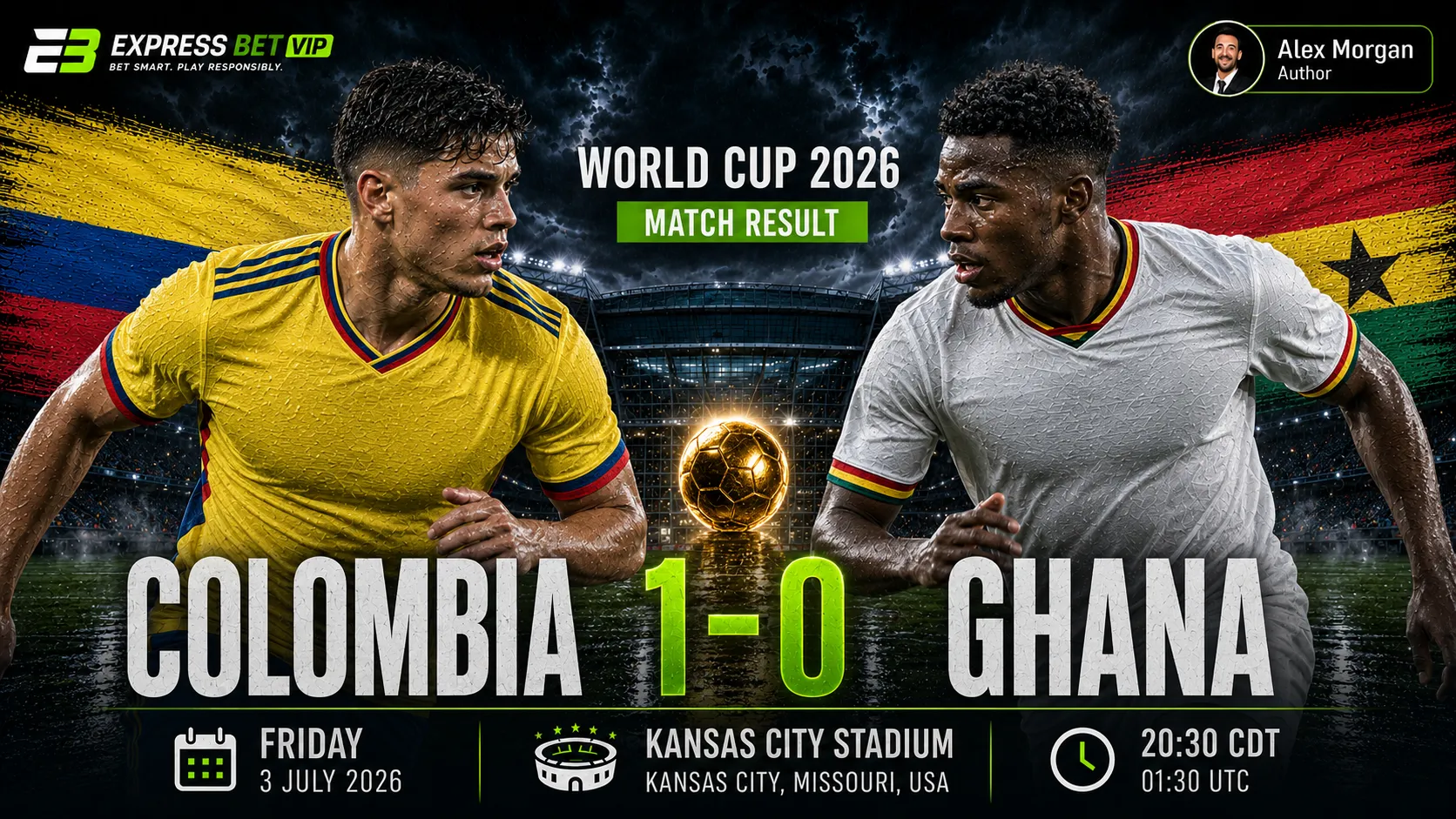
Quick Facts: Final Score, Goal, Venue, and Match Status
| Match fact | Verified information |
|---|---|
| Match | Colombia vs Ghana |
| Competition | FIFA World Cup 2026 |
| Stage | Round of 32 |
| Date | July 3, 2026 locally; July 4 in UTC and European time zones |
| Kickoff | 20:30 CDT / 01:30 UTC |
| Host country | United States |
| City | Kansas City, Missouri |
| Stadium | Kansas City Stadium |
| Attendance | 69,045 |
| Final score | Colombia 1–0 Ghana |
| Half-time score | Colombia 1–0 Ghana |
| Goalscorer | Jhon Arias 14’ |
| Assist | Luis Suárez |
| Referee | Clément Turpin, France |
| VAR | Complete appointment not confirmed from reviewed public data |
| Conditions | Approximately 30°C, hot and humid |
| Pitch condition | No major surface problem confirmed |
| Main tournament impact | Colombia advanced to face Switzerland; Ghana were eliminated |
This was the final fixture of the expanded Round of 32. Colombia entered it as Group K winners, while Ghana had qualified as one of the best third-placed teams.
Verified Facts vs Analysis
| Category | Status | Information |
|---|---|---|
| Final score | [CONFIRMED] | Colombia 1–0 Ghana |
| Goal | [CONFIRMED] | Jhon Arias, 14’ |
| Assist | [CONFIRMED] | Luis Suárez |
| Venue and attendance | [CONFIRMED] | Kansas City Stadium, 69,045 |
| Early injuries | [REPORTED] | Jhon Córdoba and Marvin Senaya were withdrawn |
| Colombia’s territorial control | [OBSERVED] | 61% possession, 20 shots and 19 box touches |
| Ghana’s attacking limitations | [OBSERVED] | Eight shots, 0.27 xG and minimal penalty-area access |
| Heat affecting pressing duration | [ANALYSIS] | Plausible from the conditions and match pattern |
| Colombia as pre-match favorite | [MARKET SIGNAL] | Widely priced as a substantial favorite |
| Exact closing odds and live movements | [UNKNOWN] | Not available from verified public data |
Facts describe what happened. Analysis explains why it happened. The distinction is necessary because a possession figure is recorded data, while the claim that Colombia’s midfield spacing produced that possession is an editorial interpretation.
Final Score and Match Summary
Colombia’s 1–0 win was narrow on the scoreboard and considerably less narrow in the football.
Jhon Arias scored after 14 minutes, Colombia controlled most of the possession and Ghana spent the remainder of the evening trying to construct an attacking response that rarely reached Camilo Vargas’s penalty area.
The decisive move began with Luis Suárez, who had not expected to be involved so early. Jhon Córdoba suffered an apparent groin problem in the eighth minute, forcing Néstor Lorenzo to use his first substitute before the match had established a normal rhythm. Suárez entered and, six minutes later, crossed to the back post. Arias had drifted away from Ghana’s defensive attention and guided the ball into the bottom corner.
An injury substitution producing the winning assist within minutes is the sort of event that encourages lazy talk about tactical genius. The more useful explanation is that Suárez understood his task immediately and Arias identified the space before Ghana reorganized.
Colombia controlled the first half through possession, field position and a more functional midfield structure. Ghana showed occasional intent but lacked the connections required to move the ball from the defensive third into dangerous central areas.
Luis Díaz threatened from the left, Johan Mojica advanced outside him and Colombia repeatedly forced Ghana to defend close to their own box. A second Colombian goal was disallowed for offside, preventing the match from becoming comfortable.
Ghana improved their willingness to carry the ball forward after halftime but did not improve their chance quality sufficiently. Their eight shots generated only 0.27 xG according to FotMob. Colombia produced 20 attempts and 2.04 xG.
The scoreline remained uncertain because football has never agreed to award goals for territorial control. Ghana were one set piece, deflection or defensive error away from extra time. Colombia avoided that moment through disciplined defending.
Goal Timeline
14’ — Jhon Arias, Colombia, open-play goal
The move developed on Colombia’s left. Luis Suárez received space to deliver after replacing the injured Córdoba in the eighth minute.
Suárez’s cross travelled toward the back-post area, where Arias had moved beyond Ghana’s immediate midfield coverage. He was given enough time to control the finish rather than attack the ball in desperation.
Arias side-footed his effort into the bottom-right corner beyond Lawrence Ati-Zigi. The finish was technically simple because the movement preceding it had made the chance clean.
The defensive error was collective. Ghana allowed Suárez time to cross and failed to track Arias’s arrival. The goalkeeper had little realistic opportunity once the shot was directed accurately toward the corner.
The goal gave Colombia control of the game state. They no longer needed to increase the tempo continuously in Kansas City’s heat. Ghana, meanwhile, had to abandon any plan based entirely on patience and transition attacks.
No VAR intervention overturned the goal. The available public data did not confirm a prolonged check.
Key Moments That Changed the Match
Jhon Córdoba’s injury
Córdoba left after approximately eight minutes with an apparent groin problem. The incident forced Lorenzo to change his attacking reference earlier than planned.
The substitution became decisive because Luis Suárez created the goal within six minutes. It also affected Colombia’s later bench management by removing one substitution option before halftime.
Marvin Senaya’s early departure
Ghana also lost Marvin Senaya during the opening phase. Two injury substitutions before the 15th minute disrupted both tactical plans.
For Ghana, the timing was particularly damaging. Their defensive structure had to be reorganized just as Colombia were increasing pressure around the wide areas.
Arias found the back-post space
The 14th-minute goal was a product of positioning rather than attacking chaos. Arias separated from his marker while Ghana focused on the ball and Suárez’s crossing angle.
Luis Díaz’s disallowed goal
Colombia believed they had extended the lead, but the goal was ruled out for offside. The decision kept Ghana within one action of extra time and prevented Colombia’s dominance from becoming visible in the score.
No verified evidence reviewed for this article supports treating the decision as a major refereeing controversy.
Ati-Zigi’s saves
Ghana’s goalkeeper prevented Colombia from turning 20 shots and more than 2.0 xG into a larger result. His work preserved the possibility of a late equalizer even while Ghana struggled to create at the other end.
Colombia’s defensive control
The final quarter was not defined by a succession of desperate Ghanaian chances. Colombia maintained compact spacing and protected the central route to goal. Ghana could move the ball forward, but they rarely converted possession into a clean attempt.
Local Match Conditions: Stadium, City, Weather, Pitch, and Crowd
| Local factor | Verified or observed detail | Football meaning | Direct evidence | Betting meaning | Status | Anti-template status |
|---|---|---|---|---|---|---|
| Stadium | Kansas City Stadium | Large outdoor venue with an open playing area | Match played at Arrowhead complex | Weather remained relevant | [CONFIRMED] | Fixture-specific |
| Attendance | 69,045 | Full crowd increased noise and communication demands | Officially reported attendance | Reinforced Colombia’s perceived momentum | [CONFIRMED] | Fixture-specific |
| Temperature | Approximately 30°C | Increased hydration and repeated-sprint demands | Reuters match report | Supported caution around late pressing | [REPORTED] | Fixture-specific |
| Humidity | Described as demanding | Increased thermal stress | Match and local reporting | Relevant to second-half tempo | [REPORTED] | Fixture-specific |
| Crowd profile | Strong Colombian majority or plurality was visible | Created a home-like emotional environment | Local Kansas City reporting | Could affect live sentiment, not result certainty | [OBSERVED] | Fixture-specific |
| Pitch | No major failure confirmed | Passing structure remained reliable | Match evidence | No pitch-based betting edge | [OBSERVED] | Fixture-specific |
| Early injuries | Both teams changed players before 15’ | Disrupted planned substitution strategy | Match reports | Increased early live-market uncertainty | [CONFIRMED] | Fixture-specific |
Kansas City did not provide neutral-match silence. Tens of thousands of supporters in yellow gave Colombia the more visible and audible backing. Local broadcaster KCUR described the city as being flooded with Colombian colors before the match.
That support did not score the goal, but it shaped the psychological environment. Colombia’s successful tackles and forward actions received an immediate response. Ghana faced both an organized opponent and a crowd that treated every Colombian attack as the beginning of something larger.
Reuters recorded approximately 30°C conditions. Pre-match forecasts had warned of even higher afternoon temperatures and heat-index values, but the evening kickoff provided some reduction from the day’s peak.
The heat did not produce a visible collapse. It encouraged both teams to choose when to press. Colombia rarely needed to chase the ball for long periods because they controlled possession. Ghana’s greater off-ball workload was therefore the more expensive physical task.
No major pitch defect was confirmed. The ball moved normally, players could combine at speed and neither goalkeeper suffered an obvious surface-related handling error.
Stadium-Specific Match Impact
| Stadium factor | Detail |
|---|---|
| Stadium | Kansas City Stadium |
| Common name | Arrowhead Stadium |
| FIFA tournament capacity | 69,045 |
| Attendance | 69,045 |
| Surface | Natural-grass tournament surface |
| Roof status | Open-air playing field |
| Acoustic effect | Strong Colombian support created sustained noise |
| Surface condition | No major defect reported |
| Wind relevance | Not available from verified public data |
| Goalkeeper distribution effect | No clear influence established |
| Set-piece effect | No goal resulted from a set piece |
| Communication effect | Crowd noise plausibly increased difficulty, but cannot be quantified |
| Data status | Attendance and venue confirmed; some environmental details unavailable |
The full attendance meant empty sections did not absorb the crowd response. Colombia’s supporters created a visual concentration of yellow around a venue normally associated with American football.
The stadium’s open design left the players exposed to the evening heat. Unlike an enclosed, climate-controlled venue, Kansas City Stadium could not remove the local weather from the tactical equation.
Colombia handled those demands by keeping the ball. Possession served an attacking purpose, but it also transferred physical work to Ghana. The Black Stars had to shift laterally and recover toward their own goal while Colombia determined the pace of circulation.
The available evidence does not show a clear stadium-specific effect on long passing, goalkeeper distribution or set-piece delivery.
City and Weather Impact
| Factor | Match detail |
|---|---|
| City | Kansas City, Missouri |
| Host country | United States |
| Time zone | Central Daylight Time, UTC−5 |
| July climate | Hot and humid |
| Match-time temperature | Approximately 30°C |
| Humidity | Exact percentage unavailable |
| Wind | Not available from verified public data |
| Rain | No significant in-match rain effect confirmed |
| Altitude | Approximately 270 metres; not tactically significant |
| Likely physical effect | Higher hydration and recovery demands |
| Actual evidence | Selective pressing and controlled tempo |
| Data status | Temperature reported; complete readings unavailable |
The conditions favored the team that could make the ball do more of the running. Colombia did precisely that.
Their possession was not always penetrative, but it served as physical game management. Short and medium passes forced Ghana’s defensive unit to move while allowing Colombia to recover between attacking actions.
Ghana could not turn the match into a continuous high-tempo transition contest. Their low share of possession required patience, yet the early goal made patience less useful with every passing minute.
The evidence does not support claiming that heat caused either early injury. Córdoba’s apparent groin problem and Senaya’s departure occurred too early to assign them confidently to accumulated thermal fatigue.
First Half Analysis
Colombia’s structure resembled a 4-3-3 in the starting lineup but changed shape during possession. One full-back advanced, the midfield created multiple passing angles and the forwards occupied different lines rather than standing flat against Ghana’s defenders.
James Rodríguez moved into areas where he could receive facing forward. Jhon Arias worked between a conventional midfield role and a right-sided attacking position. Luis Díaz held width before accelerating into the left half-space.
Ghana initially defended in a compact middle block. Their first line attempted to guide Colombia outside, but the distances behind that line were not always coordinated. Colombia could pass through midfield and then move the ball wide before Ghana completed the defensive shift.
Córdoba’s injury could have reduced Colombia’s box presence. Suárez instead entered with immediate aggression. His willingness to move into the channel created the crossing position for Arias’s goal.
After taking the lead, Colombia did not retreat. They continued circulating the ball and pressing immediately after turnovers. Jefferson Lerma’s positioning was important because he protected the centre while the full-backs advanced.
Ghana struggled to establish a stable route through midfield. Their forward players were isolated, and the passes reaching them often arrived with defenders close enough to prevent a turn.
Ati-Zigi prevented further damage. Colombia’s pressure produced attempts, but their finishing did not match the quality of their approach work.
The 1–0 halftime score understated Colombia’s control while accurately reflecting their inability to convert that control into a second goal.
Second Half Analysis
Ghana increased their attacking ambition after halftime. Their defensive line moved higher, and the midfield attempted to support forward actions with greater numbers.
The change created a little more possession but not enough penalty-area access. FotMob recorded only eight Ghana touches in the Colombian box across the match. Colombia registered 19.
Lorenzo adjusted the midfield to protect the lead without surrendering possession completely. Colombia reduced unnecessary forward runs and became more selective about when both full-backs advanced.
This was not a pure low block. Colombia continued to create chances and finished with 20 shots. Their risk management consisted of maintaining structure behind attacks rather than abandoning attacks altogether.
Ghana’s main problem was the absence of a player who could receive between Colombia’s midfield and defence, turn and force a centre-back to step out. Without that action, their possession moved around the block instead of breaking it.
Mohammed Kudus’s absence deprived Ghana of their most natural line-breaking carrier and creator. His absence did not guarantee defeat, but it reduced the team’s range of solutions.
As the match entered its final phase, Colombia’s failure to score again introduced tension. A 1–0 lead is football’s preferred method of making a controlled performance feel medically unnecessary.
Ghana never generated a sustained siege. Colombia’s centre-backs won important duels, the midfield protected second balls and Camilo Vargas was not required to produce a sequence of exceptional saves.
Tactical Picture: Why the Match Was Won and Lost
Colombia won the midfield before they won the scoreboard.
Their central unit offered better passing angles and moved Ghana’s block from side to side. Lerma protected the base, while Rodríguez and Arias occupied more advanced positions. Ghana could either remain compact and concede width or step outward and open interior spaces.
The winning goal combined both problems. Colombia created the crossing opportunity outside, while Arias exploited the space created inside and behind the defensive shift.
Ghana’s approach depended on surviving Colombia’s early pressure and extending the match at 0–0. Arias’s goal removed that foundation after 14 minutes.
Carlos Queiroz’s side then needed to become more expansive. They lacked the progressive passing and individual creativity to do so without weakening their defensive structure.
Colombia’s counterpress was another decisive element. When they lost the ball, the nearest players closed Ghana’s first receiver. Ghana were frequently forced into hurried passes rather than controlled transitions.
Lorenzo’s side did not play a flawless match. Their 20 shots should have produced a larger margin, and leaving the contest at 1–0 preserved unnecessary risk. The underlying plan nevertheless worked: control the ball, attack through width and half-spaces, prevent central transitions and force Ghana to create against an organized defence.
Tactical Collision Map
| Zone | Edge | Evidence | Key player | Local-condition effect | Result impact |
|---|---|---|---|---|---|
| Colombia left flank | Colombia | Suárez’s cross created the goal; Díaz and Mojica threatened | Luis Suárez | Possession reduced physical waste | Winning assist |
| Colombia right flank | Colombia | Arias arrived beyond Ghana’s coverage | Jhon Arias | Selective forward runs conserved energy | Winning goal |
| Central midfield | Colombia | 61% possession and better progression | Jefferson Lerma | Ghana carried greater off-ball load | Controlled tempo |
| Ghana penalty area | Colombia | 19 box touches and 20 shots | Luis Díaz | Heat increased defensive concentration demands | Sustained pressure |
| Colombia penalty area | Colombia defensively | Ghana recorded eight box touches | Dávinson Sánchez | Compactness reduced recovery distances | Clean sheet |
| Set pieces | Even | No decisive set-piece goal | — | No clear effect | Limited |
| Transitions | Colombia | Counterpress disrupted Ghana | Lerma and midfield unit | Avoided repeated long recovery runs | Suppressed Ghana |
| Goalkeeper build-up | Colombia | Vargas faced limited direct pressure | Camilo Vargas | No verified wind effect | Preserved control |
| Bench impact | Colombia | Suárez assisted shortly after entering | Luis Suárez | Early injuries made bench response critical | Decisive |
Player Ratings and Individual Performances
Colombia Player Ratings
- Camilo Vargas — 6.5: Ghana created little and official providers disagreed over whether one effort qualified as a shot on target. Vargas remained composed and supported Colombia’s possession.
- Daniel Muñoz — 7.0: Provided width and defensive intensity. His positioning helped Colombia keep Ghana away from central transition routes.
- Dávinson Sánchez — 7.5: Strong in direct duels and calm when Ghana attempted to play into the forward line.
- Jhon Lucumí — 7.0: Maintained the defensive line and helped circulate possession under limited pressure.
- Johan Mojica — 7.0: Advanced effectively on the left and contributed to Colombia’s territorial advantage.
- Jefferson Lerma — 7.5: Protected the central space behind attacks and reduced Ghana’s opportunities to counter.
- Gustavo Puerta — 6.5: Contributed to midfield circulation and pressure without dominating the final action.
- James Rodríguez — 7.0: Helped determine the rhythm and connect midfield possession with the attacking line.
- Jhon Arias — 8.5: Scored the winning goal, found space intelligently and contributed without the ball.
- Jhon Córdoba — Not rated: Left after approximately eight minutes with an apparent groin injury.
- Luis Díaz — 7.5: Consistently threatened Ghana’s defensive shape, although his finishing did not produce the second goal.
- Luis Suárez — 8.0: Entered early and created the winning goal with a precise cross.
- Colombia’s later substitutes — 6.5: Helped preserve midfield energy and positional control. Complete verified individual data were not available for every substitute.
Ghana Player Ratings
- Lawrence Ati-Zigi — 8.0: Ghana’s best player. His saves kept the match competitive despite Colombia’s 20 shots and 2.04 xG.
- Marvin Senaya — Not rated: Forced off during the opening phase.
- Ghana’s centre-backs — 6.5: Defended under sustained pressure and prevented a larger score despite losing Arias for the goal.
- Ghana’s full-backs — 6.0: Faced repeated overloads and struggled to prevent Colombian crosses.
- Ghana’s holding midfield — 6.0: Worked hard but could not consistently disrupt Colombia’s passing rhythm.
- Ghana’s advanced midfielders — 5.5: Failed to provide enough line-breaking passes or controlled carries.
- Ghana’s forwards — 5.5: Received limited service and did not force Colombia’s centre-backs into sustained retreat.
- Ghana substitutes — 6.0: Added energy but did not materially improve the team’s chance creation.
Best Players of the Match
- Man of the Match: Jhon Arias. His movement and finish produced the decisive event.
- Best attacker: Luis Díaz. He remained Colombia’s most persistent one-on-one and transition threat.
- Best midfielder: Jefferson Lerma. His positioning allowed the more creative players to operate with security.
- Best defender: Dávinson Sánchez. Ghana rarely established control around Colombia’s penalty area.
- Best goalkeeper: Lawrence Ati-Zigi. He prevented a one-sided territorial contest from becoming a one-sided score.
- Best substitute: Luis Suárez. He assisted the winner within minutes of replacing Córdoba.
- Most underrated performance: Johan Mojica. His width helped stretch Ghana’s compact block.
- Most disappointing performance: Ghana’s attacking unit. The problem was collective rather than attributable to one player.
Injuries, Suspensions, Cards, and Discipline
| Player | Team | Incident | Minute | Status | Next-match impact | Data status |
|---|---|---|---|---|---|---|
| Jhon Córdoba | Colombia | Apparent groin injury | Approximately 8’ | Substituted | Further assessment required | [REPORTED] |
| Marvin Senaya | Ghana | Injury | Before 15’ | Substituted | Ghana eliminated | [REPORTED] |
| Jhon Arias | Colombia | Yellow card | Not confirmed precisely | Booked | Accumulation impact requires verification | [REPORTED] |
| Other cards | Both | Complete list unavailable | — | Not confirmed | Not confirmed | [UNKNOWN] |
| Red cards | Both | None confirmed | — | None | None | [CONFIRMED] |
The two early injuries changed the tactical and substitution framework. Colombia adapted immediately; Suárez created the goal. Ghana’s enforced defensive change was followed by a marking failure at the back post.
No major disciplinary decision determined the result.
Referee and VAR Analysis
French referee Clément Turpin controlled the match without becoming its central figure. That is normally the preferable outcome for a knockout referee.
Luis Díaz had a goal disallowed for offside. The reviewed evidence did not establish a clear error in the decision.
There was no confirmed penalty, red card or prolonged VAR controversy that altered the result. The complete VAR team was not confirmed from the public data reviewed for this article.
Turpin allowed a physical contest but retained sufficient control. Colombia’s territorial superiority came from their passing and positioning, not from an unusual refereeing advantage.
Match Statistics
| Statistic | Colombia | Ghana |
|---|---|---|
| Possession | 61% | 39% |
| FIFA attacking possession model | 54% | 38%, with 8% in contest |
| Shots | 20 | 8 |
| Shots on target | 8 | 0–1, disputed by provider classification |
| Expected goals | 2.04 | 0.27 |
| Touches in opposition box | 19 | 8 |
| Goals | 1 | 0 |
| Attendance | 69,045 | 69,045 |
| Corners | Not available from verified public data | Not available |
| Yellow cards | Complete figure unavailable | Complete figure unavailable |
| Pass accuracy | Not available | Not available |
| PPDA | Not available | Not available |
The main statistical message is clear. Colombia had more possession, more than twice as many shots, a substantial xG advantage and far greater control of the opposition penalty area.
Ghana’s reported 0.27 xG explains why the final Colombian lead felt vulnerable without becoming genuinely besieged. Ghana remained one goal behind but did not create the volume normally associated with a likely equalizer.
There is a minor provider dispute over shots on target. FotMob and ESPN recorded Ghana with none, while live observers argued that at least one attempt required goalkeeper involvement. This variation does not change the tactical assessment: Ghana’s attacking threat was limited.
Betting Result Angle
A widely reported pre-match market listed Colombia around −190 to win in regulation and approximately −425 to qualify, with Ghana near +575. Those prices are historical market signals, not recommendations.
| Market | Pre-match expectation | Actual result | Winning side | Key trigger | Caution |
|---|---|---|---|---|---|
| Match winner | Colombia favored | Colombia 1–0 | Colombia | Arias 14’ | Value depends on the accepted price |
| To qualify | Colombia strongly favored | Colombia advanced | Colombia | Defensive control | Short odds carry poor risk-reward if mispriced |
| Draw | Secondary outcome | No draw | Lost | Early Colombia goal | One close score does not validate a draw position |
| Under 2.5 goals | Supported by defensive records | One goal | Under | Ghana’s low chance creation | Future fixtures require separate analysis |
| Both teams to score | “No” had tactical support | Ghana did not score | No | Colombia restricted box access | Provider price matters |
| Correct score | 1–0 plausible but specific | 1–0 | Colombia 1–0 | Early goal and clean sheet | High variance |
| First goalscorer | Díaz and Colombian forwards attracted interest | Arias scored first | Arias | Back-post run | Exact odds unavailable |
| Anytime goalscorer | Arias not necessarily primary favorite | Arias scored | Arias | 14’ finish | Do not infer repeatability from one game |
| Ghana shots on target | Low expectation | Provider dispute: 0–1 | Market-specific | Colombia’s block | Settlement follows the operator’s data source |
| Live totals | Early goal could raise the line | No further goals | Later under positions benefited | Colombia controlled tempo | Entry time is decisive |
The betting result largely matched the broad market hierarchy. Colombia won, Ghana failed to score and the match remained under 2.5 goals.
That does not make every Colombia bet good. A successful wager placed at an excessively short price can still represent poor long-term decision-making. Outcome and value are not the same concept.
The most instructive market was Ghana’s attacking output. Their group-stage profile had already shown limited creation, and the knockout match reproduced that weakness against a stronger possession side.
Local Betting Impact: What the Venue and Conditions Changed
| Local factor | Market possibly affected | Match evidence | Interpretation | Overreaction risk | Safer conclusion |
|---|---|---|---|---|---|
| 30°C temperature | Total goals, second-half tempo | Only one goal; selective pressing | Heat encouraged controlled pacing | Medium | Combine weather with tactical evidence |
| Full attendance | Match momentum | Strong Colombian support | Created home-like atmosphere | High | Crowd advantage is not a pricing model |
| Early injuries | Live markets | Two substitutions before 15’ | Increased uncertainty and altered roles | Medium | Reassess lineups after forced changes |
| Colombia possession | Ghana shots, corners and goals | Ghana created 0.27 xG | Reduced Ghana’s attacking volume | Low | Possession structure mattered more than heat |
| Functional pitch | Passing and shot markets | Colombia circulated reliably | No surface-driven disruption | Low | No pitch-specific angle |
| Evening kickoff | Physical markets | Conditions remained hot but below afternoon peak | Reduced the worst daytime exposure | Medium | Use match-time data, not daily maximum |
The conditions supported a slower, possession-controlled match, but they did not determine the 1–0 score. Colombia’s midfield control and Ghana’s lack of progression were more direct explanations.
What This Result Means for the Knockout Bracket
Colombia advanced to face Switzerland in Vancouver in the Round of 16. Ghana were eliminated.
The victory extended Colombia’s unbeaten tournament run after they topped Group K ahead of Portugal. Their group campaign included victories over Uzbekistan and DR Congo and a draw with Portugal.
Colombia also became the only team scheduled to play across all three host countries during their tournament route: Mexico in the group stage, the United States against Ghana and Canada against Switzerland.
Ghana’s exit left Morocco as the remaining African representative at that stage of the competition. The Black Stars had advanced from Group L with four points after beating Panama, drawing with England and losing to Croatia.
What Colombia Did Right
Colombia established numerical and technical superiority in midfield. They gave the ball carrier multiple options and forced Ghana to defend laterally.
Their reaction to Córdoba’s injury was excellent. Suárez entered without needing a long adjustment period and immediately attacked the space Ghana were leaving near the flank.
The counterpress prevented Ghana from building transitions. Lerma and the centre-backs positioned themselves close enough to loose balls to stop attacks before they became sprints toward Vargas’s goal.
Colombia also managed the lead intelligently. They did not retreat into a permanent low block, which would have invited Ghana to deliver repeated crosses and set pieces.
The main criticism concerns finishing. A team producing 20 shots and 2.04 xG should rarely require the final whistle to remove all doubt.
What Ghana Got Wrong
Ghana failed to pressure Colombia’s buildup consistently. Their forwards could not close the first passing line while also screening Colombia’s midfield options.
Once Colombia progressed, Ghana became too narrow around the ball. That created the wide crossing position from which Suárez found Arias.
Their possession lacked progression. Ghana could circulate outside Colombia’s defensive block but rarely found a pass that forced a centre-back or defensive midfielder to abandon his position.
The absence of Kudus reduced their ability to beat a line through an individual action. Ghana needed another player to assume that creative responsibility. Nobody did so consistently.
The attack generated eight shots and approximately 0.27 xG. Those numbers describe a team shooting without first improving the quality of the position.
Coach Analysis
Néstor Lorenzo’s most important contribution came in structural preparation rather than touchline theatre. Colombia knew how to occupy Ghana’s block, protect transitions and change tempo.
The early Córdoba injury tested the plan. Suárez’s immediate impact showed that the substitute understood the same spatial responsibilities while offering a different attacking profile.
Lorenzo also resisted the temptation to protect 1–0 by removing every creative player and retreating. Colombia remained capable of threatening a second goal.
Carlos Queiroz organized Ghana well enough to prevent a heavy defeat. Ati-Zigi and the back line kept the contest alive despite Colombia’s statistical dominance.
Queiroz’s problem was attacking construction. Ghana did not possess a reliable route from controlled buildup into the Colombian penalty area. The second-half adjustments increased intent but not chance quality.
Player Milestones and Records
Jhon Arias scored his first goal for Colombia in a competitive international match. His previous senior international goals had come in friendlies.
The result sent Colombia into the World Cup Round of 16 for the third consecutive tournament in which they had participated: 2014, 2018 and 2026.
No additional major player record was confirmed from verified public data at the time of writing.
Historical Context and World Cup Analogies
This was the first senior international meeting between Colombia and Ghana.
The match did not reproduce Ghana’s famous 2010 knockout drama or Colombia’s 2014 attacking spectacle. It belonged to a less romantic category: a favorite scoring early, controlling space and refusing to give the underdog a clear route back.
Colombia’s last World Cup knockout victory before this tournament came during their run to the 2014 quarterfinals. The 2026 side appeared less dependent on a single creator and more comfortable controlling matches through collective spacing.
Ghana had not progressed beyond the group stage since reaching the 2010 quarterfinals. Their Round of 32 qualification represented improvement, but the attack was not strong enough to extend the campaign.
Incidents and Controversies
The disallowed Luis Díaz goal was the main decision of note. It was ruled out for offside, and no reliable evidence reviewed for this article established that the decision was incorrect.
The provider disagreement over Ghana’s shots on target is statistical rather than disciplinary. It should be labelled as a data-classification dispute, not a refereeing controversy.
No verified crowd disorder, political incident, pitch invasion or post-match confrontation materially affected the fixture.
Information Gain: What This Article Adds
The final score alone does not explain the match. Colombia’s 1–0 victory combined an early forced substitution, an immediate assist from the replacement, a substantial xG advantage and unusually low Ghanaian penalty-area involvement.
The Kansas City layer also matters. A capacity crowd, approximately 30°C temperature and strong Colombian support shaped the physical and emotional environment without replacing tactical analysis.
The article separates the official result from provider disagreement over shots on target and distinguishes a successful betting outcome from a well-priced wager.
Local Information Gain Quality Check
| Detail | Included | Status | Specific to fixture | Update required |
|---|---|---|---|---|
| Stadium | Yes | [CONFIRMED] | Yes | No |
| Attendance | Yes | [CONFIRMED] | Yes | No |
| City | Yes | [CONFIRMED] | Yes | No |
| Temperature | Yes | [REPORTED] | Yes | Official match log if published |
| Humidity | Partly | [UNKNOWN] | Yes | Exact percentage |
| Pitch | Yes | [OBSERVED] | Yes | Grounds report if released |
| Crowd | Yes | [OBSERVED] | Yes | Exact supporter split unavailable |
| Travel | Yes | [ANALYSIS] | Yes | Team recovery data |
| Betting risk | Yes | [ANALYSIS] | Yes | Verified closing odds |
| Tactical-local link | Yes | [ANALYSIS] | Yes | Tracking data could strengthen it |
| Anti-template status | Passed | [ANALYSIS] | Yes | Recheck after updates |
Source and Data Appendix
| Data point | Status | Source type |
|---|---|---|
| Final score | [CONFIRMED] | FIFA |
| Goalscorer and minute | [CONFIRMED] | FIFA, Reuters |
| Assist | [CONFIRMED] | Reuters, FotMob |
| Stadium and city | [CONFIRMED] | FIFA |
| Attendance | [CONFIRMED] | ESPN and venue reporting |
| Referee | [CONFIRMED] | FIFA appointment reporting |
| VAR | [UNKNOWN] | Complete appointment unavailable |
| Early substitutions | [CONFIRMED] | Reuters |
| Complete substitutions | [UNKNOWN] | Not fully reproduced |
| Cards | [UNKNOWN] | Complete official list unavailable |
| Injuries | [REPORTED] | Match reports |
| Possession | [REPORTED] | FIFA and FotMob |
| Shots | [REPORTED] | FotMob |
| Shots on target | [DISPUTED] | Provider classification differs |
| xG | [REPORTED] | FotMob/Opta |
| Odds | [REPORTED] | Pre-match licensed-market reporting |
| Temperature | [REPORTED] | Reuters |
| Exact humidity and wind | [UNKNOWN] | Not available |
| Pitch condition | [OBSERVED] | Match evidence |
| Crowd profile | [OBSERVED] | Local reporting |
| Tournament impact | [CONFIRMED] | FIFA and Reuters |
Update Protocol
- Update if FIFA corrects the goal minute or assist.
- Add the full official lineups and substitution record when finalized.
- Update Jhon Córdoba’s injury status.
- Confirm any card-accumulation consequences.
- Reconcile shots-on-target figures if providers revise their data.
- Add exact humidity and wind readings if an authoritative archive becomes available.
- Add verified closing odds without replacing the original market timestamp.
- Update attendance only if FIFA issues a correction.
Last updated: July 17, 2026
Final Verdict
Colombia won because they controlled the spaces that mattered.
Arias found the back-post gap, Suárez delivered accurately and Ghana spent the remaining 76 minutes trying to solve a midfield and defensive structure that rarely lost its shape.
The scoreline was fair, although it flattered Ghana more than it flattered Colombia. The statistical difference—2.04 to 0.27 xG, 20 shots to eight and 19 penalty-area touches to eight—was much larger than one goal.
Kansas City’s heat encouraged Colombia to value possession and choose their pressing moments. The full crowd supplied a home-like soundtrack. Neither factor replaced the fundamental explanation: Colombia passed better, defended transitions better and created better chances.
Ghana remained competitive because Ati-Zigi performed well and Colombia failed to finish the contest. Competitive, however, is not the same as dangerous.
Colombia advanced to face Switzerland with an unbeaten record and a defensive structure capable of surviving knockout football. Their finishing remained the unresolved issue. World Cups have a reliable way of presenting unresolved issues to stronger opponents.
Responsible Betting Note
Football betting carries financial risk. Correct analysis does not guarantee a successful wager, and a winning selection does not prove that the accepted odds represented good value.
Prices change before and during matches. Injuries, substitutions and market settlement rules can alter outcomes, particularly for player and statistical bets.
Local conditions can be overvalued. Heat and crowd support influence a match but do not determine it.
Never chase losses or gamble with money required for housing, food, bills or other daily expenses. Set financial and time limits, take breaks and use licensed operators only. Check local laws before betting. Gambling should remain entertainment, not income.
Summarize this article with AI. Use this page URL as the source:
Summarize this article with AI:
FAQ
Colombia defeated Ghana 1–0 in the FIFA World Cup 2026 Round of 32.
Jhon Arias scored in the 14th minute from Luis Suárez’s cross.
Jhon Arias was the editorial Man of the Match after scoring the only goal and contributing to Colombia’s defensive work.
Colombia advanced to face Switzerland in the Round of 16. Ghana were eliminated.
Colombia match-winner, Colombia-to-qualify, under 2.5 goals and both-teams-to-score “No” positions won. Returns depended on the odds and time at which each wager was placed.